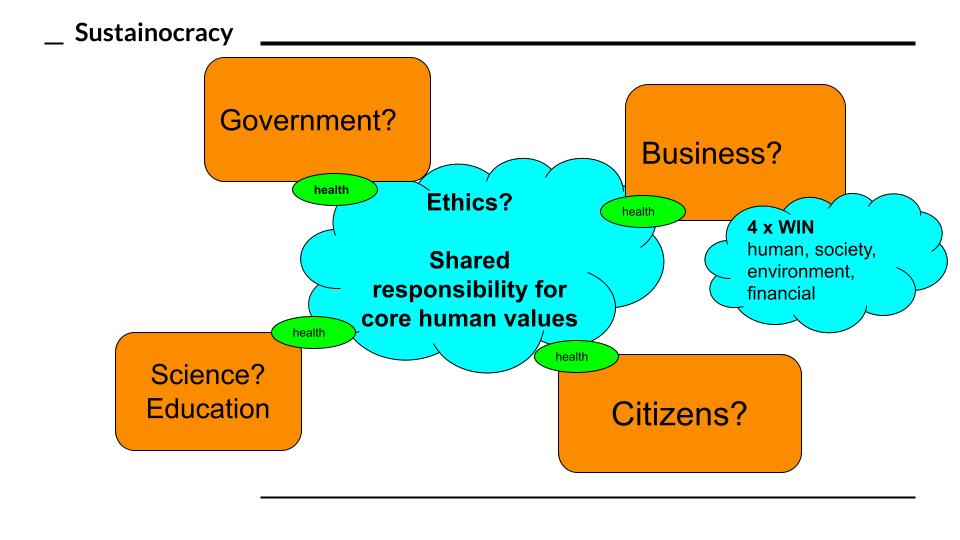
Ever since 2005, within my condition of founder of a new narrative for humankind, I have personally tried to invite and motivate the academic and eductional world to participate in the post Anthropocene initiatives of the City of Tomorrow with sustainocracy (sustainable human development as a shared responsibility). This had only ad/hoc moments of success due to the lack of institutional commitment to our existential ethics and related initiatives. Ad hoc participation was only achieved through student exchange programs, leanring challenges and research environments with financial backing.
In his recent academic self reflection, professor Laszlo Zsolnai, (professor and director of the Business Ethics Center at the Corvinus University of Budapest), proposes the repositioning of universities within the context of the challenges of humankind in the current era referred to as the Anthropocene. Even though I whole heartedly second the analyses and the suggestions of the professor, I also have noted over time the blind lack of institional leadership in this silo of society. The entire educational silo has been institutionally captured in the doctrine of political financial steering, not the open field of existentialist research and the related applied knowledge.
Equally the unversities cannot single handedly pave the evolutionary path of humankind if not supported by the other silos (government, business, citizens) of society. If one silo disconnects itself from the existing network of interdependence, it will risk its self-elimination due to lack of support. It is therefor imperative that such a change of narrative is done by all the societal silos at once and together. In this fragmented world of financial self interests and relationships based on trade and regulations, this is very difficult to achieve without a catalyst.
Understanding this I set up the stir foundtion in 2009 to act as linking pin for all functional silos to join the existential challenges together. This worked for particular local priorities, such as regional air quality and health. For that the interdisciplinary, non finance driven cooperative Aireas was born within the stir framework. The open co-creation space allowed all participants to be themselves in a contributive sense. Also the academic world participated but none of the silos took on a participatory leadership role. They all followed the Aireas path in a opportunistic way, not recognizing (yet?) the tremendous empowerment their continued commitment would represent.
That is why I finally decided to announce the stir learning environment, This will allow me to not only develop the engagement path for those communities that wish to develop the existentialist path together. I can also open up the dialogue and learning path with the theory and empowerment of each of the participating silos. My challenge now is to find areas where this wants to manifest itself in which the new era for the academic world can consolidate with that if the other silos.