Home » Articles posted by Jean-Paul Close (Page 239)
Author Archives: Jean-Paul Close
Where do you stand morally?
If we consider that 99% of western businesses are managed purely on material basis (KPI’s, product/price, cost reduction programs, etc.) you are not really to blame when you find out that you do the same. But the credit crisis has shown us that this way of thinking causes us to behave far to insensitively to moral values which causes the general and gradual decline of our overall wellbeing. In the end we do not distinguish ourselves anymore from competition and all players together become responsible for a moral crisis of which the credit crisis is just an example. More are to come.
When we draw a point of balance between moral and rational material decision making than we can visualise this point on the following drawing:
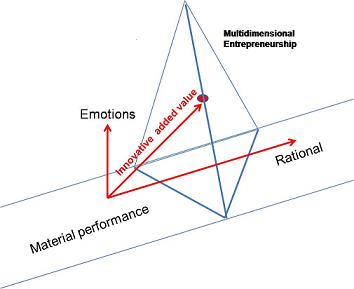
Find the point of balance
The rational path is our traditional way of entrepreneurial thinking: Product/Client/Cost optimalization with pure material goals. Money is the target and we would be willing to take immoral decisions just to make the triangle work. For who? For our pockets.
But in a global era we are too many doing just the same, covered by government who push for growth. What identity do we develop among so many others? How long a technical lifetime does our product innovation have nowadays? How loyal are our clients to us if the receive temptations all the time? How good can our cost optimization be if we run out of low wage countries? How high will inflation be if we have to compete to purchase our natural resources?
Doesn’t this mean that we are forgetting something? While we are at it making money we are destroying our own market potential by increasing the costs of resources, making low wage countries rich and competing our products so cheap we can hardly make them anymore. How TVs can a household have? Or anything else by that matter? Shouldn’t we remind ourselves continously that there are three basic moral rules to make sure we can run a business still at all in the future? Why should we want other to take the responsibility to comply with those rules and not us? Why are the companies that do comply more successful in general than those that don’t?
How moral are you when you run your business? What do you want to achieve? Money? Or recognition for a good job? Just think about it.
Public tenders should not be a potential crisis factor
Public tenders have been issued by government organizations to take benefit of so called “market workings” or, in reality: dive under any reasonable price to get the order and try to adjust later. What government really does by chosing mainly on price is to introduce speculative and potentially dangerous behavior in entrepreneurship. A common practice is to find ways to get the cheapest entry knwoing that this will get the deal. A bribe or just undercutting by planning inappropiate material usage or hiring very cheap, unskilled labor forces, whatever will do the trick.
Often we find that school or city busses are not maintained correctly, truck drivers make too long hours, balconies collaps due to wrong cementation, roads are rained away because some “forgot” to put an expensive substance into the tarmac. It all seems to go well for a while until a bridge collapses, a bus collides, a plane crashes or a building falls over. Many death, years of investigation and all the cover ups to avoid pinpointing the real causes. Just like the banks did for many years until it all blows up into our face.
Public tendersneed to include the three basis world agreements:
- Continuous iImprovement if health and vitality of the human being
- Minimization of usage of critical resources
- The company needs to present itself as a true added value for society
With those three statements as framework within which any tender has to be executed the government takes responsibility to sustainability in all its projects. If a company tenders it should first comply with this before the actual proposition is taken into account. Price is not the main determination factor but the measurable added value for society is. Like that government will protect its long term interests and companies will learn to behave with ethics and moral, competing for wealth creatin rather than self interests.
Interestingly we have been able to show that ethical behavior according to multidimensional principles does not at all make products more expensive or companies less profitable, on the contrary. The fact that responsible behavior is shown in the proposals but all in the commitment and execution those companies tend to be highly desired. Their quality of work reduces risks and hence liabilities that reduces insurance costs, pressure of regulation, etc. And that is in the interest of all of us.
Obsolete society
The capitalist world that develops welfare through a chain of added values up to the end user with taxes on every shackle has proven its excellence over the years. What has not been so effective is the political capacity to use that chain for permanent social renewal. In fact over the last twenty or thirty years we have sat back and let our western organisation grow obsolete.
When we look at the world wide stress on natural resources, movements for cradle to cradle, etc we can only conclude that we have used our intellect to cure symptoms without actually addressing the potential problems of old social patterns that we had chosen. That very costly political attitude caused years of inflation and the crossing of existantialist lines of humanity. It is time to do something about it as our society as we now know it is cracking up in all places and needs to be replaced by a new organization .
Roads with individual cars, traffic lights, traffic jams, etc, are a potential hazard to human health, a killer for the environment, a inflationary probem and the most unsustainable solution one can think of. Around 1890, when we started to replace horses with cars for the first time, we could not forsee such problems but in the 60’s and 70’s, when traffic started to pile up and we ran into the first world oil crisis, we could have come to innovative conclusions. We did not because of the powerful rise of the car industry and the economic dependence on this world through labor, oil consumption related to taxes, etc. The more cars the better and politics became the largest ostrich of the world putting its head as deep as possible into the ground. Now the credit crisis has shown the lack of morality of the past by avoiding gradual or in depth innovation and now we have to address issues of severe problems all at the same time and with urgency.
When we look at housing we see the same problems. In many countries houses are built side by side, avoiding heights. The prices of the houses have been artificially pushed up by keeping a calculated shortage and hence stimulating the unreal inflation of economies. But the housing issue is obsolete now because it is also agains any rule of sustainable sensitivity. New innovative housing solutions need to be introduced fast to make sure that we can safely maintain our wealth and health with the available resources. Infrastructures? The same story, etc. etc.
And we can go on like that in every sector that we know. In fact we can only conclude that society is due for a total remake. We need to make a step by step plan to transform and rebuilt society around multidimensional disciplines of sustainability. We have not to worry about money because we have shown that we can create that at will and every investment in innovation of real values will revert directly back into the economies through the capitalist nature of our organizations and the added value of multidimensional innovation. The more we invest, he more we would get back through efficiency, health and wealth development.
But before we can do that maybe humanity has to suffer just that little bit more to become totally convinced that the old ways simply do not work anymore, that the old leaders have to be replaced by new ones or open up their eyes and we all need to get back to work hard to build up the society of our dreams.

