Home » multidimensional world (Page 157)
Category Archives: multidimensional world
Where do you stand morally?
If we consider that 99% of western businesses are managed purely on material basis (KPI’s, product/price, cost reduction programs, etc.) you are not really to blame when you find out that you do the same. But the credit crisis has shown us that this way of thinking causes us to behave far to insensitively to moral values which causes the general and gradual decline of our overall wellbeing. In the end we do not distinguish ourselves anymore from competition and all players together become responsible for a moral crisis of which the credit crisis is just an example. More are to come.
When we draw a point of balance between moral and rational material decision making than we can visualise this point on the following drawing:
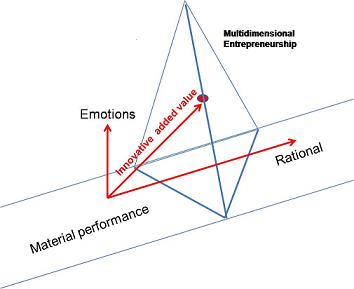
Find the point of balance
The rational path is our traditional way of entrepreneurial thinking: Product/Client/Cost optimalization with pure material goals. Money is the target and we would be willing to take immoral decisions just to make the triangle work. For who? For our pockets.
But in a global era we are too many doing just the same, covered by government who push for growth. What identity do we develop among so many others? How long a technical lifetime does our product innovation have nowadays? How loyal are our clients to us if the receive temptations all the time? How good can our cost optimization be if we run out of low wage countries? How high will inflation be if we have to compete to purchase our natural resources?
Doesn’t this mean that we are forgetting something? While we are at it making money we are destroying our own market potential by increasing the costs of resources, making low wage countries rich and competing our products so cheap we can hardly make them anymore. How TVs can a household have? Or anything else by that matter? Shouldn’t we remind ourselves continously that there are three basic moral rules to make sure we can run a business still at all in the future? Why should we want other to take the responsibility to comply with those rules and not us? Why are the companies that do comply more successful in general than those that don’t?
How moral are you when you run your business? What do you want to achieve? Money? Or recognition for a good job? Just think about it.
Obsolete society
The capitalist world that develops welfare through a chain of added values up to the end user with taxes on every shackle has proven its excellence over the years. What has not been so effective is the political capacity to use that chain for permanent social renewal. In fact over the last twenty or thirty years we have sat back and let our western organisation grow obsolete.
When we look at the world wide stress on natural resources, movements for cradle to cradle, etc we can only conclude that we have used our intellect to cure symptoms without actually addressing the potential problems of old social patterns that we had chosen. That very costly political attitude caused years of inflation and the crossing of existantialist lines of humanity. It is time to do something about it as our society as we now know it is cracking up in all places and needs to be replaced by a new organization .
Roads with individual cars, traffic lights, traffic jams, etc, are a potential hazard to human health, a killer for the environment, a inflationary probem and the most unsustainable solution one can think of. Around 1890, when we started to replace horses with cars for the first time, we could not forsee such problems but in the 60’s and 70’s, when traffic started to pile up and we ran into the first world oil crisis, we could have come to innovative conclusions. We did not because of the powerful rise of the car industry and the economic dependence on this world through labor, oil consumption related to taxes, etc. The more cars the better and politics became the largest ostrich of the world putting its head as deep as possible into the ground. Now the credit crisis has shown the lack of morality of the past by avoiding gradual or in depth innovation and now we have to address issues of severe problems all at the same time and with urgency.
When we look at housing we see the same problems. In many countries houses are built side by side, avoiding heights. The prices of the houses have been artificially pushed up by keeping a calculated shortage and hence stimulating the unreal inflation of economies. But the housing issue is obsolete now because it is also agains any rule of sustainable sensitivity. New innovative housing solutions need to be introduced fast to make sure that we can safely maintain our wealth and health with the available resources. Infrastructures? The same story, etc. etc.
And we can go on like that in every sector that we know. In fact we can only conclude that society is due for a total remake. We need to make a step by step plan to transform and rebuilt society around multidimensional disciplines of sustainability. We have not to worry about money because we have shown that we can create that at will and every investment in innovation of real values will revert directly back into the economies through the capitalist nature of our organizations and the added value of multidimensional innovation. The more we invest, he more we would get back through efficiency, health and wealth development.
But before we can do that maybe humanity has to suffer just that little bit more to become totally convinced that the old ways simply do not work anymore, that the old leaders have to be replaced by new ones or open up their eyes and we all need to get back to work hard to build up the society of our dreams.
Poverty policy is key to capitalist success
Most business policies focus on welfare and growth communities because that is where the money goes around. Hardly any of the business plans involve the markets of the poor. The companies that do actually included those markets structurally in their policies tend to score better on the Multidimensional Index of the 5K Group. Why is that?
There is nothing noble about combating poverty. It is good business practice. During the credit crisis we have seen the down fall of big, so called “solid”, institutions s.a. banks due to a moral crisis rather than financial. Typically this moral crisis was caused over the backs of the financially unstable and unwealthy. Does this indicate a contradiction in my argument? Not at all.
The risktaking of the banks by entering bad credit zones was caused by greed and self interests of high level executives who covered their backs by insuring bad credits with others misplacing the trust relationship in the chain. As the entire chain was based on the same material principles of greed the business was a pure speculation that unnoticed inflated the ballon of risk until it exploded into the face of the world. One can hardly argument that all this was a policy to help the poor.
When we design a policy to develop markets with poor people we do that from the moral multidimensional principle of the ideal market development through healthy and motivated people. To achieve this poverty needs to be eradicated from the entire world. We do not talk only about poverty in complex, unstable, tribe oriented third world countries. We talk also about the growing poverty in the rich welfare countries. When a company decided to address this market too, not just by making products available to it but by truely developing a strategy to address the issue effectively, it shows moral integrity. Nobody will ask the company to finance such development our of their own pocket because such strategies of sensitivity to the reality of the world finds many partners in government, institutions and foundation to join forces for a common goal.
The willingness to address such markets by connecting with other organizations and creating serious policy shows and develops an authentic and responsible company culture that is filled with sense and that subsequently will radiate also into the wealthier markets where competition is strong and one does not distinguish anymore through price or quality but with company integrity and authenticity. And this is the basis of any sustainable success and therefore the reason for a company to score high in our Index.

