Home » multidimensional world (Page 88)
Category Archives: multidimensional world
Van Gogh inspires
We all know Vincent van Gogh from his extremely valuable paintings. However, the way the human being Vincent inspires people with his character, world changing views and talent to perceive and describe his surroundings, is less know. That’s why a group of passionate entrepreneurs came together this day to highlight this element in particular while suggesting a relationship with the unique characteristics of the mentality and landscapes in the Dutch province of Brabant. Van Gogh inspires because he himself was inspired which can still be recognized from the creativity, paintings and unique style of Vincent.
Start in Eindhoven
We gathered in the old characteristic Park Hotel of Eindhoven. During the lunch, offered by the new owner of the hotel, organizer Jan Karel Felderhof explained the “Enjoy Van Gogh” program and objectives. We then spend some time to get to know each other in the group as well as the individual motivation to participate.
It was a lovely sunny summer’s day. Park hotel had organised a light lunch after which we would go by bike to the “Van Gogh village” Nuenen. Van Gogh had only lived there 2 years but they were significant for many of his paintings, conflictive relationships and worldview development. The 10 km bicycle ride took us through areas of Eindhoven and Nuenen which one would normally not see when any other means of transportation is used. This made the tour already a pleasant exercize.
At the Vincenter in Nuenen we were received to get some insight in the life of Van Gogh, listen to some real, recorded testimonials of people who actually had met him personally, and see an exposition of his time. We then walked to see the actual places with a guide. She compared visual landmarks with the Van Gogh paintings, showing how Vincent interpreted what he saw and practiced techniques on canvas. We learned things about the person, his personality, his perseverence and struggles with dogma’s of a protestant elite family and his free and often troubled mind. The many letters he wrote to his brother Theo are a well documented remainder of the way he interpreted and analysed himself and his relationships or work.


Despite his family struggles Vincent described his relationship with Brabant as “the place where your dreams appear close to reality”. It was this sentence among others that linked his mentality to the one we also felt ourselves. The land in which we live and where we do our own creative work, where Philips once found fertile grounds to grow, is worth viewing to try to explain the typical value driven mentality, the community building around quality of life and powerful innovative entrepreneurship of our region.
The group consists of entrepreneurs, visionairs and executives in the field of paradigm shifts, hospitality, export, art, productivity and healthcare. Each with his/her own leadership mentality, determination and fully aware of the challenges we face as a species. In essence we could sense to be little Van Gogh ‘s in our own talented way. What would the sum of this unique group bring and what can we bring to the world.
Gradually this became the topic of our conversation as we cycled back to Eindhoven with a stop at the 11th century watermill to enjoy a Vincent beer brewed by one of the participants.

Vincent beer
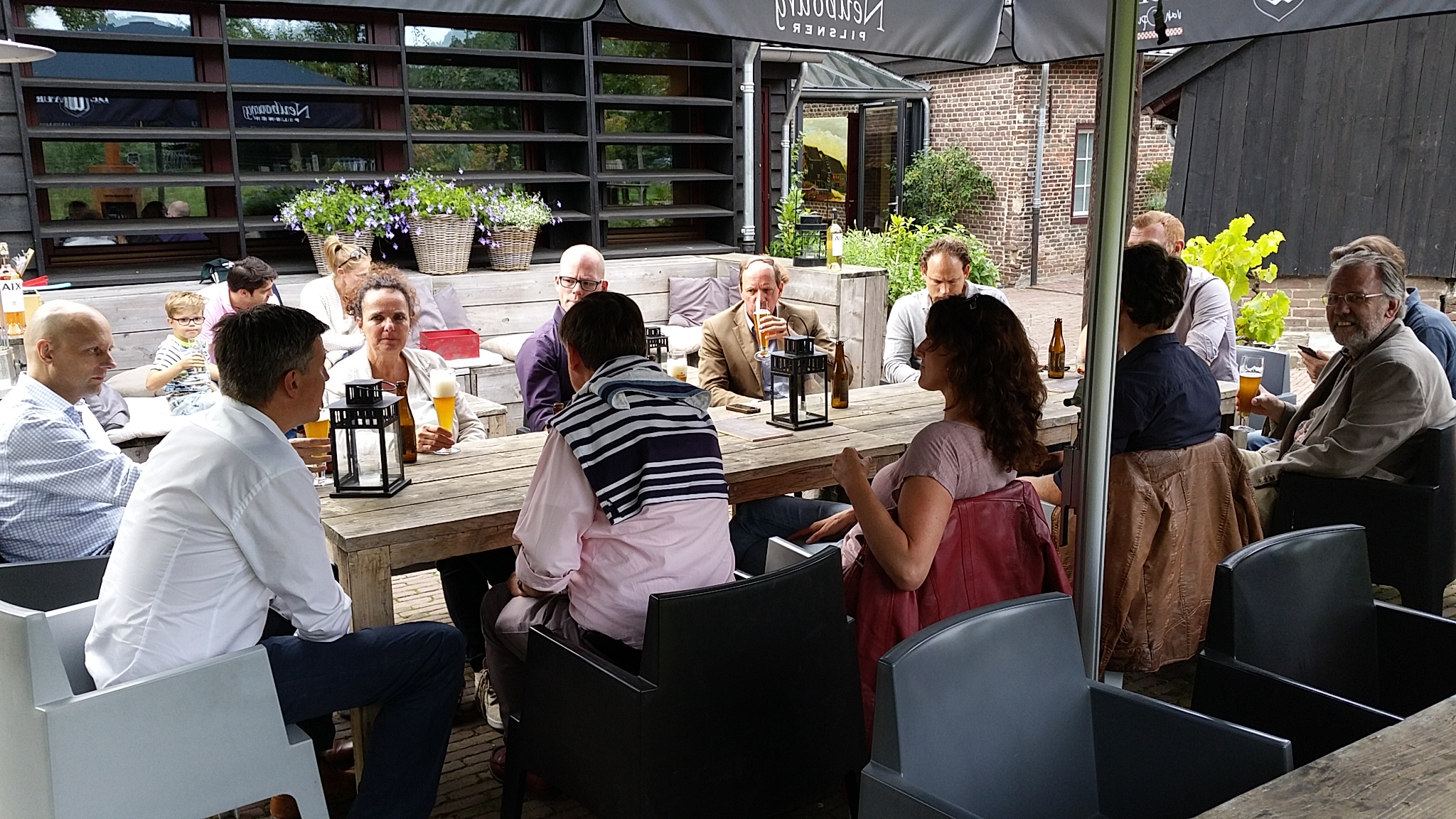
Enjoying the afternoon stop at the watermill
We then continued our return to Eindhoven with a small detour to get a feel of the Van Gogh bicycle path, an ingeneous night time experience of light reflection based on one of the paintings of Van Gogh.

Bicycle path resembing the milky way of one of the paintings of Van Gogh
We then continued to the center of Eindhoven for our evening meal en open dialogue at Mr. Frits (the way the general public referred to Frits Philips, former president of Philips after the founders Anton and Gerard) restaurant.
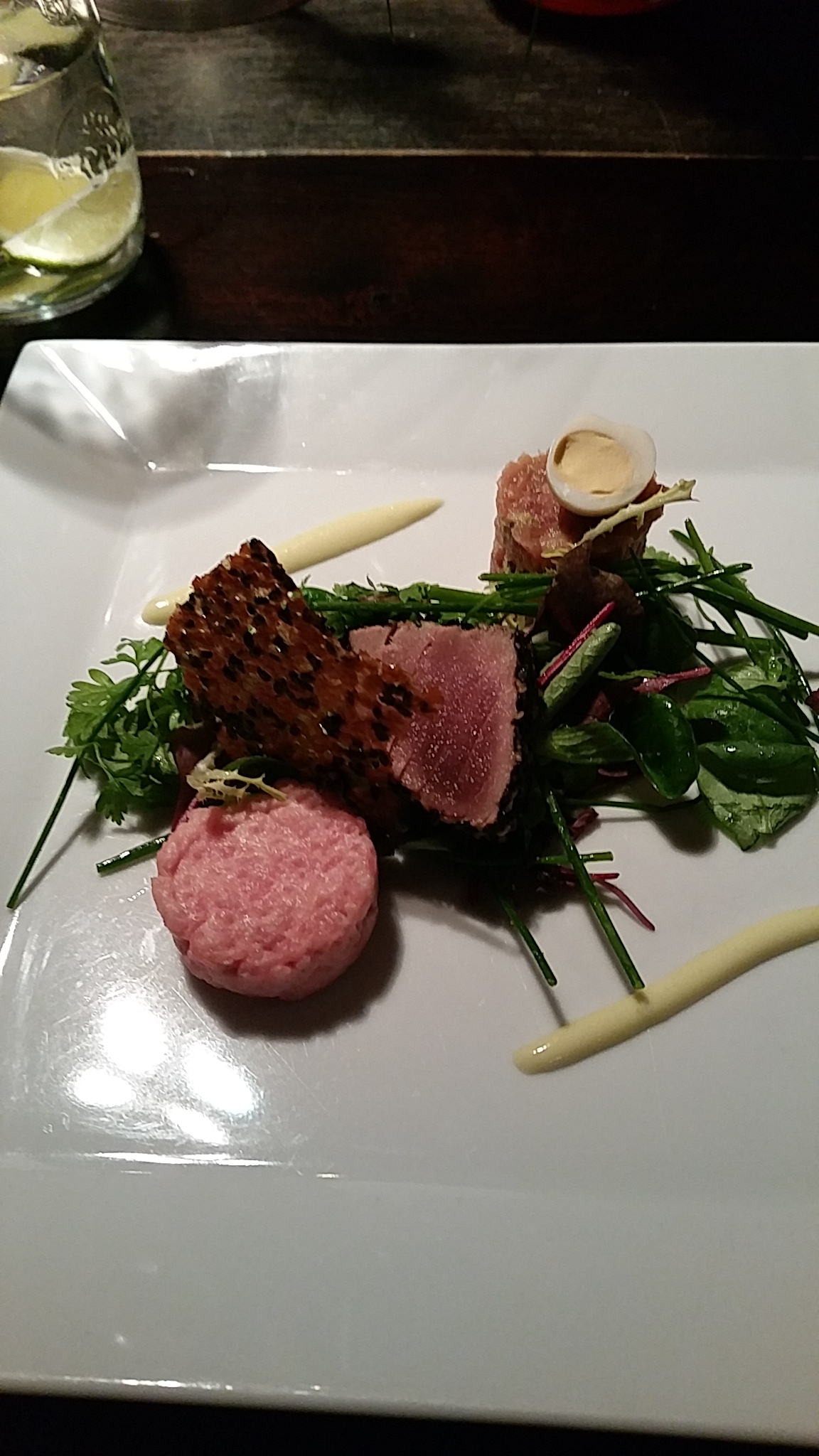
Excellent dinner
We were received with an excellent three course meal during which we had ample time to share ideas, insights, ideology and feelings about Vincent, the day, our group of beautiful people and what we could do together in cocreation.
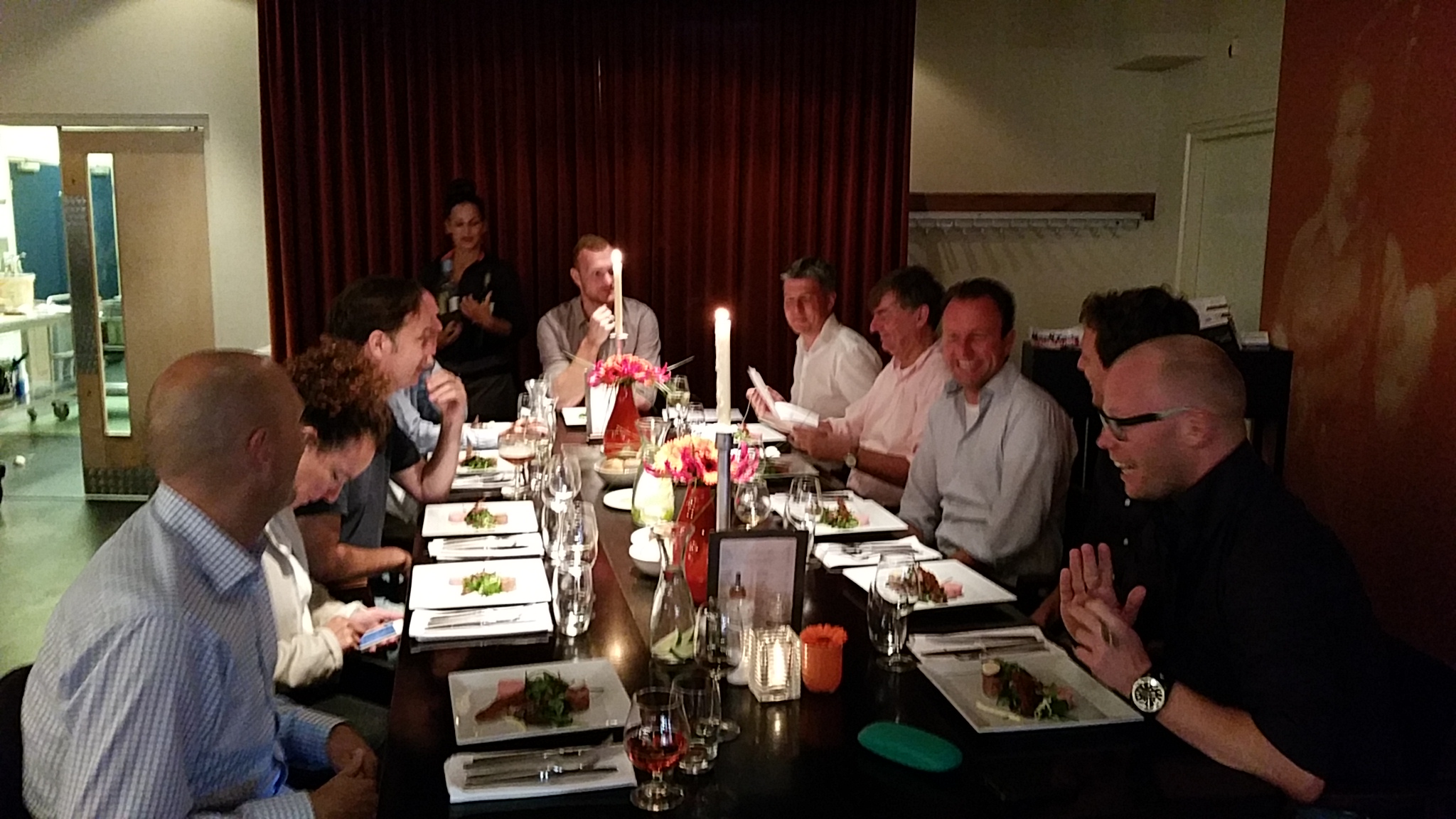
Great group of local entrepreneurs ready to make a difference like Van Gogh did.
It was an excellent day. We don’t know yet what will come out of it all other than all kinds of positive intensions to show the people some of our history, the way we live and take commitment around issues that generate positive vibes. Vicent van Gogh was the inspirer who opened our eyes to how inspiring we and our region is and worth showing to the world.
Laudato Si and me
When I published my Dutch book “Geheimen van echte welvaart” (Secrets of true welfare) in 2009, local Catholics repeatedly came to me with their surprise that “the Pope says the same as you”. This unintended allegation that the Pope would repeat my words rather than the other way around, was amuzing me. It is not at all strange that the patterns of evolutionary thinking between me and a theological institution like the Catholic Church show alignments. After all we both look at humankind from the long term existential point of view rather than the short term economical and political reality that is displayed continuously in our surroundings. Since 2009 this alignment has grown stronger as the current Pope, Francis I, dropped the tradition of dogmatic imposition of church laws to open up for a transparent, epistemological learning dialogue and action driven exercize to address the current humanitarian and ecological disharmony in the world. The first real encyclic of this Pope is called “Laudato Si” (Praise be on you) with the subtitle “On care for our common home”. The subtitle suggests a call for ecological awareness but the publication is much more than that.
Many converging viewpoints
The message of the Pope is clear. He formulates a learning dialogue in which he describes, in well chozen arguments, the firm beliefs, observations and theological foundation of the Catholic church. He invites other viewpoints to converge, not to dispute each other in competition or single dominant hierarchy but to open up in dialogue to actually solve the enormous issues we face together. The encyclic as such becomes a source of inspiration, no dogmatic ruling, yet an invitation to take responsibility as one would expect from a species that was created specifically by God for that purpose (one of the fundaments of this religion). The Pope analyzes the current situation of global economics, the throwaway culture, the lack of overall empathy to the destruction that we produce and seem so reluctant to deal with. He openly acknowledges that he nor the church has all the answers but hidden in the open dialogue, commitment to address the issues and diversity of standpoints, we can find the way forward.
I personally see this encyclic as a first sign of a new global force that sets aside the bureaucracy of dogmatic rules and inspires to open up to the spiritual inner quest for true meaning. The Pope may be critical, steering in some occasions with very firm statements but always underpins with arguments and analysis. One can agree or disagree (see media humor below when discovering the political hypocracy) with statements, arguments or analysis yet by giving the right example this Pope invites those who emphasize with the challenges to come up with better alternatives or take action with the same sense of responsibility as displayed by the Pope.
Three human levels
Theologist Eduardo Echevarria produced a theological analysis of the encyclic which was published in a national Catholic paper in Holland. People in my surroundings tend to share this with me to reenforce or put in perspective my own work. He expresses his worries that the huge diversity of complex issues (ecological crisis, climate change, poverty, apocalyptic risks, capitalist dominance, etc) expressed by the Pope may cause that “through the trees we do not see the forest” anymore. Echevarria tries to simplify by relating the build up of the encyclic to three theological levels of the architecture of human development (Compendium of Social Doctrine of the Church) :
- Fundamental level – the level of motivations
- Steering level – the level of establishing norms to form society
- Consideration level – the level of reflection and consciousness
When he started to elaborate on this it immediately gave relevance to the different interpretation and usage or positioning of those three levels. The word “level” suggests a “hierarchy” as levels tend to lay on top of each other, like this:
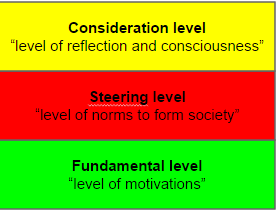
A hierarchy of levels?
When interpreting the levels as such we find that the level of motivations becomes mediated by the steering efforts of the norms of society if we want to access the level of consideration and reflection. This is probably the simplest illustration of the dominant position that the steering level can develop over our motivations, blocking us deliberately from reflection and the consciousness. It is not just the political and economical reality that wants to steer us this way. For a long time the church itself has considered itself as sole mediator between the religious interpretation of the conscience, translate it into dogmatic impositions referred to as the norms of Catholic belief and taking a dogmatic standpoint. Other religions do the same in their own way, sometimes producing even violent interpretations that influence the layer of motivations of those who are deprived from thinking for themselves and act through manipulation of “belief”.
In fact we see this wall of dominant steering determining today still the type of education our children receive, what we watch on television, how history is registered or how news is brought to our attention in a manipulated way. This brings me to this beautiful fragment of the movie “Dinner with Andre” (1981) (A conversation about reality) in which a city is described as a prison in which we are both the guards and prisoners:
The Pope’s mayor breakthrough
The mayor breakthrough of this particular encyclic is the Pope’s voluntary repositioning of the layers. Voluntarily setting aside its dogmas, the church is opening up to the overall redefinition of our steering mechanisms that form society. By doing so the Pope opens up to the critical self-reflective dialogue between the diversity of dominant and upcoming systems in relation to the challenges we face. Setting the example he invites other dogmas (economic, political, technological, scientific) to do the same and open up to reflection by involving directly the layer of motivations at humanitarian and ecological level.
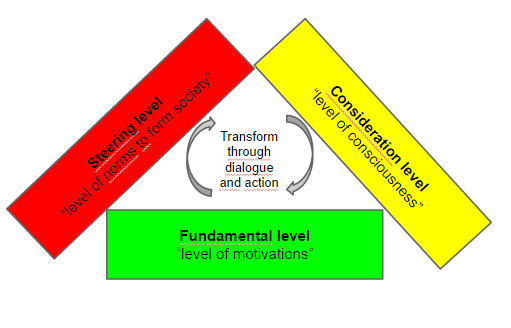
By stepping into the global societal group the Pope does not reduce the message of the church, he actually re-enforces it by placing it in overall perspective. The church is not the only truth anymore as other dominant realities are equally or often even more influential. It is one reality now among many others that reign today, yet one that is equally worth argumenting by analysis and interpretation in face of the huge human challenges that we need to deal with.
The Pope’s message is powerful because of the humility. Accepting different points of view and opening up the epistemological dialogue (What is knowledge? What is belief? What is real? What is responsibility?) the Pope `sacrifices` fragmented dogmatic dominance to achieve equality and purpose driven dialogue with others. By doing so he can focus on the powerful inspiration that the church provides while allowing for the influential contribution of technology, science, politics, education, humanitarian and ecological awareness and the involvement of the masses “because we are all in this together”.
Analogy with the City of Tomorrow
When I started the STIR Foundation (City of Tomorrow) in 2009 we worked very hard on awareness development, organizing congresses and establishing working groups. We provided a kind of critical message and structural DNA to work things out in purpose driven communities. Always we asked others to do the work, based on the inspiration we offered. The groups however formed around me as initiator of the processes and always looked at me with the question: “Jean-Paul, what do we do?”. This felt like a new hierarchy in which I was owner of a process and others had become my slaves. This was exactly opposite the ideology that I had for myself. I had no problem with taking the initiative for change but could not be asked to know how to produce it. If I could I would have done it long time ago. The fact that “we are in this together” also means that we have to “solve this together”. At one point I deliberately and openly decided to step back and let the group become a community with authority rather than puppets under my command. This process of pulling forward and letting go to achieve a combined forward action is key and extremely difficult in real life. While pulling the participating people (and institutions) feel the comfort of individual leadership that stands upfront (the Pope and his encyclic, or me and “JP what do we do?”) but when letting go (“we are in this together”) the group is asked to take a leadership attitude individually and together. The issue is leading, the sum of individual talent that deals with it produces the action in open dialogue and determination of priorities, not one single figure telling what to do.
That is why I feel highly identified with the way this Pope deals with the complexity of breaking through the barriers of the many dogmas that block our progress. He describes them all, including the church its own, and places them all in perspective to the challenges we face. Rather than “church ego” (religion says) he develops a “human eco” (including the church). He does not want to say what we need to do, he just explains the standpoint of the church in very clear wordings, and invites all others to do the same while focussing at the common issues at hand. “Laudato Si”, Praise be on you, is then a clear acknowledgement of the guts and commitment to think for yourself, gain access to the level of (self) reflection and join the group that redefines society by addressing the issues at hand together.
For me it is a further reassurance that the path we set out and developed over the years with STIR, AiREAS and the STIR community, as living examples of multidisciplinary group commitments, is now gradually finding fertile grounds to fractally spread around the world as practically proven multidisciplinary little engines of integral change. The papal encyclic has shown humankind that we have more choices that just the financial or technological dominance for our long term perspectives. And it is up to us to open our eyes and mind to make our choices.
Co-creation is an erotic experience
It is not at all strange that people in a co-creative team have erotic sentiments during the process and towards each other. In the STIR Foundation we have been working in multidisciplinary cocreation for 6 years now. Dealing with key human values is attracting both women and men. It is performed with passion, empathy and determination, giving rise to unprecedented results and innovations, but also unexpected erotic extras.
The intense creative work is built around this formula:
Talent x Input x Purpose = Value x Reciprocity
The fact that everyone is putting in that unique authenticity of one’s own connects with the emotional attraction among the members of the team. It is like falling in teenage love again. This is very confusing for the participants since they have to deal with these very private “secret” emotions that are normally reserved for one’s partner with whom one has children and a cocreative life as a family. Where does this sudden “lust” come from? Barbara Marx Hubbard explains the side of women ecstatic sensitivity in group processes of co-creativity:
Observing the facial expressions of Barbara she talks from experience. It is interesting to describe the transformation of society from a sexual or erotic point of view. We come from a society that is highly structured and manipulated in pyramids of power and control in which sexuality plays no significant role, in fact is structurally avoided, except maybe the one of masculine dominance over women, women’s submission to power for security, and greed with lust for a few (rather than evolution).
At one stage I blogged that “the next pope will be a woman“. We are afterall in the midst of an era that transforms from purely masculine mechanics into a feminine way of producing symbiotic harmony based on equality, safety and trust. The most recent encyclic of the catholic Pope is extremely feminine compared to all others, asking for responsibility and cocreation.
When individuals get into such cocreative group process they experience a physical and emotional transformation. We have seen civil servants enter the group with fear and distrust, using their typical manipulative instruments proper of the type of system where they have operated for years, professionally surviving by protecting their back. They suddenly open up into beautiful human beings with excellent skills and powerful commitment based on trust and a “can do” mentality. We have seen harsh commercial people entering the group with the objective to “sell and take” without understanding the group dynamics. The group remains in tact despite the attacks of other energies that try to suck out the energy of the group for their own short term interests, and strengthens around common sense trying to transform the energy into constructive progress.
Meanwhile, inside the group the equality, the can do mentality, but also the sensing of powerful energies building up, give people a personal look that radiates love and care. The expression in their eyes is soft and open, with direct access to their soul. They feel safe inside the group and develop a physical and emotional reaction that resembles an intense sexual encounter. Rationalizing such feelings often disturbs people because they were not necessarily rationally known or even avoided in the ego-driven environment based of self-satisfaction and self-protection through the locking up of emotions. One has to come to terms with the feelings that give rise to the desire to touch, to hug, to celebrate the joy of togetherness and melt together in this pool of positive energy that seems to accumulate by mere interaction.
In STIR we do this on a multidisciplinary level with executives from the old and cold ego world coming together in this new world of warmth and eco connectiveness. Our challenges are to develop those constructive energy boosts on city or regional level, even an entire country or continent. That is the essence of the transformation we are developing, based on love, erotic sensitivity and energetic genius as of spring. It is beautiful to be part of all this and welcome all that are like us, in creation mode.

 Sustainocracy, the new democracy