Integrating nature back into ourselves and our industrialized societies
Recently we enjoyed the regular online presentations of the Holos-Earth project organized by Claudius van Wyk. This time the session developed around the difference between the globalized industrialized environment, in which sustainability measures are taken in order to reduce its negative impact (do less bad), and placed based self sufficiency communities that develop around the positive impact of engagement with nature (do more good).
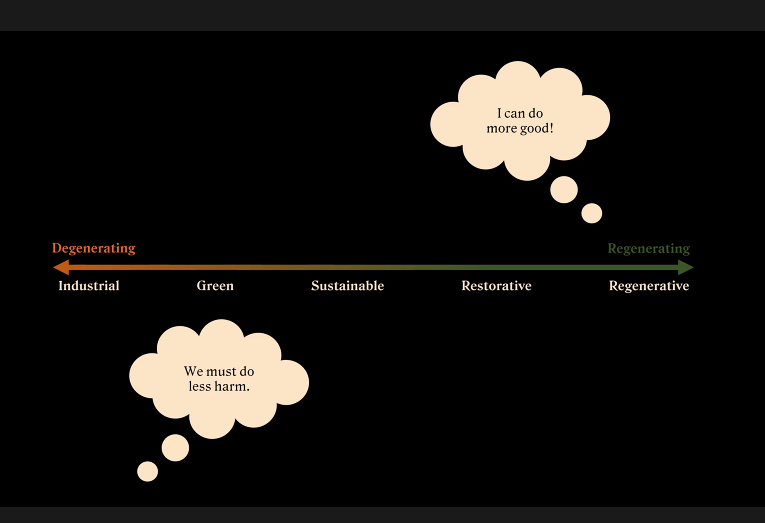
The left side of the picture (Degenerating, Industrial) is the industrial arena, degenerative from a nature point of view, generative from a financial point of view in the global capitalist consumer markets. The intentions to be more green don´t dispute the industrial fragmentation, technical focus and abundant use of natures resources. They are just attempting to be less harmful.
Currently cities are still a reflection of such degenerative dominance
If we look at the development of cities we see that they have been historically facilitating this industrial evolution. They got dominated by the different layers of finance: creative productivity and trade, expensive systems of remedial care and speculation around shortages. Everything, such as infrastructures, facilities, housing the workforce, integration of services (entertainment, care, mobility, waste management, supermarkets, water supplies, sewers, etc), education, etc were oriented at its (financial) effectiveness. The population in cities grew very distant from regenerative nature and its deliverables such as food, drinking water, material resources, healthy air, etc. Cities became extensively mechanized and filled with electronics, citizens blind consumers of all commodities.
Generations have become fully accustomed, even indoctrinated, by education and family heritage, to their citizen bubble of money dependence through competitive employability, entertainment and consumption. People in leadership positions are there to manage any of the related institutional bubbles.
Also the rural environment was industrialized to supply the never ending hunger for resources of each the silos of the industrial environments (business, cities, citizens). Regenerative nature was gradually converted into degenerative industrial productivity (the economy of extraction), destroying living ecosystems in order to develop manipulated, polluted, mass production of monocultures.
Regenerative nature
The right side of the picture shows the regenerative environment proper to living nature. This environment is not a financial economy. It is governed by the laws of nature (eco-nomos), a living ecosystem of interdependence, reciprocity and cooperation.
It is interesting to note that the human being is naturally part of this regenerative nature in our condition of a living species. Our sustainable expectations entirely depend on the optimal functioning of this ecosystem. Gradually people are discovering the intense emotional, spiritual, physical and mental impact (damage) that is caused by the degenerative industrialized environment. It is not only degenerative for the planet, its limited resources and living ecosystems. It is equally degenerative in many ways for entire humankind.
Jean-Paul Close (Founder of Sustainocracy)
Highly industrialized economies, such as the Netherlands, developed a society divided into silos based on specific interests and financial interdependence. The local government sees societal caretaking and protection as a cost which is covered by taxing labor while facilitating the industrial processes for profitability and growth. The degenerative spiral affects such societies as health deteriorates, populations grey, pollution is generalized, new labor is attracted from abroad, etc while societal costs, regulations and bureaucracies, developing exponentially. Also the impact of these societies on the world through the massive and global movements of goods is creating associated problems all over.
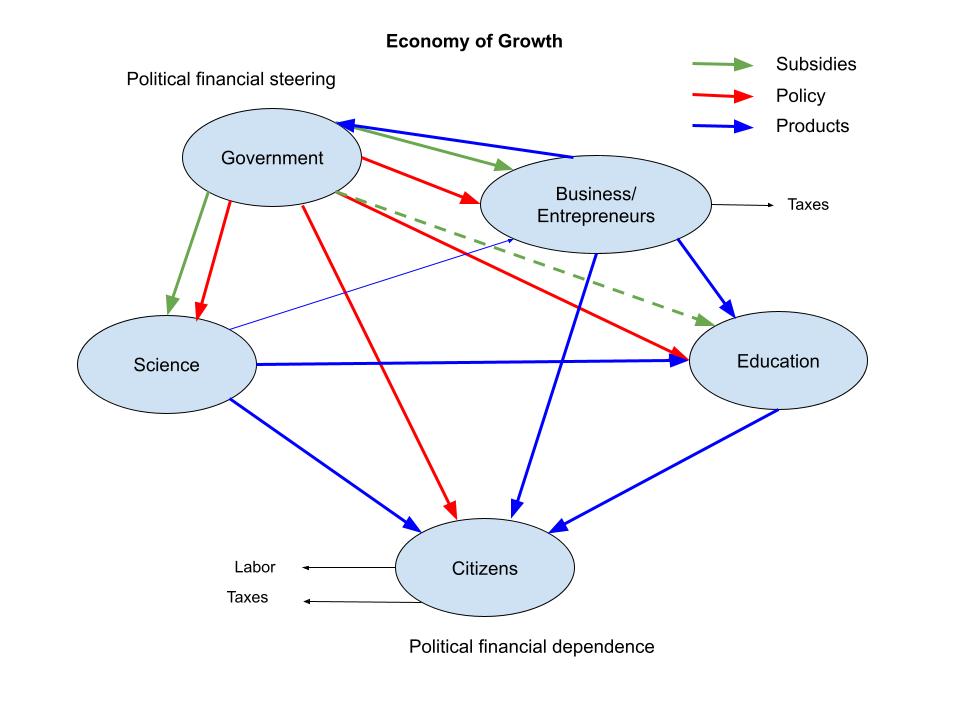
Such societies tend to get financially rich for certain stakeholders and degenerative in general (health deterioration, social deterioration, aggression, environmental deterioration, growth of bureaucracy, remedial expenses, political fragmentation, narcissism, etc). A mayor turnaround is needed, moving these societies strongly beyond sustainability, preferably towards (or into) the area of regenerative nature. This in fact means to bring back the living nature into these societies, not just as patches of nature, but integrated functionally into such communities. We even could use this to redesign the function of cities entirely and providing genuine purpose to people through meaningful participation. As such the Netherlands has the possibility to develop a modern, long term blueprint to redesign the functions of industrialized communities and large cities into multidimensional, well balanced ecosystems.
The problem we find is that the silos involved are too tunnel visioned to be motivated by themselves to take such steps of reintegration. They did show some convergence as a triple helix (science, government and business) to become successful together in applying for subsidies or developing cost saving synergies, but still within the financial dominance of the reigning mindset. So how should these silos, institutions and citizens alike, all together move to a common understanding around essential, natural values for resilience?
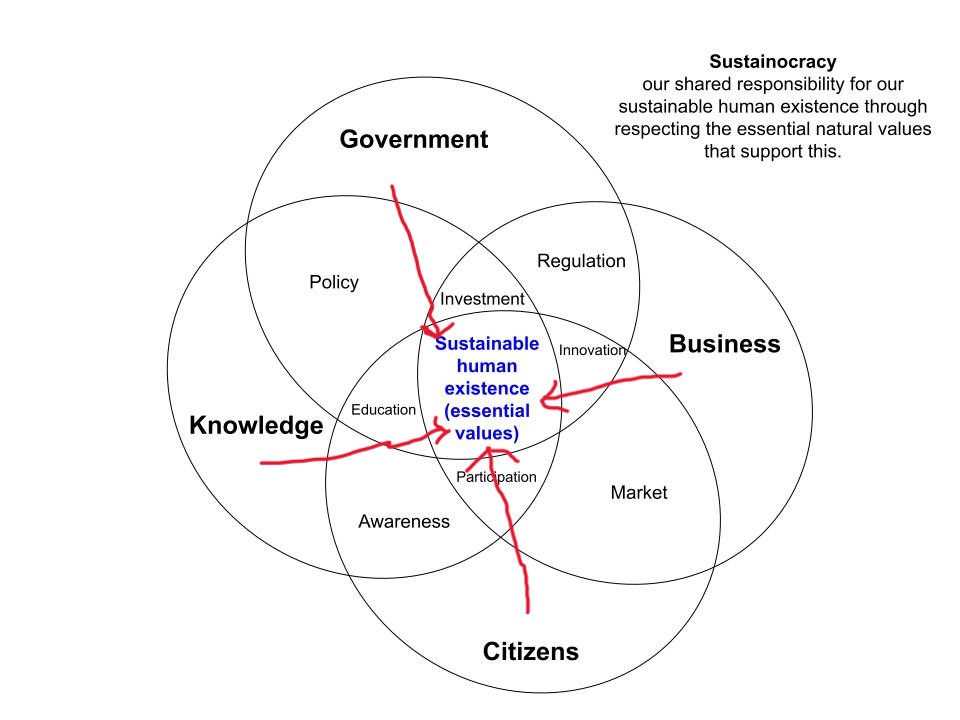
That is where STIR foundation comes in with our Sustainocracy approach. STIR positioned itself as research foundation to study human behavior, and especially when confronted with the essentials of our sustainable wellness. Instead of preaching about such core values we could measure the reaction to the invitation to join environments for sustainable human development as shared responsibility. Placing STIR amidst all the silos with the invitation to join into developing our resilience together, we could create an innovative open, common space for purpose driven interaction. With STIR managing the open space, not as another silo but as a partner organization, each could stay its authentic self, defend its self interests while contributing to the common good. STIR had defined five essential natural human values as shared responsibility of everyone (citizens and institutions) together.

But where to start?
We need to understand that the common denominator in all the expressions of humankind (industrial, capitalism, consumerism, religion, etc.) is the human being itself. The natural essentials expressed by STIR in Sustainocracy are valid for all the functional expressions, as a key responsibility, no matter what. After experimentation STIR arrived at a first step to try to get all stakeholders to join:
health.
Health is a largely unknown factor in human behavior as we tend to take it intuitively for granted. We only start taking health seriously when the opposite, sickness or disability, presents itself. Our first reaction is remedial, trying to address the illness to get back to our old comfort zone of health. But gradually over time we learn that health is more than developing remedial routines. We learn that it is a responsibility that needs to integrate itself into our understanding of life essentials and societal development. Health is much more than the absence of sickness. It comes with our understanding of a human being as a manifestation of the living nature that surrounds us. When we pollute or destroy that living nature we do the same harm to ourselves, no one excluded (status or financial interests do not exempt us from the impact of our actions on ourselves and our environment).
The combination of human and environmental health became the first step of STIR that received the positive engagement of all the silos.

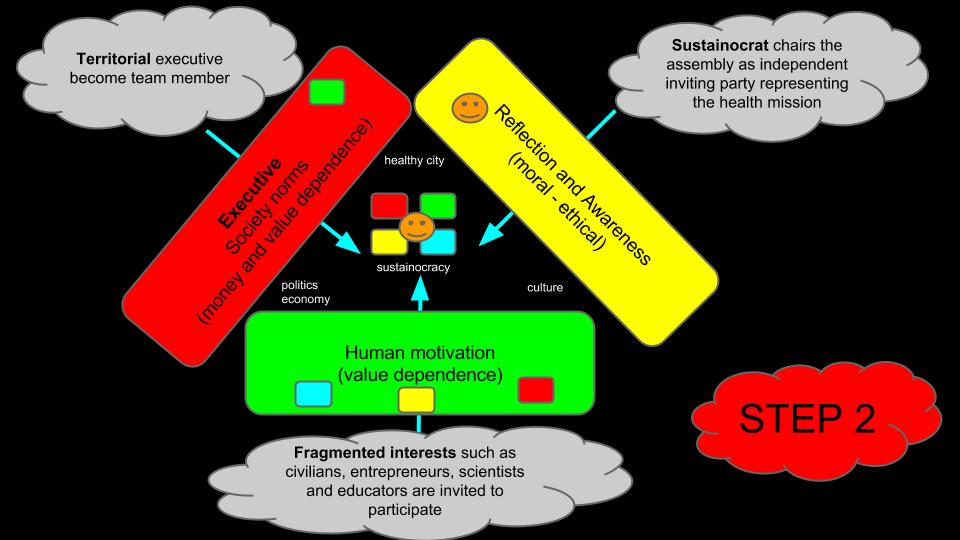
In the center of the convergence of the bubbles of self interests each learn to develop empathy for each other´s contribution, looking at ways to enhance them with the contributions of one own. Science brings in existing knowledge, business develops innovative products, government facilitates with public money and infrastructures while citizens engage through motivation for behavioral change, applied innovations, etc. The cooperative center carries a totally different energy than what one is used in the rest of their own silos. It is a cultural challenge for participating executives to translate this positive regenerative energie into something that their institutions can work with. Not all institutions can cope with that since their reason to be developed entirely in the degenerative arena but most can, creating a self selecting shake out in the community.
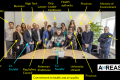
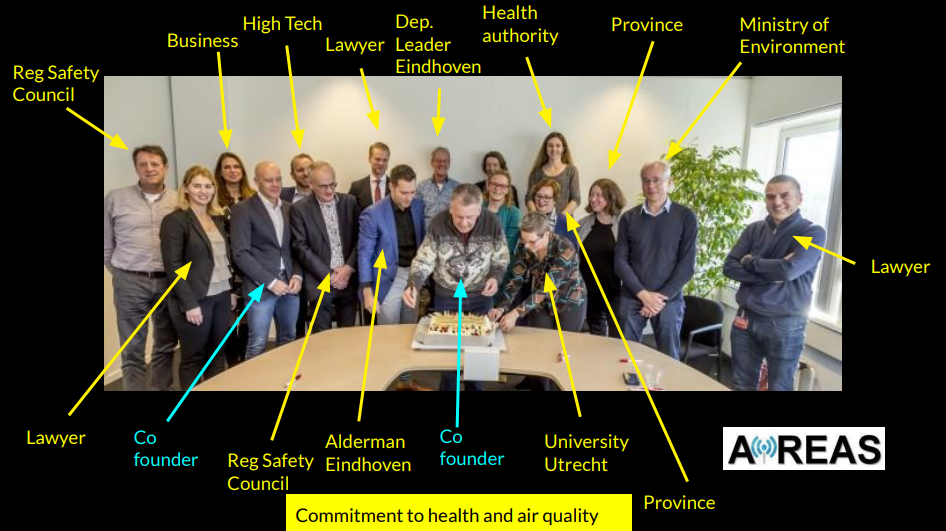
All involved develop levels of awareness of both the need to converge with the opportunities and challenges that arise while doing so. They don´t only join to help the others but also reflect about their own share of responsibility in the issues at hand. Both events, self awareness and cooperative co-creation of the common natural good of health, started a positive regenerative spiral of development. In the picture below we can see the engagement of a large diversity of institutions in the second wave of commitment to develop regional human and environmental health in the region of Eindhoven (Netherlands) with the involvement of 21 municipalities. In the center, cutting the cake for celebration, you find humble me, the only one without any other status than the representation of our core human natural essentials.
Visualizing the same picture in the format of merging silos we see this. AiREAS is the formal, legal partnership cooperative created by STIR to host the open space of co-creation of our health and healthy environment. It was formalized in order to be able to get projects on their way that were defined, funded and manned by the partners together:

Gradually a new ecosystem of interaction started to develop, among all silos together or some of the silos one to one. Also gradually more and more people got involved, through projects, challenges, presentation, usage of innovations, etc. We actively started to engage the younger generations that are still largely open minded, flexible and often hands-on aware of the issues at hand in the world. We also see that soft social skills develop in the world of services. Think of integral positive health, massage, meditation, nature based empowerment groups, urban food systems, etc. Gradually we see convergence around the essential values such as health to such an extend that we can even start concentrating activities in regional clusters that are focused on integral wellness through integral participation and cooperation with nature. All stakeholders have then assumed the same mindset and the habit to interact together to develop such “Health Valleys” (as opposed to the industrial alternative of silicon valleys).
The complexity of letting go
Once in the center of convergence into our natural values, all participants are challenged to let go of certain aspects proper to their traditional comfort zone while adopting other aspects, new ones. This is maybe the most complex part of the convergence because all those aspects of letting go have old interests attached to them. These can be within the scope of traditional behavior or working format of the institutions that need to be adapted. That can be done with the right motivation and leadership.
More complex is the acceptance that some of the essentials that we rely on for our sustainable existence as a species and cooperation with nature, have been integrated in the industrialized working formats, with huge financial interests and powerplays worldwide. These cannot be seen anymore as commodities. They need to be leveraged to the position of our shared responsibilities developed at local community level.

This literally changes everything, from the design and functioning of our cities, the position of the citizens, the functioning of our rural activities, the supply chain, our involvement, etc. In these areas the industrial processes are replaced by regenerative natural ones, collaborative programs together with nature. It also redesigns the financial economies, the citizen´s participation, the sharing and caring mechanisms in society in favor of all, etc.
It also redefines our inter human relationships. The safety and securities that we create together through integrating care for and with each other, the positive and constructive dialogue, the warmth of purposeful togetherness and sharing, the develop of respect for each other and our environment.

Also this is very challenging for people. In degenerative industrial based societies dependence develops fear, the focus on (financial) performance creates competition, individualism and traumas for those who cannot comply, is a mayor challenge for people. And also the related institutions that developed a tendency of societal push, distrust around use of social services, bureaucracy and regulations. Letting go of fear, competition, rules, distrust, etc is huge step for anyone and a mayor transformation of inner wellness that requires guts and trust. Guts is a highly individual aspect but trust is gained through the development of a trustworthy surroundings in which everyone can find him or herself. And this can also be found in the center of our community commitment around our shared responsibilities where everyone is respected, treated as an equal and contributing according their own possibilities and potential.
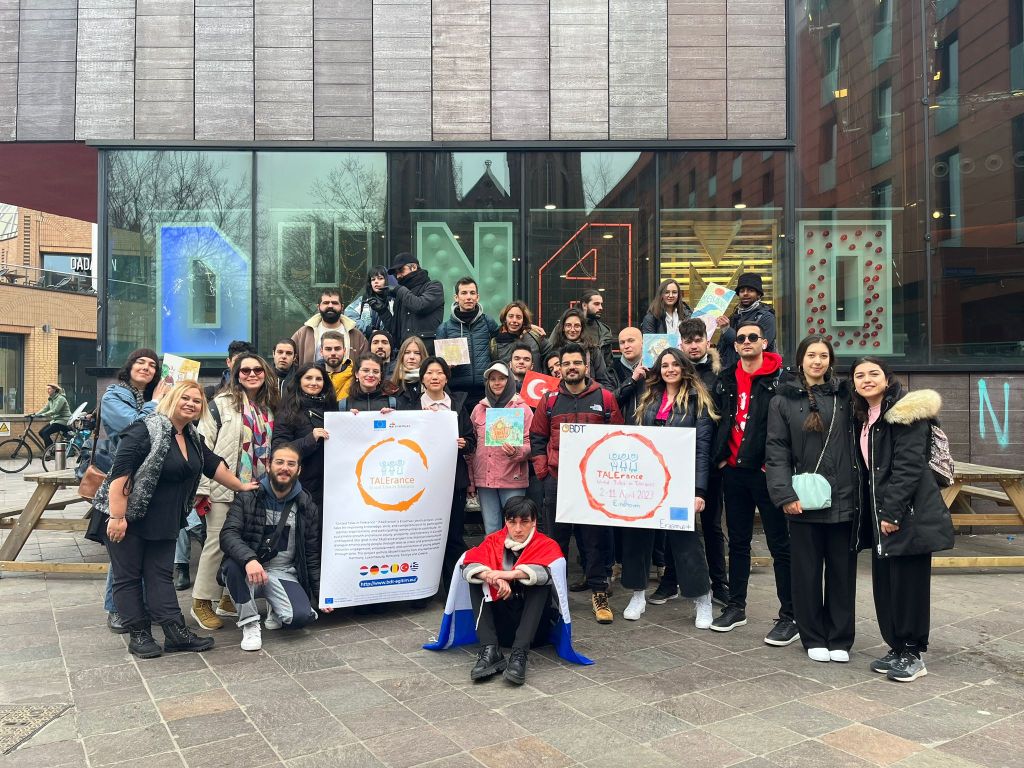













Youth exchange about Mental Health in Turkey from the perspective of one of the young participants
Meylor Seven (25) participated in our Erasmus+ youth exchange as part of the youth team from Portugal. Other teams joined from North Macedonia, Turkey and the Netherlands. The total was 20 as reported here in a previous post. Now we listen to Meylor how she tells us what it did to here as a youthful participant. She relates to a reality that many young people have to deal with, especially after covid. Listen to her comments…..

Merging the silos into sustainable human wellness development
Our current society model, also referred to as “the system”, consists of functional silos that interact on the basis of self interest and financial dependence, within a mindset of financial growth. Regional governance is based on facilitating this model while attending any negative consequences through policy making, regulations, taxes and bureaucracy. Issues are seen as a cost, covered by taxes and debt while our basic needs are treated as consumable and speculative commodities, not as shared responsibilities.

The increased needs for financial means has diverted from care and regenerative productivity into speculation around shortages, causing large areas of poverty, institutional financial tunnel visions and massive citizen dependence on financial means, deprived of ways to be self sustaining while resident in every growing cities. Also the environmental issues, where resources are extracted from (the extraction economy) in a seemly unlimited way, are reaching a point of no natural recovery.
It is hard to pinpoint a sole responsible for the existential values that are important for our integral long term sustainable existence as a species, let alone our wellness. These essential values all seem to be in severe jeopardy. The only way to address this is by taking our responsibility together, with all silos engaged. Interaction not based on their money dependence or hierarchical interests but by contributing to these shared essentials. But who is supposed to do the engagement work where equality is leading among all islands of engagement? If any of the silos does this, the engagement develops according the DNA of that silo, not the core essential human values.
That is where the STIR foundation moved in as a research foundation about human behavior around creating perspectives for its own sustainable existence. STIR started to invite the silos into coalitions that restore and sustain prioritized essential human values at regional scale. STIR researches the way the different old silos react to this invitation, seen from their old comfort zone, their self interests, their expertise and their possible presence in the center of the shared commitment. Below we see one of such prioritized platforms of engagement, called AiREAS. It is about restoring and protection our health and health environment together.

The picture above may lead to the confusion that AiREAS is receiving the responsibilities of the silos in a delegated way, as a separate institutions. This is definitely not the case. AiREAS is a partnership organization, with a purpose and meaning. Each partner is asked to carry their own responsibility and gather in AiREAS to connect with each other and strengthen each other’s commitment by developing programs together. STIR chairs the AiREAS interaction in a contextual way, safeguarding the contextual essence and commitment while doing the project management in the multidisciplinary environment. Redrawing the picture we arrive at this. The bubbles of each start overlapping when accepting the invitation.
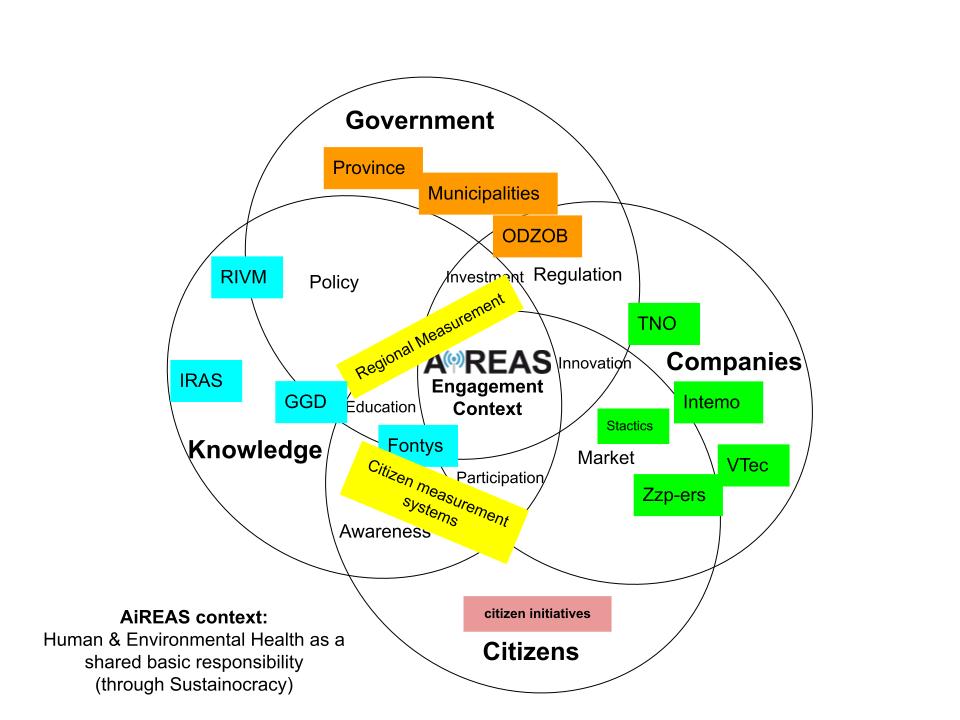
There where all silos meet and overlap, the open space of co-creation and integration appears. It is developed under guidance of AiREAS and STIR in order to assure the framework in which the co-creation takes place. The further away one stands from the central overlap the more one does things oneself, or allows other traditional (self)interests to play a role in the commitment. It is up to the participants themselves to decide where to stand in the picture. Often it starts shyly self centered somewhere in the outer boundary, pinpointing responsibilities to others while protecting their self interests. But gradually one gets to taste the value of co-creation and regeneration, also for themselves. Then the move to the center and the joy of the meaningful positive “can do” energy in the community is a fact.
The rules in the converging center are different than in the outer perimeter of each silo itself. In the center the results count, not just the discussion or intention, including the impact driven contribution of each of the participants (members). The center is based on absolute equality, respect and trust among the participants, without hierarchical power positions, impositions or limitations. It is the commitment to achieve regenerative health and a healthy environment that counts and the concrete actions that are designed to get there in an integrated way. STIR pulls the zipper towards integration until integration becomes a valued position for refueling the short and long term successes of each of the participants. Meanwhile the region is and stays healthy and with an unpolluted environment.

 Sustainocracy, the new democracy