
From reacting to symptoms to applying awareness for mechanisms of integral change
One of the main challenges we face as society is to break with the treatment continuum within a structurally unhealthy and destructive financially steared and dependent paradigm. What does this mean?
Our human community presence and participation is guided by a jobs related productivity in a political and financial ecosystem created by humankind. We get rewarded through those financial means. This gives us access to the perceived abundance provided by this system in order to fullfil our daily needs. When signs or symptoms arise of system flaws, in terms of human illnesses, pollution, poverty, inequality, etc, we try to resolve them through treatments. These are focused on getting back to the optimal status quo (the neutral point) for system’s productivity.
A political financial system, such as capitalism, reacts to signs and symptoms that potentially destabelize the functioning of the system. It does not react to the disfunctional relationship it has with other overarching systems such as nature in general or the complexity of biological or spiritual human health. The Sustainable Development Goals (SDGs) are a clear example of such a treatment paradigm that tries to fight premature (system) death by addressing issues that are caused by the system itself. It does not dispute the system itself.

We see this in the example of covid-19. The system already reacted to exponential rise of health care needs due to unemployment, poverty and an aging population. It did that through a general cost reduction program of the health care systems. They also raised health care prices, insurrances and personal financial contributions to the services. It also reacts on the impact on the IC capacity by both reducing the IC capacity and attempting to reduce the affluence of very sick people through lock down mechanisms and vaccination campaigns. It react to Covid19 as if it were the only problem at hand. Suddenly all other diseases seemed to have disappeared, just like system related health issues like diabetes, overweight, alcohol and drug abuse, negative stress, behavior disorders, etc. They don’t receive equivalent attention at all.
It does this purely from a system’s dynamics (premature system death as seen in financial crises, system collapses, etc). The measures have nothing to do with human health, a healthy society or a healthy economy. On the contrary! We even see that those reactive measures create an overload of new signs and symptoms (stress, burn outs, delayed treatments of other diseases, people aggression, suicides, increased mental problems, climate problems, etc). The treatment paradigm again reacts with more measures, more police, more vaccines, more bureaucracy, more controls of everything, more demand for power and money. Yet it does not look at itself as the prime cause of all problems. The neutral point is never reached anymore and a point of general collaps is coming closer and closer.
Awareness and learning
Awareness is a condition of our human reality. We can place ourselves above our systems and see ourselves and all issues in multidimensional contex. This brings us into a learning curve as a species. Our systems only have this learning curve when we apply ours to them. For instance we can determine that a petrol based car produces pollution. The car itself does not. We can change the technology of the car, put on a filter or eliminate its use. The car itself will not, it will always be a car. In the case of a system such as capitalism we can see its system flaws, but it remains capitalism. So people working within capitalism act the capitalistic way, just like the petrol engine does in the car. It is the context that defines the functioning.
We cannot change capitalism, we can change the context, environment and mindset in which people (including politicans, businesses, etc) excersize their functions and responsibilities. We then learn to abandon capitalism and adopt something else, such as the core natural human values and shared responsibilities defined in Sustainocracy. The little blue square in the drawing above.
We don’t look at the premature death avoidance of capitalism, we look at the premature dealth avoidance of humankind in general and our relationship with nature (instead of money). A new awareness and learning curve appears that grows and places capitalism and everything else into context. One of the symptoms then to eliminate is the capitalist working, not by sustaining it but by replacing it. By adopting the laws of nature and our core values as our points of reference we develop our long lasting wellness as a species. We apply proactive learning and constant adaptation of the human made systems we use instead of adapting people to the systems.
This represents a mayor turnaround in governance and mindset of the entire population. If we don’t do it we will face the general collapse produced by an obsolulete system’s dynamics that is forcefully being held up by those that excersize blind power through it. If we do we need to reorganize ourselves and disconnect from the old hegemony, also in our own behavior and addressing reality.


Breaking the vicious dead end circle in three steps
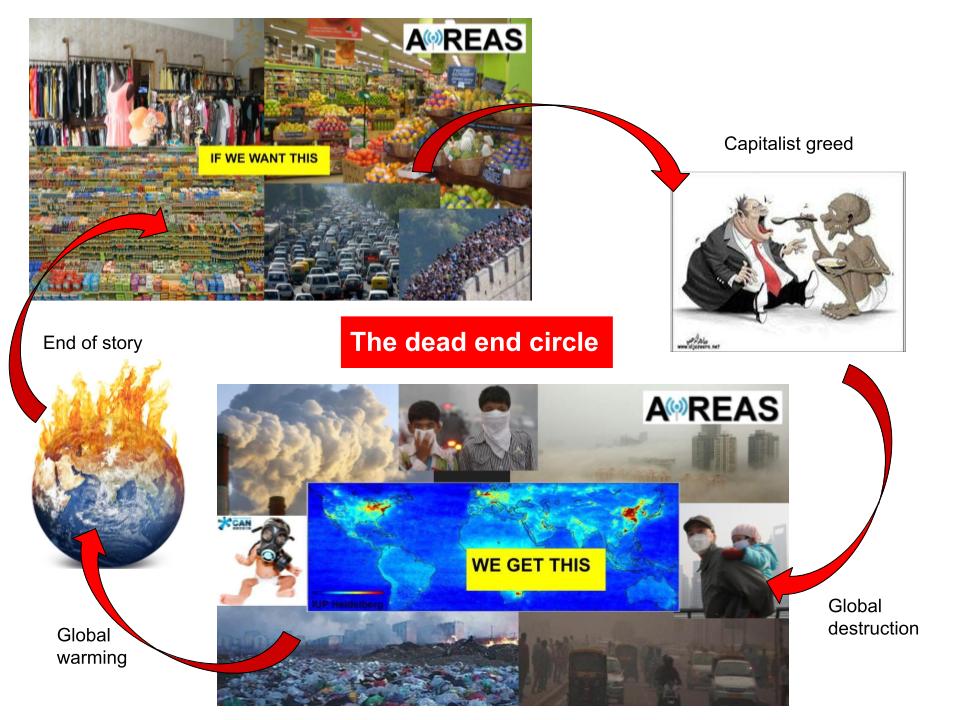
The current vicious circle of destruction involves us all. How can we break the circle? We introduce three Sustainocratic steps that can solve this problem by taking our own responsibility. Now we can do so voluntarily, soon we will have no choice.
Dead end cycle
With AiREAS we make visible the invisible, not just from an air quality and health point of view but also in lifestyle and behaviour. Addressing this first is our instant gain in wellness improvement and breaking the circle. Because with our consumer lifestyle we feed the capitalist hegemony that takes abuse of the land and resources to further feed our consumption.
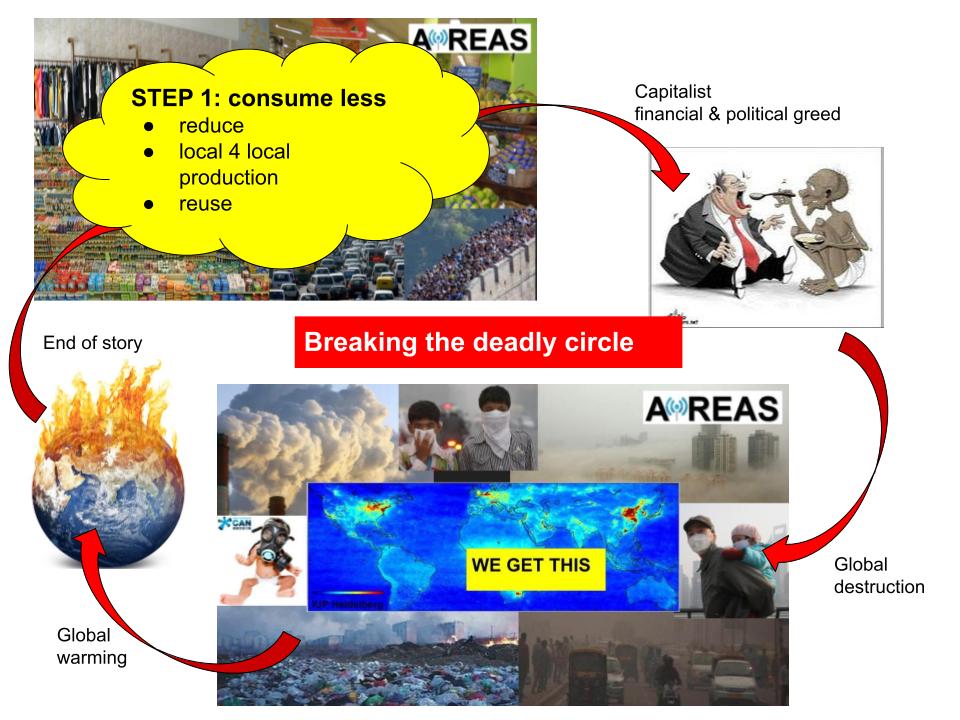
Step 1: Reduce our consumption
So if we address our consumption attitude we can reduce our risks of shortages, decrease our dependence on big supply chains and the speculative or abusive nature of their structures. Reducing our desires to our basic needs, engaging in producing these needs mostly ourselves and introducing circular reusage of resources, we take away the capitalist financial & political power over our old dependence. This has a direct and positive effect on the rest of the cycle. In the beginning it may take a little of getting used to a minimalistic lifestyle but this step improves our social life, our community spirit and general happiness. We gradually get into the positive cycle of sharing abundance with health and safety as a consequence referred to as collateral benefit.
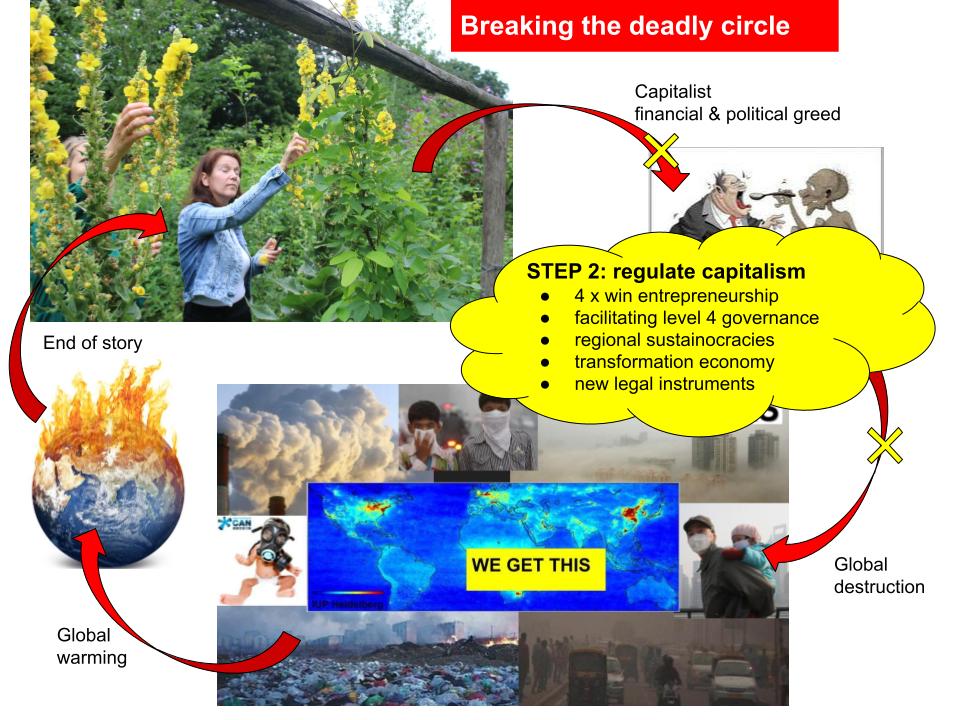
Step 2: regulate capitalism
This step is a bit more difficult. It involves the institutional engagement to sustainocratic thinking anf handling while letting go of the 1 x WIN (financial profit or political power) focus. There are two important ways of public handling: 1. Don’t buy from the large 1 x WIN pollutors by focussing on step 1. If one needs to buy something then choose a local supplier, not a global player. 2. In the democratic voting process ever 4 years choose a political party that supports these steps. Sustainocracy is not al all politically oriented because we don’t support the political hierarchy of interests. As we concentrate, also in the current system (while it still exists), on developing the core natural human values and share responsibility, we can gradually make a difference in the political structures also.
As business leaders we will feel gradually more comfortable in the field of multiple WIN (human, societal and environmental) than the single WIN (financial) at the expense of our environment and human sustainable progress. If we stick to the single WIN phylosophy than eventually we will be stopped by the new legal instruments that will call for responsibility. This is also the case for political leaders that choose for money instead of value for society.
Step 3: Globalize Sustainocracy
Step 3 is to consolidate our local for local focus into a global network of sharing our abundance in close relationship among each other and our natural environment. We define our prioritities in relation with our core natural human values in a changing environment. When we can solve our issues by ourselves we do so, if not, than we can count on the help of our surroundings. We will be a global family, taking care of eachother and our planet.


Earthbeat reveals climate drama and we are all part of it
The global smartphone video challenge project, Earthbeat, received 77 entries from 31 countries around the world. The video challenge was shown during the climate conference at COP26. It revealed the local effects of the mining industries and industrialized agricultural on the habitat of indiginous people. Changes in their ecosystem, floods, disrupted food chains, pollution that kills food resources, expropriation of their lands, expelling people, unjust land ownership, criminality etc are all crimes against humanity and our planet. It is not just these minorities that suffer. They are a prelude of the problems that spread as a blanket of destruction across the entire world. The question arises: Who is to blame? The miners or farmers? The capitalist greed behind it all? Or is the modern western “consume it all” addictive culture? Is the politics to blame that supports this all out of electorial self interest?
We can only conclude that we are all to blame. Our consumerism feeds the capitalists that just want more and take the resoures where they can find them. Our politicians depend on the taxable money streams to finance the status quo. It is a spiral of greed and destruction that somehow needs to be stopped. In the end it is nature itself that probably pulls out the plug. Humankind seems to have wrapped itself into this spiral without escape other than self destruction. Have a look at some of these short locals Earthbeat reports made by local with their smartphones…
 Sustainocracy, the new democracy