
Self aware citizens that take climate action
Today I videotaped a few people in Eindhoven with their short 30 seconds to 1 minute pitch about what they do, their motivation and climate impact. Enjoy the citizen’s empowerment and engagement. Their messages will be collected and taken to the climate conference in Glasgow, COP26.
1. Meet Joyce. She organizes a climate festival once a year.
2. Meet Peter. He just turns things around. If I can throw litter on the ground, I can pick it up too. It is a choice. If millions of people make this positive choice, the world will become a great and clean place again…
3. Meet Eva. She is member of the city council and explains her political and personal commitment to climate actions…
4. Meet Rik. Together with his neighbors they set up a car sharing cooperation. 15 people, just 2 cars!
5. Meet Roxanne. She enjoys to help people in awareness of their own potential in climate actions. She uses a game.
6. Meet Joris. He used to be angry and disappointed, until he joined a group in which he can make a positive difference.
7. Meet Anuj. He invites people to talk about trash management in order to see if help is needed.
Empowerment of our youth
Recent research has shown that over 80% our youth feels depressed about their future, let down by their governments, even betrayed. This feeling needs to be transformed into a sense of positiveness, a “can make a difference” attitude. Governments need to step aside and provide space for a new mindset, a new direction, a new humanitarian and ecological focus. Our youth can take the lead in open up that space, take action, become the leading force of societal renewal and change of perspective from fatalism in to opportunity.

Leadership trail

In September I (Jean-Paul Close) more or less blindly joined a pilgrimage referred to as a leadership trail. During 8 days we walked small Italian roads and trails from pitoresque village to village. My physical condition as a 63 year old was still in a deplorable state. It was the result of both an adventurous and exagerated lifestyle, topped with 18 month of relative covid immobility. Health had become the number one core natural value of my own society model referred to as Sustainocracy. I had personally focused very much on the welbeing of my daughters as a single father. They had become my source of inspiration to determine the core natural values of sustainable human evolution. As a consequence I extended the focus on wellness to all children of the entire human world. My own health however had received less self aware attention in the turmoil of a life full of stressful challenges.
A certain incident made me aware to pay more attention also to myself.
About five years ago I had started to address my own health and wellness by challenging my lifestyle through self reflection, awareness and experimentation with newly acquired information about myself. My voyage deep inside had taken a new dimension. As a consequence I had gradually reduced my medicine use (of about 12 pills per day) to only a few arthritus related painkillers per week. My sense of quality of life had evolved into the simplicity of enjoying nature, photography, family and friends. At the same time, and within the scope of Sustainocracy, a network of holistic health related locations emerged around the world where I could enjoy the benefits of massages, personal attention, cultural interaction and human warmth. This I also shared with many others by organizing health awareness trips, social engagement events and other types of health driven coalitions.
Letting go had become for me an exercize of internalization into the now, all the time, every instant, during each and every day. The space that reveiled itself again and again would offer so many new experiences, encounters, places to visit and all would enrich my soul by leaving a lasting impression, a cherished memory. Also these experiences were again to be released in the eternal letting go process. This is how I signed up for the trail, without expectations other than meeting again a dear friend after many years. This friend (Sujith Ravindran) was the one who had invited me to join.

Travelling to Rome was already new for me. The trail would go from a small place called Piediluco, all the way to Assisi, a territory in Italy that was to be discoverd now by me. The group consisted of 12 travellers, all men and each of them new to me, except of course my friend. All came with their packpack, a bottle of drinking water and some cash for our costs along the trail. So did I.
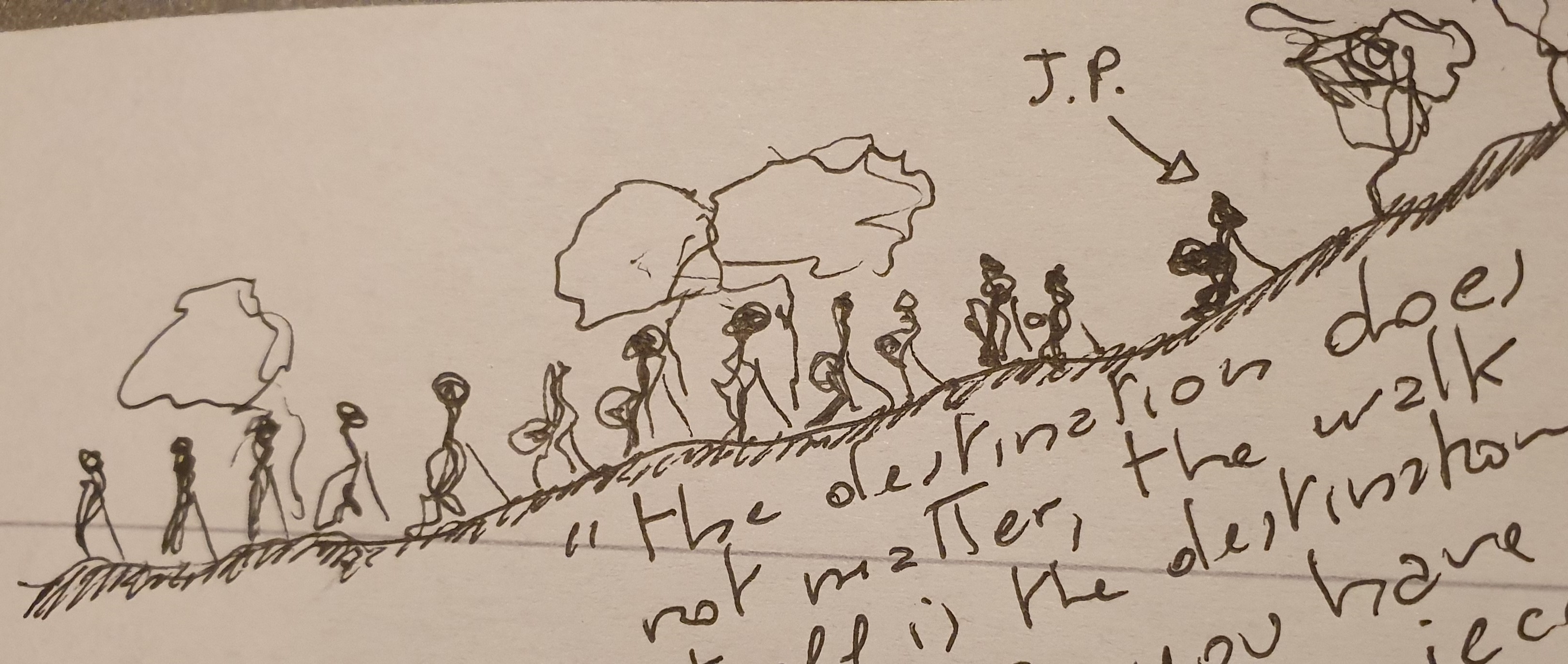
The slowest man walks up front
……And no one is left behind. This was the beautiful motto imposed onto the group by our leadership coach. Not an easy motto for people who are in the prime of their adult lifetime, living mainly a hectic professional and private life. As it happened, I was the slowest man due to my painful handicaps, left overs of the old injuries of careless incidents in my own lifetime and deterioration through age.

The first thing that I had to let go was my sense of guilt of being the one that slowed everyone down. The trail had very steep decents and rough long and steep rising paths. If I let the others go in front they would surely have lost me behind in no time. With them behind me give me a motivation to push myself beyond my limits.
The second thing that I had to let go was my pride when someone kindly offered to carry my backpack when the tough became really tough. Such pride I had let go already a long time ago when I had to depend fully on the support of family and friends to establish a home again for me as a single father with my two daughters after a second traumatic divorce. In fact, shared responsibility and cocreation had become part of the core natural values of the society vision that was born out of such experiences. A vision that determines that – our lasting wellness is a shared co-creation, not a cost nor a competition over the back of others -, a vision that was clearly present in the group process. The strongest man, that temporarily carries the heaviest weight, helps the entire group move forward better. This is a lesson in the political/financial world of competitive self centered hierarchies that still needs to be learned.

Help was offered all the time 
The two Italian Francescos proved to be strong supporters
Sometimes two men decided to divide the load between them by attaching my backpack to a pole.
The analogy of real life, as it should ideally be, showed itself during the trail
Accepting this help for my self was also in the benefit of the group. At the same time I did not want to relieve myself from the challenge of carrying my own weight. Finding the right balance between self sufficiency and group dynamics became a beautiful and heartfelt negotiation. It reminded me of a motto that I had introduced into the Sustainocratic (people and institutions together) cocreation groups – what can be done by one self is done by one self, whatever is to complex or difficult, is done together -.
The slow pace allowed my fellow travellers to engage in deep conversations and sharing stories. My own attention was primarily on myself and finding my walking “cadans” in harmony with my own body. To my surprise I could manage fairly well and even, after a few days, could do my bit without any painkilling medication at all. Walking was relatively painless. Standing still, cooling down or sitting down was however a living hell for my knees. This I needed to deal with through some self determination.
Leadership archetypes
During the day, from morning till evening, Sujith introduced symbols, group rituals and basic overaching rules (such as “the slowest man”) for awareness and group cohesion. He also took his time to explain certain processes that he was taking us through. He had one to one conversations with the participants, shared wisdom and insights individually or collectively and conducted circle talks for the entire group.

Of particular interest to me were his five archetypes of leadership (Sage, King, Expert, Magician and Commander). Although these archetypes are often visualized as particular personalities or specific functions in society, to me they are all part of ourselves and our inner processes for inner and outer harmonization or symbiose. In my own learning processes over time I had visualised this in the first logo of my own STIR Foundation, including a color code.

The image represents the four elements (intelligence, emotional, physical and spiritual……or earth, air, water and fire if you like) around the fifth one represented by the layers of awareness (the awakening consciousness) that are gradually revealed to us.
This is also the way I organized level 4 regional development, by gathering the archetypes together around the same table.
A few years later I visited a spiritual place in the Netherlands, the village of Steyl, where a spiritual leader had been made a Saint by the Catholic church. He had used the same color code as I had, only 150 years earlier, also with a similar significance. We also recall the Circle of Life of the Indians or other ancient native cultures around nature. We always find back this commonality in understanding our inner and outer processes. It was beautiful to see the analogy with the insights of Sujith.
I was not only the slowest man, but also the most silent one. Not that I did not want to speak. Often during the trail I was too short of breath or too concentrated on my steps. Instead I could observe and see that each of the participants was going through their own leadership development path. While my own inner process at the time of the walk was primarily physical, others had to deal with other aspects of themselves. Some encountered themselves with their inner emotions while others deepened into their beliefs or spiritual wellness. Many developed their rationality through the open dialogues that arose.

For all, each in their own way, new layers of awareness were somehow revealed and uncovered. For me it was yet again a confirmation about what I was doing every day in my daily life through Sustainocratic ventures. However with a difference. This time I was the one who was enjoying the abundance of care of the group while in the usual circumstances I am the one bringing all together, the care giver, the initiator of processes. It was rest giving for me, very comforting, and surely the type of sense of security and support by togetherness that I try to extend across the world.
 Sustainocracy, the new democracy