Home » Posts tagged 'AiREAS' (Page 19)
Tag Archives: AiREAS
AiREAS international blog
The first Local AiREAS in Eindhoven (Holland) is a precedent of co-creation around local hotspots of global attention. In this case the attention went to the effects of air pollution on our health due to direct (exposure) and indirect (global warming) consequences.

Air quality -> Human health
Working together in a purpose driven way by creating Local AiREAS in other cities, and a network of interaction between them all, demands a transparent reflection which we try to achieve via the new International Blog.
http://www.globalaireas.wordpress.com
We describe the earliest experiences in Eindhoven including the difficulties that we had to overcome to make it happen. Such difficulties can also be expected elsewhere in the world. We can learn from each other buy anticipation, sharing best practice and inspiration.
Feel free to follow the development of the global AiREAS movement to create healthy cities and wellness based communities, at its earliest phase of pioniership and growth. If you feel professionally or personally committed to the higher purpose or know people who are feel free to connect and develop with us the entrepreneurship 21st century for sustainable human progress.
Sustainable human progress
AiREAS: Air quality curiosity and BBQs
Our civilian sustainocratic initiative AiREAS designed its own low cost real time city measurement network for registering and displaying air quality in near real time. We use state of the art technology, scientific modelling insights, etc. and measure ultrafine particles (UFP or PM0.1) that are smaller than a virus, PM1, PM2.5, PM10, ozon, temperature, SO2, etc. Our network was installed and calibrated in December 2013. Since then we collect and store valuable data.
Making the invisible visible from an air quality point of view is necessary in our multidisciplinary attempt to co-create a healthy city. Having the data is one, interpreting them is a totally different story as this unexpected event will show.
Unexpected peak
One of our partners, Imtech, in charge of data storage and ICT, is experimenting with data display on mobile telephones. I have the test app now on my phone to do some early fieldtesting. Another partner, ECN, in charge of the equipment development, has an internal display tool for testing and benchmarking purposes. This tool I use too to compare app and network data when necessary.
Every day I look at the status of the city. On the app I generally see the network as a bunch of green balls. They change color when the norm is reached (orange) or passed (red). On the computerbased tool I can see more detail and summary over time. There I often detect sudden peaks that come and go fast.
On the monday morning of Juli 21st I looked again on my app. The traditional boring green balls were all flashing red and orange. Here I display what I saw that morning:

It immediately triggered my interest. What could cause such sudden city pollution, particularly in the field of PM2.5? The other measurements did not show the same peaks.
I contacted ECN and they not only confirmed what I saw, they added that the peak had been gradually building up from midnight onwards! That was strange. We expect traffic related peaks but not a nighttime buildup when the city is expected to be at rest. Was there a fire somewhere? Quick research revealed that no special events were reported.
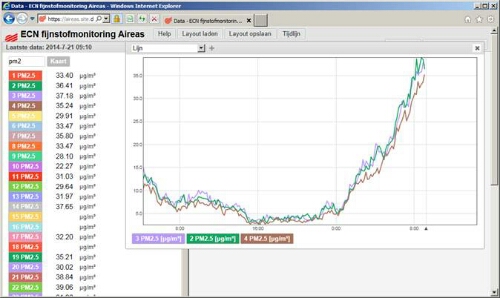
The sunday before had been a nice, warm summer day. The evening was warm, humid and windstill. Many people were still in town as their holidays would begin a week later. Reports from our civilian network spread over town added two issues to be considered:
* many people had been barbequeing that evening
* lots of people had complained of respiratory difficulties and a sleepless night
That night a fog had been building up over town from midnight onwards and slowly disappeared around 10 am that monday morning. The pollution peak had coincided with the fog, not the human BBQ activities. We were puzzled.
Someone suggested that our network was measuring water droplets as if it were finedust. That plausible idea could be eliminated because we use drying techniques before counting the particles and other foggy days had never shown such peaks. And water does not necessarily produce respiratory discomfort.
The local hospital also entered the debate. The hospital has operation chambres where also meat is burned, for instance to close wounds. CO2 concentrations in the OCs at one time had been high causing people to loose concentration and complain of fatigue. There is a natural relationship between healthy air and the number of ions in it. Ionizing the space helped overcome this problem. Then a new problem occured. Personnel had complained of nausea after closing wounds with burning techniques. Research showed that a specific combination of air moisture, ions and gases from burned meat caused chemical reactions that produced the sickness.
The question now arose if this could have occurred in the public space? The theory now is that on that sunday evening people massively BBQed in Eindhoven. The city is geographically located in a shallow dip. The bbq fumes accumulated in the city and were not dispersed due to the lack of wind. The high humidity caused fog to develop from midnight onwards. The water condenses on the finedust producing chemical reactions with the gases from the burned meat. Sensitive people who inhaled this experienced breathing problems, sickness and a sleepless night. At 10 am the problem disappeared as the fog lifted.
Conclusion
The explanation seems plausible as it could be contrasted with the experiences in the hospital that had been researched. Some AiREAS partners have promised to try to simulate the event in a lab environment to confirm the analysis or offer new insight. From a healthy city point of view we feel motivated to introduce bbq alternatives and innovations in town. We also have a new impuls to see if in wintertime similar situations occur when burning wood in stoves for heating. What does this do during foggy days?
All people involved were impressed with the multidisciplinary interaction to come to a plausible explanation. Many people were triggered positively to participate in the debate. It has not ended yet of course but the curiosity has pinpointed us to an issues that we can solve ourselves as citizens through awareness and innovative response.
AiREAS is creating Local AiREAS initiatives throughout Europe now. Maybe we can share experiences both in the field of public space as special environments s.a. hospitals.
Jean-Paul Close
Co founder of AiREAS
The STIR loop
Global issues, local solutions, global application
Redefinition of our system’s complexity: holistic, governance, technological and social innovation for sustainable human progress.
This documentary of Rebecca Hosking about the “farm for tomorrow” is a well worked out case and example of one of the challenges we face now and the coming decades: food and energy. This we call a “global issue” that needs local solutions. But there is more…
Food and energy is key but there is more. Air quality, climate change, pollution, migrations, rising sea levels, poverty, water shortages, etc. I refer to these as “global issues, local solutions, global application” as a transformative process.
Unprecedented complexity
(Introducing the Eindhoven precedent with sustainocratic ventures)
If we want to do something about it we face challenges that are unprecedented in human history. The documentary of Hostings is quite clear about this. Knowing this what can we do? Ms Hosking may have an idea on how to deal with it on her own territory. She can make her own choices. But how do we transform a country full of cities, people, culture, politics, economics, expectations, opinions and relationships? Even the most powerful, selfaware business, government or religious leaders tend to find themselves trapped in a system’s-culture. It takes a certain mentality to take on the challenge, another to avoid it. In any case, it involves us all.
But how do we solve the riddle? My own contribution is called “Sustainocracy”. As part of that I present the practical “STIR loop”. Let us go through it in a few steps.
Understanding where we come from and its shortcomings.
Look at this picture. This is how we have seen our reality for a long time. Our surrounding national systems provided us jobs, healthcare and other securities.

System’s leaders operate from their own perception of reality
The current national systems are mostly based on a culture of economies of growth, consumption and consequence solving. Inside the system we find a tremendous fragmentation of interests based on economic relationships. Business, government, science, population, etc all interact through an economy of mutual interdependence. “Nature” plays no significant role. Economic growth, efficiencies, relationships, protecting self interests through globalization are the key instruments. Humankind has never experienced a larger growth in population ever before in history. Many individual people experience a level of wellness and life expectancy that is equally unprecedented. It is mentally extremely difficult to place this all in the temporary context of a small time frame of several generations referred to as “the oil-people”. Most disturbing is that we, the current adult population, are probably the last of that unique group of generations. Our children and grandchildren will have to deal with change much more and intense than we. The more we can anticipate today the better.
What is the reality that we have neglected?
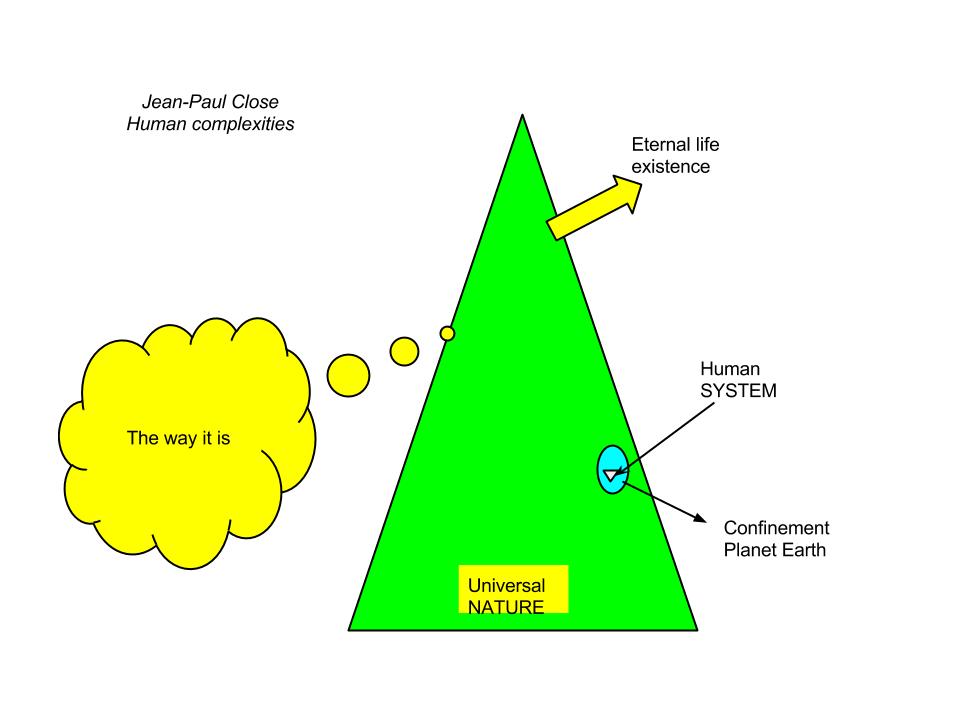
The human systems develop within the limited confinement of planet Earth within the universal laws of harmonic natural progress
When we become aware of the huge unbalance between system’s dominance and universal natural leadership realities we need to “transform”. This means that we need to (voluntarily) let go of one system to co-create a new one that better serves our sustainable progress as a species.
But how can we transform when all human dependencies and securities seem to be firmly anchored inside the system? Within the fragments the issues that arise may be addressed as good as they can. But it is not just the fragment that causes the problem, it is the way the fragments relate to each other to form a destructive whole for humankind, while it was perceived and experienced as very constructive before. The current system’s executives trust they can get that back by applying the same measures that caused the problems in the first place. We are now even in the hands of speculative materialists that have dangerously changed from globalization of volume productivity and marketing into keeping shortages for inflation, debt exposure of the needed with control over the limited resources and those who get access.
One of the options individual people choose is to step out of the old system and start a new one of their own, facing problems and challenges like Ms. Hosking does in the documentary.
The STIR loop
The application of the STIR loop is relevant to complex transformations of entire communities. In 5 steps it can clean up systems, making them sustainable in progress again. The key is that every relevant person and institution needs to be involved. The whole loop is focused on the quality of sustainable life in a particular territory (a city, a province, an island, an autonomic region, etc.)
The 5 steps to get back into productive balance
Sustainocracy describes the process of taking multidisciplinary responsibility locally around global issues. This can only be done in a particular way:
Step 1: Awareness
In the picture I have drawn the two systems (local human dominance and leading universal natural responsibilities) next to each other. I place the human being in between, with active selfaware citizenship and productivity as choices between both systems. The human system has human hierarchical leadership, fragmented structures, relations based on money and transactions, etc.
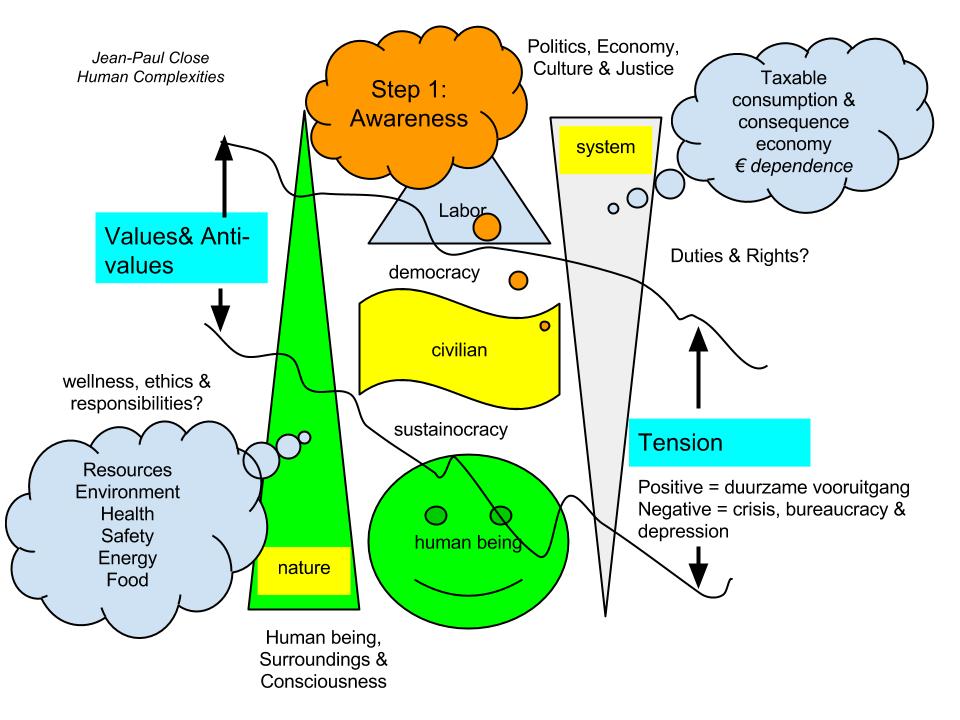
Awareness means that we manage to position the human system as instrumental, not dominant for our human evolution
As human beings we ARE nature. Everything we do that affects our environment negatively reflects in our natural systems of life. We show growing health problems that affect us much deeper than medically and scientifically (human system dependent) acknowledged. At one time I even wrote about the genetic anthropocene (the unprecedented damage we cause inside our genetic structures with lasting consequences). So it is not just food we need to take responsibility for. It goes much further.
When aware we face the tension between the old system and the new one we need to develop
Step 2: Choice of priorities
Within the context of global issues, such as food, water, health, security, self sufficiency or awareness, it is imperative to find local self supporting solutions. Rising seawater, food shortages, pollution, migrations, climate changes, dense populations, fossil energy disappearance, etc give rise to important local catastrophes, caused by globalized human systems, the local demographical situation, nature itself or a combination of all three. There is no generalized priority. Every territory has its own unique combination of threats. The local awareness has to have led to a generalized consensus “that something needs to be done urgently” and “we need to do this together”. This opens up for the initiation of the loop:

The need for action has to be acknowledged as well as the impotence of the fragmented parts to do this “alone”.
In Eindhoven (Holland) by experimental persistence and chance I arrived at “air quality, public health, regional dynamics” in 2010. A financial threat from the European Union (air pollution norms) got the local government to open up to new experimental formats. AiREAS became the first precedent world wide of Sustainocracy. In other places around the world different priority choices can be made, not necessarily air pollution, in any combination of the key issues of sustainable human progress (health, safety, self sufficiency, awareness and food).
Step 3: Establish the Sustainocratic commitment within the system of nature.
The essence of this step is to take the priority outside the human system, away from politics, economics, justice, etc. into the area of natural responsibilities. It is the start of the loop. The only representative of both systems is the natural evolutionary human being. So it’s the biological human creature that invites the powerful instruments to unite in a multidisciplinary way. This inviting person is the Sustainocrat, a key independent player. It is referred to as “the world upside down” for the participants. They are forced to reason through the views of the paradigm of nature, harmony and change.
The group consists of the Sustainocrat, local citizens, leaders from science, business and local governance (see picture below). The group concentrates on all aspects of addressing the chosen issue:
- Why are we starting the loop
- Create a vision for change (dot on the horizon related to Sustainable Human Progress)
- Initiate the stip-step process
- Apply innovation (Social, technological and structural)
- Develop the knowledge that can be implemented elsewhere
- Contain the unique values for the stepping back process
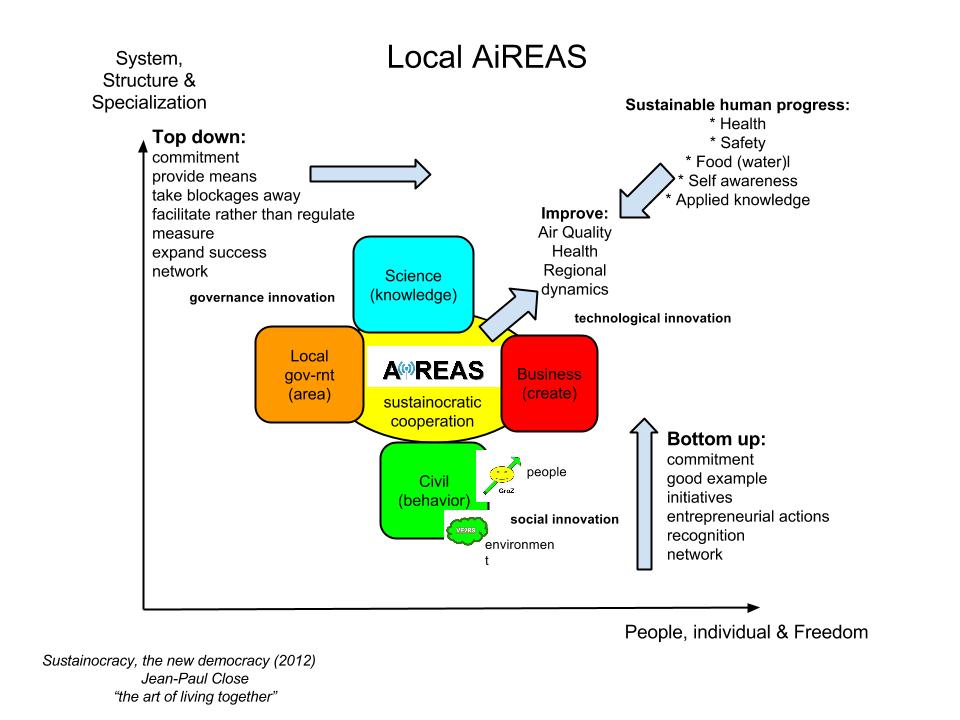
Top down and bottom up processes come together in AiREAS “Healthy city”
Step 4: the loop back
While dealing with the system from “outside” all the blocking bottlenecks and impediments become visible with each of the partner’s normal functioning as well as in their system’s imposed relationships.
The values that are co-created outside the system can be expanded again within. But also the many handicaps can be addressed and resolved in a documented, argumented and programmed manner.
The expansion of new unique values have an important economic potential that can be used to keep the loop going for as long as it is needed. In fact the loop itself becomes a competitive added value of a region and its local partners that make it happen. The values are always locally proven and then presented for world wide application.
Global issues thus have changed from a tremendous unsolvable problem into a local challenge and global opportunity. Local loops may seemingly get to compete with each other in the world wide context but always deliver uniqueness because of the diversity of local situations that each will have to deal with. Uniformity in the problem does not mean that uniformity will ever be found in the solution.

The loop back is significant as a transformative economy of change but also confrontational with the old system
Step 5: local consolidation
For the partners this 5th step is perhaps the second most difficult phase, after the letting go phase of step 1. Consolidation means that adjustments described in step 4 need to find their way into the old system, change it up to a new workable situation. The process is well received in the relevant parties that are still part of the progress. Those that need to be phased out, or were part of particular context and loose that context in the new setting, will of course oppose. In some cases they are powerful conservative blockages that avoid no means to keep their interests alive.
It takes guts and leadership to do the mayor cleaning up. At least the STIR loop backs the leadership with powerful instruments and indisputable reasons to do what needs to be done.
Conclusion
Solutions are at hand. They have been described AND put into practice with early precedents. They are a new instrument in those areas where change is key but too complex to be dealt with in the traditional way. The STIR loop then become a powerful method to make change happen, gain support for it first as an experiment and assure that the right steps are taken afterwards. During the start of the loop “nature” leads, the return is in human leadership hands bringing it back into the practical human reality.
The STIR loop is educated through the STIR Academy and associated partners.
Jean-Paul Close
 Sustainocracy, the new democracy