Home » Posts tagged 'consciousness' (Page 2)
Tag Archives: consciousness

If we want to live in a healthy environment we will have to organize ourselves in a healthy way…
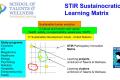
In the picture below we see the many parties that are currently involved in the AiREAS challenge and the commitment to achieve a healthy, unpolluted living environment. We call the circles the 4 legs at the table of the local society. These are drawn as “overlapping islands” where we all converge into the center for the overarching commitment. But a large part of the islands also lie outside that center which is referred to as the AiREAS context.

When we look at the drawing, the different areas of overlap speak their story. I have written a characterizing text in it to form an image. Where we adapt our behavior to each other in the center and make choices together that directly contribute to the quality of our living environment and our health, other interests often play a role or even prevail further away from the center. In the fragmented, money driven society where we come from, that AiREAS center did not exist. There, the islands interacted on the basis of financial dependencies, objectives and regulations.
All reports show how important it is for everyone to do this together. This approach is also praised at the administrative level (such as aldermen, deputies, boards, etc.). Only that field of tension emerges again and again between “taking responsibility together” and the way in which the islands themselves work with the varied mixture of old interests and new wishes. If you find it difficult as a person or as an institution, then defining a common project is even more difficult. We are so used to reasoning from within our own island and self-interest with critically pointing to the other islands, that we often conveniently omit ourselves and our own requirements to change.
The various authorities are trying to bring all sorts of things into the center. One has come up with a product that it would like to sell or try out from within the AiREAS 4 x WIN context. The other has books full of knowledge from research or expertise to share. The governments have pooled money to make “the invisible visible” through measuring instruments (air pollution, noise) in the hope that through awareness raising citizens and companies will participate and take responsibility. Ultimately, it is about our health that we can directly influence through our behavior.
The center area of AiREAS is growing. Nowadays there are also institutions and people who reside permanently in that center. They have grown with the value-driven commitment and have linked or derived their behavior and authenticity from it.
There we find citizens who no longer have a car, do everything by bicycle, public transport or partial transport, who buy locally, live together and share costs. They have often made it their business to help others achieve better health, more self-confident and cooperative living. We find companies that pursue the 4 x WIN principle in the field of cooperation with nature, food supply, water, energy saving, local basic facilities, care for and with others, etc. New school systems and collaborations are emerging that involve as many children and young people as possible in their awareness of nature, their self-awareness and acquaintance with the essential values of our existence, often in collaboration with the STIR Foundation and Sustainocracy. Certain departments of the local government can be found here. They still clash internally with other departments that do not show the same commitment or have learned to function based on different interests and priorities.
In the drawing we see the gradual transition that we go through together in an evolutionary way. When the STIR Foundation started experimenting with Sustainocracy in 2009, we only saw a few freelancers trying to survive by developing new ideas in their island of interests, inspired by the ideas of the healthy City of Tomorrow. In 2011 AiREAS was born. The intended collaboration between the 4 legs (government, entrepreneurs, education and citizens) soon came to life thanks to an initial financial support from the Province of North Brabant. There was no real overlap between the islands yet, but the foundation had been laid to make that a reality.
Now, in 2023, AiREAS as a functional shared responsibility and context can no longer be ignored. The format and challenge are greatly appreciated by all participants. “It's about something real” is often said and people are willing to step into the field of tension within their own organization to make the best of it. Two islands prove very slow in response and connection. These are the somewhat larger companies that originated in the old 1 x WIN context and linger there with their lobbies and financial tunnel vision, often supported by old legislation. These have shareholders and interests that are only compatible with the higher purpose of AiREAS if the organization goes through a fundamental transition.

And then there are “the citizens” who have made unhealthy behavior their comfort. Behavioral modification requires more than awareness. It requires a cultural adjustment in which health and safety is leading for everyone even though people tend to find it abstract if not confronted with illnesses. Many young people do recognize themselves in this new mindset, but older generations are "programmed" differently with their lifestyles. They find it difficult to let go of their established comforts (such as the car, status, purchasing behavior, etc.).
Anyway, the center of AiREAS is growing. It is heart-connected, warm, co-creative and innovative, full of people, functions, commitments and ideals. It is growing steadily. It is an example for other targeted local communities and essential values such as FRE2SH (food resilience), COS3i (social inclusion) and others that are emerging. Also internationally clusters based on Sustainocratic insights are emerging and can be helped on their we with the expertise accumulated in STIR, stepping up their potential with a positive learning curve without having to go through all the pitfalls.
New blueprint for education in the 21st century
The prime concern of our current era is the assurance of our sustainable existence as the human species in a finite, polluted and destroyed environment. In the previous centuries we have violated the essential values of our existence, not knowing what they were. Today we do know, so we need to educate ourselves accordingly and take corrective measures to transform the violation of those values into sustainable progress.
In Sustainocracy (sustainable human progress and our shared responsibilities) we defined five of such values. None of them are currently taught in an overarching manner in our schools while they represent the fundamental blueprint for our evolutionary processes and learning criteria.
Jean-Paul Close, founder of Sustainocracy
Our learning dynamics are always placed in the context of the time in which we live. In the 19th and 20th century the industrial era ruled. Our education was geared towards the labor market. In the 21st century for the first time we have become fully aware of our vulnerability as a species in the finite space and the limited resources provided by our home planet Earth. We recognize now that our old path has become dystopian, potentially leading to self destruction. Our overarching learning dynamics are now about how to take responsibility for our sustainable existence. The labor market, the diversity of institutions, our entrepreneurship and business mentality, our science and our education, needs to be placed into that context.
The situation of today is very difficult and leads to confusion among those that have been used to trying to solve our issues in a remedial way, within the reigning tunnel visions such as money, technology, regulation, take overs, controles, genetic manipulation and redesigning our environment. These people have not yet understood the complexity of the essential for the sustainable presence of a species within a natural ecosystem. In fact “eco-nomy” refers in essence to the “laws of nature” and not the speculative format we have given to it based on our own laws. Deviating from the laws of nature in order to create our own financial ecosystem, based on making use of humankind and our finite environment for financial self interest, has brought to this dystopian point.
Does that mean that we have to change everything?
No, not at all. There will always be professional functions in society, the need for specialists, also at institutional level. There will even be elites, people that have more authority than others because of their position or expertise. And we all need our guided learning paths to develop ourselves in the complexity of daily life. What we we need to do is to acknowledge our shared responsibilities based on the essential values for a sustainable presence and future while adopting wholeheartedly this mindset. In Sustainocracy we defined a set of five essential values, each being a shared responsibility among all of us, people and institutions alike. These values correspond to the laws of nature. It may seem simple, just five essential values. But when we start taking them at heart they prove to be transformative of the entire societal dna, taking away stress and bringing wellness for all.
We are to place everything in this context of core values for our existence, including our financial economy of growth, our government structures, our own behavior, our care systems, entrepreneurship, productivity, engagement as citizens, etc. By doing so we also redefine the entire educational learning process. Instead of teaching domesticated obedience we learn about respect, tolerance, equality and working together in values driven routines. We learn about authenticity, contribution, reciprocity, safety, trust and the essential values applied to ourselves and all of us together. We learn to be responsible in our behavior, our actions, our creativity, our leadership and awareness development.
By doing so we resolve many of our problems, reducing the financial, humanistic and ecological burden of our abuses of the past and its consequences on us, our societies, economies and our environment. We heal our past and develop resilience in all layers of our existence.
The blueprint of our new age education
Taking the above seriously at heart we need to look at ourselves as human beings. We are unique manifestations of life within the context of our natural environment of fellow living species on a finite planet in space. We are blessed with self awareness and the unique observant self learning dynamics for our own benefit and resilience. As a species we have gone through huge, long lasting phases of confusion that became the foundation of our current understanding and learning processes. We are unraveling our understanding of what we are, developing both humility and determination. Today we are living the biggest turning point in history of humankind. This historical process is also needed as guidance for our youngest generations to a productive, engaged, happy and wellness driven adulthood and life’s fulfilment.
Playful childhood
The growing up of toddlers represents the discovery of the fascinating world that surrounds them. Experimentation is their name of the game. The protective guidance of the parents helps to avoid the dangerous pitfalls of life. Playing is key to deploy the physical motorist skills, balance, interpretation of danger, emotional skills, etc. Early communication skills to interact with the parents develop as the child grows up. The learning show be an open space for free discovery and experimentation within the contextual framework of the core natural values such as health and safety. The child learns to establish limitations, consider risks and warning signals, interpret communication and interact through expressing wishes, fear, pleasure, etc.
The “I am” learning path
Gradually the infant starts to discover his or her large diversity of abilities. At this early stage it is mainly a copying behavior of what is being observed through parents, brothers or sisters. This is enhanced when the child gets in contact with other kids. Here the child can potential start learning about the authenticity of its own being, the unique “I am” development. The natural attitude is to learn through comparison, competition, challenges, victories and disappointments. The learning skills need to develop around social values such as compassion, empathy, tolerance, equality, respect, self awareness, a positive self image, awareness, etc. Here a solid foundation is created for the emotional stability of the youngster. Play, music, theater, art help in the development of the expression based skills. It also is sense making for developing language and communication skills in at all levels of speech, listening and interpretation abilities.
The “we are” learning path
The following learning path is oriented around group processes, the awareness driven cocreation and participation. The underlying skills developments of the experimental playfulness and self awareness (I am) continue of course and require continuous attention. Now the fundament of togetherness is further elaborated within the function of recognizing each other’s unique abilities and contribution in the field of cooperation. The aspects of sharing, spreading the load of responsibilities, leaving no one behind, creating value together. taking initiative, leadership skills, creativity, entrepreneurship and sharing it among all, are key elements of this learning path. Community spirit, the value of care for and with each other, are extended also to the inter-generational levels of attention. Respecting the practical experience of elderly while appreciating the youthful energetic outbursts of the younger provides a magic melting pot of opportunities for progress. The elderly have to avoid the dogmatizing of processes, stimulating the youthful creativity of the upcoming generations. The younger generation have to learn to appreciate the guidance of the elderly with their levels of awareness breakthroughs and elaborated expertise.
The “shared responsibility” area
Reaching adulthood the young people have sufficient baggage to further specialize in certain functions. Meanwhile they develop harmonic relationships with their own potential partner, possibly having children of their own while playing a role in different communities that fit their personality, professionally and otherwise.
Era of integration
Meanwhile our societal construct transforms based on the core natural values that lead our progress. We peal off old societal laws around the financial hegemony and abuse, protecting ourselves against outbursts of narcissism and expressions of pure, destructive self interests. Entrepreneurship, governance and all other institutional expressions are redefined within the same values driven mindset and sharing of responsibilities. Certain key aspects of life, such as food, water, warmth and air are taken our of the arena of commodity based trade and placed within the area of integration of our shared responsibilities, cocreation, positive interaction with nature, regenerative processes, etc. It will give rise to totally new “eco-nomies”, levels of engagement and development of circular interactions. This makes also the adult world a field of continuous adjustments, learning, innovations, applied science and technologies. The early playfulness is never lost, nor the “I am” and “we are” quests in the dynamics of the evolution of life and circumstances. Shared responsibility for our core natural human values is never reaching a status quo. It is always a balancing act to achieve harmonization and integration that will show moments of scarcity, chaos and new impulses for awareness driven adaptations. But addressed together, with wisdom, care and respect for the Whole, the moments of adversity and abundance are celebrate equally, with joy, determination and trust.

STIR Foundation
For over a decade now STIR had been introducing this new learning path. At first we were rejected, now we are being gradually accepted by increasing numbers of partners and do we engage with large groups of people, especially young generations. Read more about the build up of our experiences here.

Spirituality and Business
Prof. Dr. Sharda Nandram reflects about this during the Nyenrode University “radical thinkers” event. You can watch and listen to her arguments here.
It is of course admirable that a Business University takes a stand away from the traditional bottom line business philosophy that we tend to call “1 x WIN, 3 x LOSS” referring to the negative impact on society, the human being and our environment, purely out of financial win motivation. When I myself occupied general management positions in big multinational I had been drawn into that same tunnel vision and related competitive complexity. Only after leaving such a position I started to develop my own awareness resulting in the 4 x WIN entrepreneurial ideology of the 21st century. That is how I got to intellectually and spiritually interact intensely with the predecessor and mentor of Nandram, Prof. Dr. Paul de Blot. It was in that occasion that I briefly met Ms Sharda as highly valued disciple of Paul in Nyenrode.
In my quest to develop a societal evolutionary path it became key to simplify the process, despite the complexity of the engagement and transformational consequences. It is not so much radical thinking but more the acceptance of a shared collective social, humanitarian and ecological responsibility. The five essential values for our sustainable human existence, as defined in Sustainocracy, also reflect the “To Be” spirituality, the meaningfulness, of a new era for institutions and institutional positioning. This “To Be” is not only relevant for the business environment but also for government institutions, scientific and educational organizations and even us as citizens in a new world of shared responsibilities. This “To Be” then determines the “To Do” impact and action driven reality of these institutions. It would fill in the K2 and K3 referred to in the speech as “unknown” and “belief” into belief in one’s authenticity as institution and its positive contributions to our harmonic and symbiotic relationship with our selves and our natural environment.
Our spiritual (non religious) evolution from “conscious competition and survival” to “conscious living in harmony”
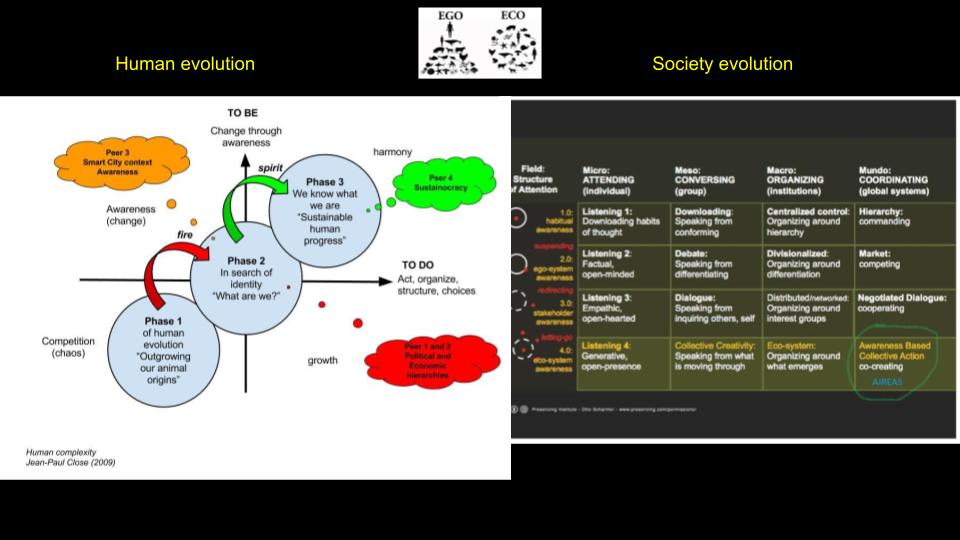
Our societal path from hierarchical self interests to shared responsibility and sustainable progress
 Sustainocracy, the new democracy