Home » Posts tagged 'sustainable progress' (Page 19)
Tag Archives: sustainable progress
What makes a business “sustainocratic?
A sustainocratic business is essentially very different from a traditional type of business of today. The very first thing we notice is the positioning of the company. It recognizes the different paradigms or worldviews that reign the human worlds and places itself consciously in the field of complex human sustainable progress for well being, not financial greed. This positioning shows in its functioning in society. The company is purpose driven, extremely talented and very cooperative in all kinds of multidisciplinary ventures.
The business is very flexible, challenge driven within the scope of sustainable human progress. This requires a visionary leadership culture that goes beyond the board of directors where the results in human progress are leading the company, not financial KPI’s. The structure is dynamically organized allowing people to take their own initiatives, show self leadership and commitment with the end results that the company stands for. People do not work in the company, they contribute to a higher cause and are willing to give more of themselves than strictly asked for. Their personal return is based on business reciprocity. Hardly anyone is on the payroll but everyone is highly committed.
The organization shows organic growth through spontaneous division, local for local added value and multidisciplinary commitment. Not one of the subsidiaries is the same yet the commitment to the kernel of the company’s reason to be is the same for all. Management does not form a hierarchy but a functional facilitating cooperative.
Above all a sustainocratic business is willing to reinvent itself continuously or else risk to die. It takes calculated risks that have no financial impediment because progress is developed together with other parties. The company is run through multidimensional entrepreneurship (MDE) using the 5 keys of 21st century success (the 5K’s) and UNITED as local team builder and guidance. The company produces 4 x profit: profit for its customers, for society, the planet and as a consequence for itself (pyramid business paradigm). Money is a catalyst means that produces purposeful value.
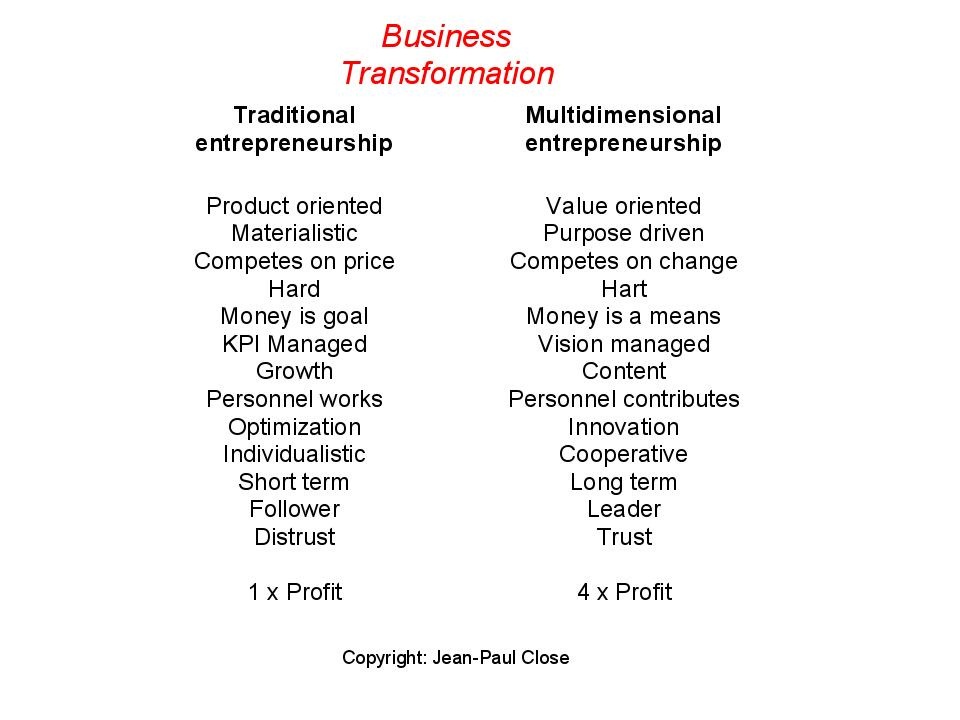
If you work at a company now how do you feel? Do you go to work to fill the pockets of your boss or do you contribute to a higher cause that makes you feel valuable yourself? Can you describe easily what benefits you company brings to the world? In SME type companies you may respond positively but in larger multinationals answers may be complicated. You evaluate for yourself “what responsibility you take?” Do you stick at the job for the salary? Or do you actually feel that you are contributing something by going to work? You always have a choice.
Route of least resistance – law of opposites
In various places of the world there are forthcoming general elections again, so are in the Netherlands. The public media circus has started again in which politicians compete with their lies to see if they can lure people to them. New political parties are not granted access to the commercial media that finds its friends in those who have most to give. New initiatives can’t grow in the darkness below powerful structures and need to wait until they fall over.
Or they find the route of least resistance.
Well-being is located at exactly the opposite side of the human complexity model from chaos. In human evolution societies reach the state of chaos normally due to the inflexibility of a long period of greed. Wellness is something that people tend to want to keep conservatively, creating systems to preserve it against progress. Progress is risky and could put wellness in danger. Greed gradually appears in the systems.

Greed is a brick wall for those who wish to move from chaos to wellness
So when people or institutions find themselves in or near the field of chaos they can do two things:
- Move back against the line of human evolution (clock wise circle) to get to wellness via greed. They would either have to become greedy to fit in (criminality, manipulation, aggression) or try to force their way through the massive opposition of hierarchies, bureaucracy and system rules. (the red line)
- Or choose the rout of least resistance through awareness, trust building, cooperation (the green line) and development of pre-paradigms until one breaks through to replace the old one.
Interestingly in the model the opposition between greed and spiritual awareness is also well visible in reality. The more greed develops in the system the more people oppose through spiritualization, still highly individual but with a gradual built up in the field of awareness. This group is also fed by people who follow the traditional line through chaos and search the enlightenment of conscious reflection when facing the aggression in chaos. They create renewal by proposing true alternatives.
The green line is the route of least resistance but needs the talent of organization and willingness of people to build a new, parallel society. People can group together and use the modern means of social and alternative media to communicate and build up sufficient strength against the organized dominance of greed. In the field of greed competition and self interest is high and deadly. It has the tendency to inflate as a bubble to explode into a crisis with chaos as a result. My people keep up powerful positions managing the old system out of self interest.
In the field of awareness the process is exactly opposite. People become so aware of themselves and society that they need to be challenged to join and become organized around progress. The more greed collapses into chaos, the stronger awareness can organize itself eventually into wellness.
The law of opposites rules here. When people claim in public that they want to go back into recent history because of the wealth of that moment they can try the difficult (impossible) or the easy way (complicated). The way back is the one in which no lessons are learned, no forward reflection takes place. There is a simple anxiety to relive something of the past. The way forward is the one where abundance of the past is learned from in perspective of the scarcity of today. Steps can be taken through awareness to develop a new society based on accumulated knowledge. The route of least resistance is the one of awareness, hence an inner one of reflection, and action based o trust in each other. Sustainable human progress hence has to do with applied knowledge in the warmth of social innovation. It can be applied, not by fighting the system of greed but by avoiding and even neglecting it, positioning your society building outside the dominant structures. If the latter are greedy for money, organize yourself without money.
Use the law of opposites and you will follow the green line without finding resistance.
Sustainocracy – not a choice nor a process
The fact that sustainable progress is not a democratic choice nor a transformative process was a true revelation to me these days. It is an act of taking responsibility. If I take responsibility I can ask others to so too, even institutionally. And if they do not take responsibility I can ask them to justify their reasons and even ask justice to speak out. Wow! Will the near future look like that?
I came to that revelation while wrapping up my new booklet on “the new society” with my conclusions. My model takes a complex issue (a human value s.a. health) in a region and asks business, government, science and the civil community to take responsibility together. Purpose driven, multi-disciplinary ventures appear s.a. AiREAS or STIR (initiatives that I started myself). Today I am still relying on the voluntary choice of an institution to participate despite the value driven purpose.

Taking responsibility together for sustainable progress
“Sustainocracy” defines the new model for society. The word is a fusion between Sustainable Progress and Democracy.
Sustainable Progress is in my view not a democratic choice but an imperative mission of humankind. The imposition on all of us to work together on a healthy, vital and safe human community seems very logical to me. New leadership in this new society is represented by someone who takes the initiative to create new age purpose driven venture based on that moral imposition. Why would a single person take such complex initiative? Because no one else can, not institutionally anyway, because of the way economics works.
My own awareness came when I was challenged to make an instant decision of human value. The safety of my children or my money driven career? There was no middle way. For me it was no choice, I was given no transition time, I had to make up my mind instantly. My decision was to bring my children into safety. What else? Would I at that instant be at ease with myself if I had made the other choice? Once a person is aware the decision is not a choice anymore, nor a process. It become an instant change of mindset, taking responsibility at once. After that moment, the consequences are huge because the process of no return starts when the new responsibilities need to establish and organize themselves in one’s life while letting go the old securities and way of life. But there is no way back. The new mindset was instant, the decision made and the consequences are logical and permanent.
This is key. When someone who is aware and has taken responsibility for sustainable progress and subsequently takes a seat on that line of sustainable progress in my model, starting to invite government, business authorities, scientific institutions and civil individuals to join him and take responsibility too for a complex local issue around human health, vitality or safety, can any such authority decline their participation? On what grounds?
In my own experience so far the institutional excuses have been as varied as:
- Not our main priority
- No people, time or money available
- If you have no budget we are not interested
- Don’t how to contribute
- Not taxable so we cannot support them
- My shareholders won’t let me
It is amazing that in the fragmented, consequence driven, money dependent organizations, the corporate interests have no connection at all to sustainable issues. Else there would be no issue to join the venture, would there? They would be honored, but they are not. Amazing! And even more appalling is the fact that this attitude is considered normal and legally supported. Right now our common focus is on the economies of growth without any interest or even awareness of the consequences of such mentality. Even the genuine invitation of participating with corporate talent and authority in value driven ventures is treated with apprehensive policy choices.
Sustainocracy is dictatorial from a perspective of a common human goal, and democratic in how to achieve it. Democracy by itself is inclined to sum up the self-interest up to a point of self-destruction (Club of Rome warns for this already from the 70s). It is necessary that we accept the greedy nature of humankind but also acknowledge the wisdom that sustainable progress is mandatory, not by human choice but by universal logic. A simple modification in our global systems of justice, defining that all institutional hierarchies should commit to sustainable progress by taking responsibility, could help reform instantly our global wellness expectations. This is of course wishful thinking at this stage, however while precedence with the new model grows the pressure on institutions to take responsibility will grow too.
Important for everyone to know is that sustainable progress can be instantly accepted everywhere in the world. It is now not a political choice anymore, nor a transition process that takes many years. It is a simple moment of instant truth in which we take responsibility or not. This decision is not made through voluntary choice but instant awareness, an act of consciousness that opens up our eyes to universal truth. When this occurs individually the consequences are personal and demanding. But can we expect this responsibility and awareness from our institutions? Yes, of course we can. They are not more than instrumental to human progress. We can demand from them to be constructive and not destructive.
There is not one single reason that would justify the lack of our participation, individually or institutionally, in human health, vitality and security improving missions defined by sustainable progress. It is up to ourselves to open up our eyes, take responsibility and expect others to do so too.
 Sustainocracy, the new democracy