Home » Posts tagged 'transformation' (Page 19)
Tag Archives: transformation
STIR Lustrum 1 – re-positioning society
First of 3 lustrum blogs….
Re-positioning society
On June 25th 2009 the STIR Foundation, or “City of Tomorrow” (as it was rapidly called by people) was announced and initiated. Now we celebrate already 5 years of activities that re-position the way we build society. In three blogs I will explain what happened, what we have accomplished and what I expect next.
How it started
The foundation was set up by me to do whatever I could to pass onto my children a society that protects real human values and sustainable human progress rather than money and destructive systems of power.
Things had happened in my personal life that had made me powerfully aware of the intense need to transform our civilization or accept our self destruction. But awareness is not enough to change the working of a complex society. On the day of the kick off I had managed to surround myself with a very first group of intellectuals and professionals that were either interested in finding ways to address sustainable progress or solve the financial crisis, especially their own. 55 persons came to the kick off congress.
Together we started experimenting with our idealism by creating groups that addressed issues that we wanted to pay attention to. There were groups to address energy, mobility, coaching, new way of working, city design, housing, value system, food productivity, education, health care, leadership, etc.
My book (in Dutch) “Secretes of true wellness” had introduced my own first basic views of our human evolutionary complexity. This I used to guide the group’s processes together with the 5 keys of entrepreneurial success that I had published in 2005. Both models and insights have been perfected ever since.

In 2009 we position ourselves in the area of chaos in the midst of the effects of the 2008 credit crisis. Willingness was high to address key issues but the culture and mentality within the groups was still very much money driven. People were in a survival mode and saw in STIR a possibility to access new entrepreneurial markets. Whenever a market had been defined the cooperation disappeared and self interest started to prevail again in foresight of profits or subsidies. This did not work.
STIR organized monthly congresses on a variety of topics that helped us further in expanding our views while trying to find support and commitment from others. The regular work group encounters helped us understand better the complexity of the challenges, especially that of our own individual money dependencies and behavior, but we did not get changes initiated.
After 8 months all work groups had been dissolved, over 20.000 volunteer hours had been spend but the spirit of change had disappeared due to lack of results and overdose of struggles. I decided to take responsibility myself to materialize my views and realized that I could not proceed through the traditional entrepreneurial way. My own criticism to the groups was that they had all been money driven, not focused on change or value creation. I had to adjust my views that entrepreneurship was the sole engine for change. It may still be but not the type that placed money first. That kind of entrepreneurship was manipulated by money dependencies and hence would never change society. I wanted transformative change to lead and this cannot be done by considering it first “a market” or “a product”. Re-positioning society is more complex than that.
The idealistic views showed the need to involve also people from government. Experimenting with this multidisciplinary approach I could make valuable steps forward towards defining what we now call “Sustainocracy” and the “transformation economy“. Having clarified this in my own mind it became important to make it work in practical reality.
Breakthrough
In February 2010 I was invited to speak at a world encounter via internet in Amsterdam. My speech was about the difficulties to get government into sustainability projects of change initiated by citizens. University of Madrid was presenting a project on air quality measurements with 3D presentations of the results. Cisco presented a trial done around the effects of working at home on the emission of CO2. Both projects were ending. For me however it was a mental breakthrough. Summing up my own activities with those of Madrid and Cisco got me to a holistic vision and approach. It was not the fragmented approach that makes the difference but addressing “the whole” would do it.
Air quality as a point of reference for regional health development became my goal to which I could attach all kinds of transformative issues too. I presented the idea to a group of people and finally also to the political director of our province. He remarked that if we wanted to address such complex issues we would have to work through the quadruple helix (government, business, citizens and science). It became clear that none of those four pillars could take the initiative “in the old world” because of their fragmented interrelation based on money and systems of control. A true co-creation would have to be initiated by an independent person, and that had to be me. I had be the connecting pioneer. The working format became clear.

I placed myself on the green dot and invited the rest to participate
In 2011 AiREAS was registered as a multidisciplinary cooperative, initiated by me and a well chosen partner (Marco van Lochem) who added an extensive network in high tech business. The quadruple helix model was enhanced in AIREAS to become the first Sustainocratic venture in the world. Rapidly scientific and business partners joined in the free of charge commitment through membership. My formula of co-creation became effective:
Talent x Input x Purpose = Value x Reciprocity
Our mission became to co-create a healthy city using air quality and human health as guiding measurement. We got the commitment and support from local Eindhoven government with a very first co-creative assignment: “making the invisible (air quality) visible”. The practical re-positioning of society had started. The precedent was initiated.
The values created so far (2014) by AiREAS are:
- We have positioned and proven the co-creative working of Sustainocratic ventures
- We co-created and implemented the intelligent real time measurement network technology with scientific guidance.
- We learned how co-creation works in a multidisciplinary context with a higher humanitarian purpose
- We defined the basic fundamentals of the “transformation economy” by creating unique complex values first and subsequently expand those values world wide.
AiREAS has also shown how difficult and contrasting the two worlds are (leadership in value driven co-creation, and management through fragmented self interests that interact through transactions) and how complex it is for them to interact. The recent blog about the small window of co-creation between these two worlds (motivated by chaos) was a direct result.
AiREAS has various path ahead. Future will tell what we can achieve:
- Create Local AiREAS across the world to co-create “healthy cities” using Local AiREAS Eindhoven as example and precedence,
- Expand the AiREAS values (products and services) through its partners in the traditional economy of transactions
- Get the reciprocal circular economy going
- Develop more unique values (knowledge, products, policies, justice, etc) in all the Local AiREAS using the demographic, cultural and historical differences
- Use the experiences in AiREAS to address also other key humanitarian issues within the STIR definition of sustainable human progress

Taking responsibility together for sustainable progress such as AiREAS
The repositioning had finished. We now know how we can peacefully address the complex global issues. Establishing local sustainocratic ventures there were the issues need attention we can deal with all complex problems, not just air quality. With the precedent readily available we can offer Sustainocracy to the world, education people and institutions to take local responsibility together and benefit from the transformation in multiple ways.

Most of the world is active on the financial side avoiding transformation until it is too late.
Lifelong education, sustainable human progress, conciousness and applied sustainable leadership
One of my ambitions is to create a world wide knowledge sharing and consciousness building network for measurable sustainable human progress and the development of individual sustainable leadership.
Now I am ready to set it up.
It is called STIR. Officially it is still the Foundation called Sustainocracy, Transformation, Indexation, Research. In practice it is a learning cooperative between people who want to experiment with their own life, authority and daily responsibility for sustainable development of themselves, their families and their local community.
Top intellectuals
I already have a large personal network of excellent lecturers and intellectuals connected to me via a large diversity of specialisms. My own sustainocratic work gives us plenty of things to do together and a motivation to stick together. This shows me that again that knowledge is only of mutual interest when it can be used in real life. That is where new knowledge develops too to enhance progress even further.
I work with the professors directly not with their institutions. Professors are human with human motivations. Universities are not.
That does not mean that we do not work with the institutions. On the contrary. But we use them for what they represent from a specialised research perspective and detailed specialised education on scientific topics. In STIR we translate this deep knowledge in true sustainable human progress which is a different learning process all together. That is why professors like to work with STIR because it brings their specialism into contact with the tremendous diversity of real life. It is hence a reciprocal process in which the educators learn as well.
STIR invites top lecturers, professors, visionary people, scientific researchers and exemplary pioneers to select or create their own best minors (a short block of lectures and practical exercises that last about 6 month) to be shared with us on and offline. A minor remains in STIR as long as there is sufficient (Global) demand for it.
I expect to be able to offer 100’s of minors for you to choose from. But following a training is not enough. That is not the purpose of STIR. The real purpose is to apply knowledge for local sustainable human progress and make change happen through your commitment. In STIR we also work with Sustainocratic cooperations for the extremely complex issues. When they develop in your area we can budget the STIR education and make it available free of charge.
The only stable factor in life is change.
STIR grows through fractal patterns. We started in Eindhoven and invite anyone to become member free of charge. With enough members in a region we set up a local off line community, otherwise we provide tutorials online.
STIR mission: to contribute to sustainable human progress globally (Global issues, local solutions, global application ).
STIR focus: develop the consciousness and sustainable leadership.
STIR method: lifelong learning by purpose driven experimentation, open reflection and knowledge sharing.
STIR levels: the 5 levels of consciousness, individually and as a community.
STIR infrastructure: Online (Global) and Offline (Local).
We do not tell you how you should live your life, we just help you understand.
Membership fee: free of charge but not free of commitment (you commit to sustainable human progress)
Lifelong learning fee: 1% of published average local yearly wages, per person per year. Or free of charge when within local sustainocratic cooperation.
Education: You choose your own education out of all available minors. The more members the more educators.
The first year (2014) will be free of charge also for the learning fee as we build up the network.
Sign up through the website. I will soon publish the first set of online minors (short intensive training of several weeks).
Also sign up if you have a minor to offer. It is a cooperation so feel free to contribute with ideas and initiative. STIR is not just me but all that sign up for the higher good of sustainable development of humankind.
Why we need money to show that we don’t need it
Sales tradition
We experience in our daily business life a money driven culture. We just tend to want to sell each other our products and services. So when I invite people to join a Sustainocratic cooperation they tend to ask two things to judge their opportunity: “Do you have a budget? What is your need?”. When I say that I have no budget nor direct need they often regard me as a waste of time.
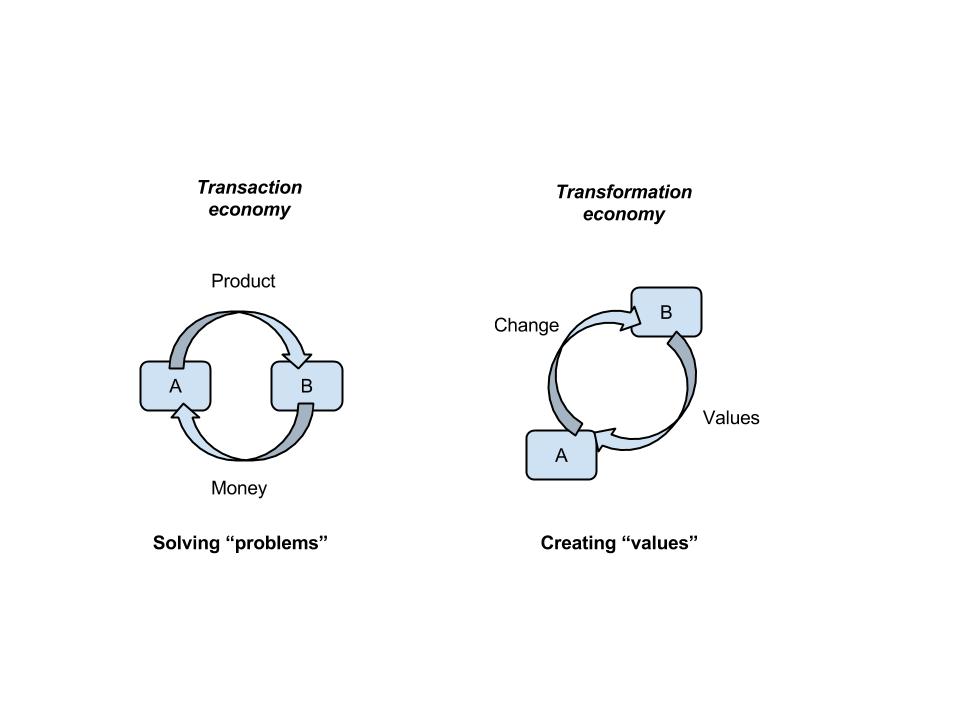
Two type of economy
Sustainocratic cooperative
This is a venture that takes responsibility for co-creation of something of true human value. One example is AiREAS that co-creates a “health city with healthy air”. AiREAS is entirely in the Transformation Economy but works with partners that excel in the Transaction Economy. Involved are all instruments that shape a human society: government, business, education, population.
We start with the higher purpose (healthy city) and work our way back to what we would like to modify today (priority). We start with an empty table and a powerful reason to be together. What the motivation us of the ones present is up to each of the partners. Their contradictions are usually their combined strengths. Together we define one or more projects and allocate resources. This is not just money. Also technology, manpower, knowledge, etc is allocated. Stip-step we call the process. It is focused on change.
Two economies, two different way to work
The transaction economy is focused on growth. Growth is a management issue and success is determined by rational wit, efficiency and control. Sales in a transaction environment is based on “solving problems”.
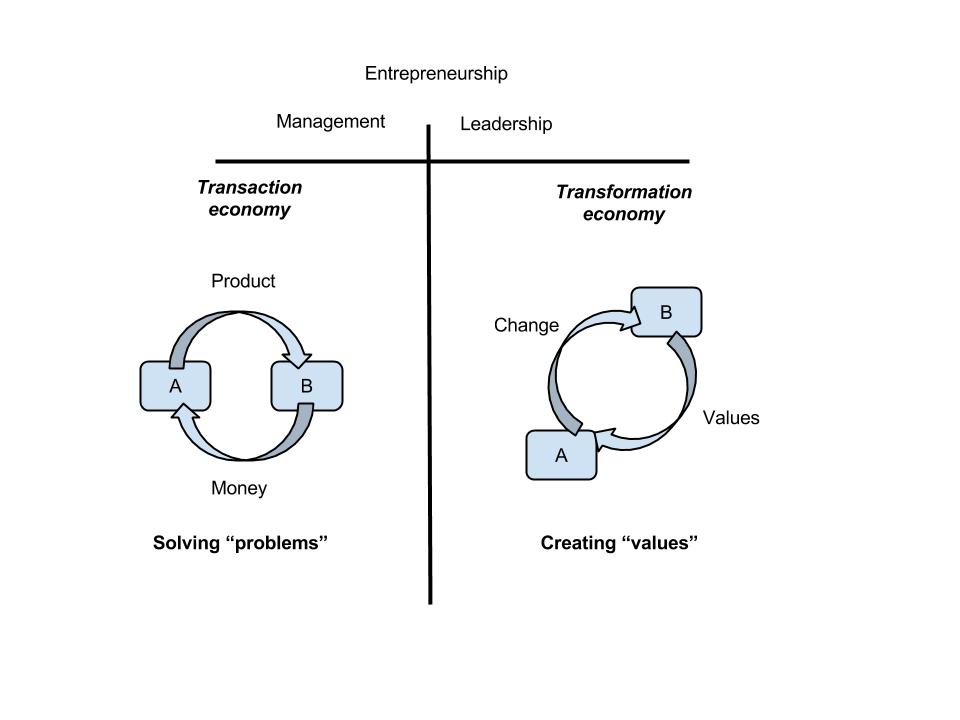
Management versus leadership
Change requires vision, guts and passion to go from one situation to a better one. Change is an investment around a responsibility of values that can be created. Transformation deals with an opportunity, not a problem.
Money needed, no money needed
In a transaction environment money is always needed to exchange for problem solving valuables. In a transformation environment no money is needed because there is no exchange of values, values are created. This requires talents and authority.
The two worlds need each other
Changes produces values that can be enlarged through sales within the growth environment of the world of transactions. The transactions world needs continuous renewal from the transformation world to avoid its saturation. We see in business (also in government) the tendency of unbalancing leadership and management. Management has the tendency of using a situation as unlimited cash cow. Leadership always wants the excitement of risk and change. Together they balance out very well but need totally different personalities to deal with the situation.
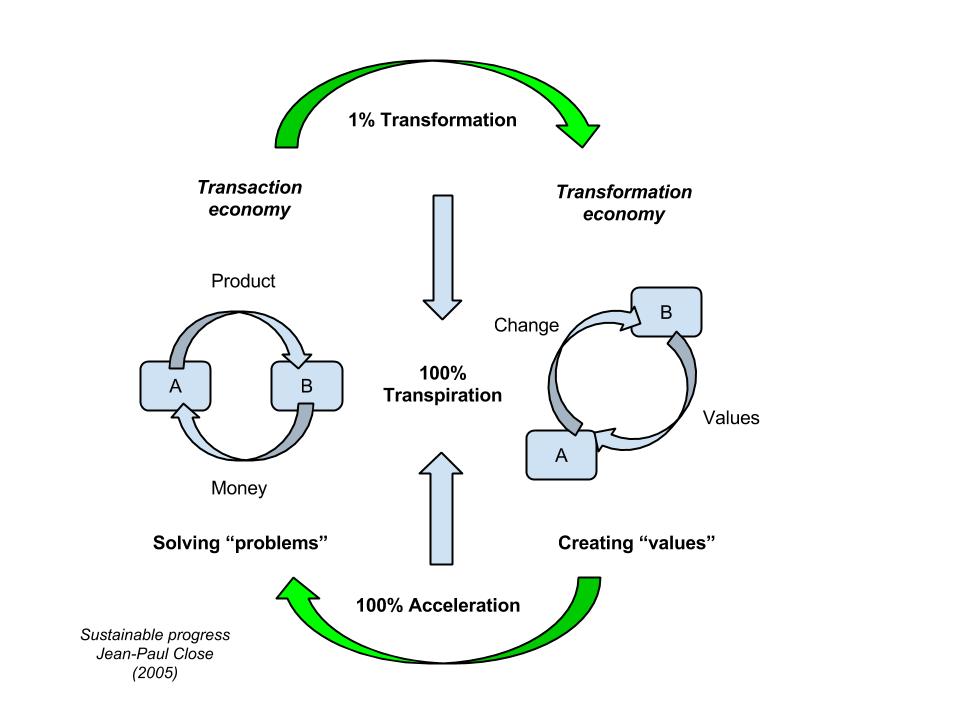
Two complementing worlds
When change is avoided
There are many situations when change is avoided. This is the case with national economies and their current tax infrastructures, or banks with their outstanding long term investments. Change will challenge their outstanding commitment and introduce risks. Many governments and banks cannot address change even if they wanted to. When hierarchies are built around growth, change is out of the question, even if it promises a new path for growth. Management people in power are more worried about what they can loose than what they can win.
Things change when a society is in long term crisis. When the old instruments do not work anymore new ones need to be tested and allowed. So when I introduced Sustainocracy as an engine of Transformative Change, it was dealt with as if it were Transactional. I invited people in business, government and science and they asked me how much they could grow in money making? Many even did not want to come aboard the venture if there was no money put upfront.
Transformation fund
AiREAS started with nothing more than a higher purpose and lots of passion and vision. Now we establish a transformation fund that is used for only one thing: to provide a sense of peace of mind to the transaction driven participants. They need to know that money is there for payment even through the fund is not touched. When values have been created in the AiREAS processes they are so unique and valuable to the rest of the world that each of the partners gets a fair share of wealth back. We even fill up the transformation fund with royalties before we need to pay out our participating partners. We show them that to create value we need no money, just confidence in our selves and a good reason to work together.
Money is a proof of valuable change used by those who follow leadership through effective problem solving management. In the STIR Foundation we opened now a transformation fund just to be able to increase our ambitions in the field of societal change for sustainable human progress. The higher the fund the more value we can create and the less funding we really need. Weird but just part of the time we live in.
Information? Just contact me: jp@stadvanmorgen.com
 Sustainocracy, the new democracy