Home » Posts tagged 'transformation' (Page 3)
Tag Archives: transformation

If we want to live in a healthy environment we will have to organize ourselves in a healthy way…
In the picture below we see the many parties that are currently involved in the AiREAS challenge and the commitment to achieve a healthy, unpolluted living environment. We call the circles the 4 legs at the table of the local society. These are drawn as “overlapping islands” where we all converge into the center for the overarching commitment. But a large part of the islands also lie outside that center which is referred to as the AiREAS context.

When we look at the drawing, the different areas of overlap speak their story. I have written a characterizing text in it to form an image. Where we adapt our behavior to each other in the center and make choices together that directly contribute to the quality of our living environment and our health, other interests often play a role or even prevail further away from the center. In the fragmented, money driven society where we come from, that AiREAS center did not exist. There, the islands interacted on the basis of financial dependencies, objectives and regulations.
All reports show how important it is for everyone to do this together. This approach is also praised at the administrative level (such as aldermen, deputies, boards, etc.). Only that field of tension emerges again and again between “taking responsibility together” and the way in which the islands themselves work with the varied mixture of old interests and new wishes. If you find it difficult as a person or as an institution, then defining a common project is even more difficult. We are so used to reasoning from within our own island and self-interest with critically pointing to the other islands, that we often conveniently omit ourselves and our own requirements to change.
The various authorities are trying to bring all sorts of things into the center. One has come up with a product that it would like to sell or try out from within the AiREAS 4 x WIN context. The other has books full of knowledge from research or expertise to share. The governments have pooled money to make “the invisible visible” through measuring instruments (air pollution, noise) in the hope that through awareness raising citizens and companies will participate and take responsibility. Ultimately, it is about our health that we can directly influence through our behavior.
The center area of AiREAS is growing. Nowadays there are also institutions and people who reside permanently in that center. They have grown with the value-driven commitment and have linked or derived their behavior and authenticity from it.
There we find citizens who no longer have a car, do everything by bicycle, public transport or partial transport, who buy locally, live together and share costs. They have often made it their business to help others achieve better health, more self-confident and cooperative living. We find companies that pursue the 4 x WIN principle in the field of cooperation with nature, food supply, water, energy saving, local basic facilities, care for and with others, etc. New school systems and collaborations are emerging that involve as many children and young people as possible in their awareness of nature, their self-awareness and acquaintance with the essential values of our existence, often in collaboration with the STIR Foundation and Sustainocracy. Certain departments of the local government can be found here. They still clash internally with other departments that do not show the same commitment or have learned to function based on different interests and priorities.
In the drawing we see the gradual transition that we go through together in an evolutionary way. When the STIR Foundation started experimenting with Sustainocracy in 2009, we only saw a few freelancers trying to survive by developing new ideas in their island of interests, inspired by the ideas of the healthy City of Tomorrow. In 2011 AiREAS was born. The intended collaboration between the 4 legs (government, entrepreneurs, education and citizens) soon came to life thanks to an initial financial support from the Province of North Brabant. There was no real overlap between the islands yet, but the foundation had been laid to make that a reality.
Now, in 2023, AiREAS as a functional shared responsibility and context can no longer be ignored. The format and challenge are greatly appreciated by all participants. “It's about something real” is often said and people are willing to step into the field of tension within their own organization to make the best of it. Two islands prove very slow in response and connection. These are the somewhat larger companies that originated in the old 1 x WIN context and linger there with their lobbies and financial tunnel vision, often supported by old legislation. These have shareholders and interests that are only compatible with the higher purpose of AiREAS if the organization goes through a fundamental transition.

And then there are “the citizens” who have made unhealthy behavior their comfort. Behavioral modification requires more than awareness. It requires a cultural adjustment in which health and safety is leading for everyone even though people tend to find it abstract if not confronted with illnesses. Many young people do recognize themselves in this new mindset, but older generations are "programmed" differently with their lifestyles. They find it difficult to let go of their established comforts (such as the car, status, purchasing behavior, etc.).
Anyway, the center of AiREAS is growing. It is heart-connected, warm, co-creative and innovative, full of people, functions, commitments and ideals. It is growing steadily. It is an example for other targeted local communities and essential values such as FRE2SH (food resilience), COS3i (social inclusion) and others that are emerging. Also internationally clusters based on Sustainocratic insights are emerging and can be helped on their we with the expertise accumulated in STIR, stepping up their potential with a positive learning curve without having to go through all the pitfalls.

Spirituality and Business
Prof. Dr. Sharda Nandram reflects about this during the Nyenrode University “radical thinkers” event. You can watch and listen to her arguments here.
It is of course admirable that a Business University takes a stand away from the traditional bottom line business philosophy that we tend to call “1 x WIN, 3 x LOSS” referring to the negative impact on society, the human being and our environment, purely out of financial win motivation. When I myself occupied general management positions in big multinational I had been drawn into that same tunnel vision and related competitive complexity. Only after leaving such a position I started to develop my own awareness resulting in the 4 x WIN entrepreneurial ideology of the 21st century. That is how I got to intellectually and spiritually interact intensely with the predecessor and mentor of Nandram, Prof. Dr. Paul de Blot. It was in that occasion that I briefly met Ms Sharda as highly valued disciple of Paul in Nyenrode.
In my quest to develop a societal evolutionary path it became key to simplify the process, despite the complexity of the engagement and transformational consequences. It is not so much radical thinking but more the acceptance of a shared collective social, humanitarian and ecological responsibility. The five essential values for our sustainable human existence, as defined in Sustainocracy, also reflect the “To Be” spirituality, the meaningfulness, of a new era for institutions and institutional positioning. This “To Be” is not only relevant for the business environment but also for government institutions, scientific and educational organizations and even us as citizens in a new world of shared responsibilities. This “To Be” then determines the “To Do” impact and action driven reality of these institutions. It would fill in the K2 and K3 referred to in the speech as “unknown” and “belief” into belief in one’s authenticity as institution and its positive contributions to our harmonic and symbiotic relationship with our selves and our natural environment.
Our spiritual (non religious) evolution from “conscious competition and survival” to “conscious living in harmony”
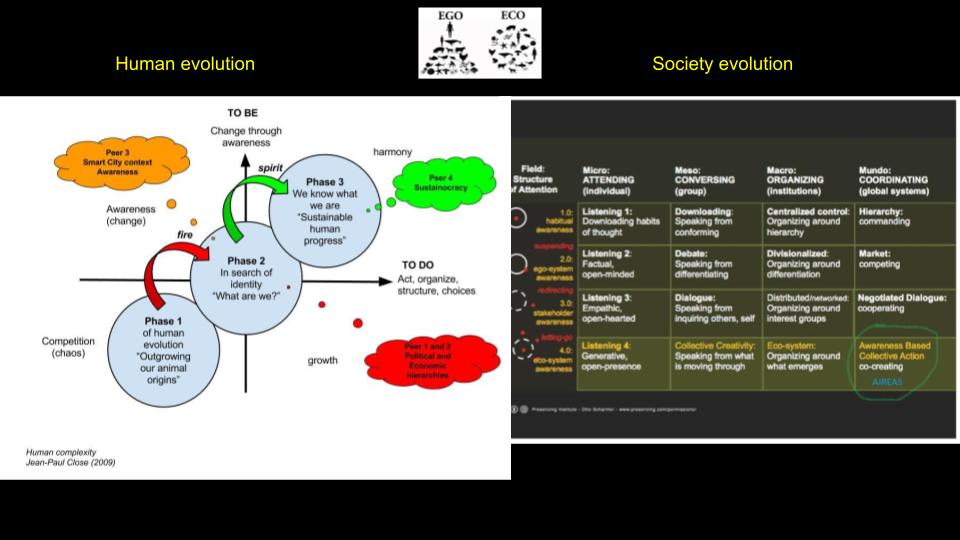
Our societal path from hierarchical self interests to shared responsibility and sustainable progress

One world, one people, one commitment
Gradually the evolutionary puzzle pieces start falling together.
- People start becoming aware that the artificial hierarchies of power and financial interests do not serve our sustainable existence anymore. They are willing to engage into new action driven commitments to sustainable and shared progress.
- Self aware institutions become aware of their 1 x WIN vulnerability and develop into authentic 4 x WIN societal partners.
- Gradually the essential values expressed in Sustainocracy are developing as an ethical and moral guidance of cooperation between people and institutions.
- Technology allows us to build a global society based on equality, servant institutions, shared responsibilities and values in real time.

 Sustainocracy, the new democracy