Home » 2013 (Page 7)
Yearly Archives: 2013
Choosing your own blindfold
Today I received a short story of the Belgium system critic Werner van Ginneken (in Dutch). He defined the Sustainocrat as someone who is the same as everyone else but at the other side of “the wall”. This drawing summarizes his story.
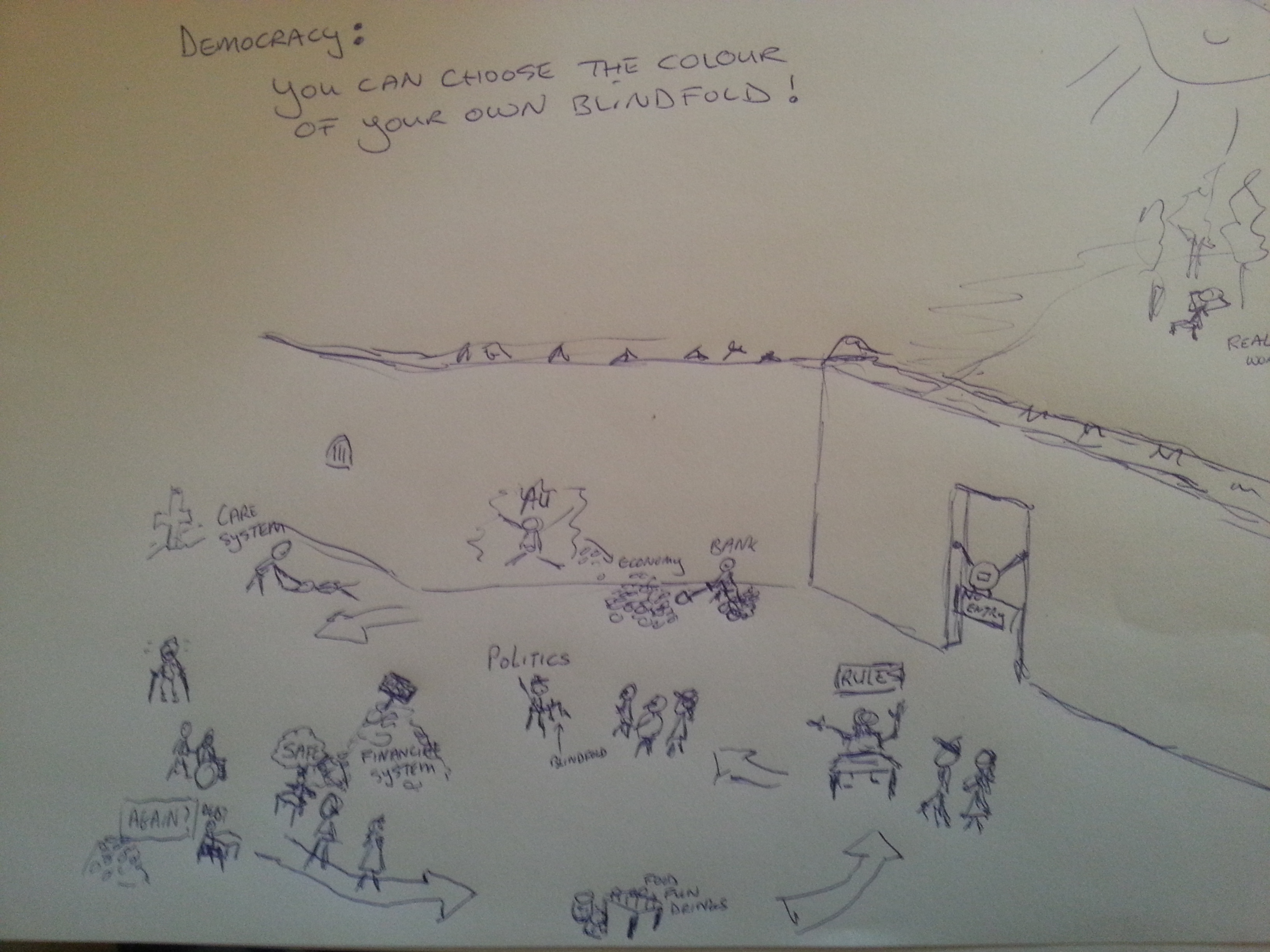
Which blindfold do you choose?
It is funny to see that it clarifies the current democratic structure of political parties that all defend the same financial system of consumer debt and dependencies by offering the population their own colored blindfold before letting them crash and try again after some care taking.
When I showed the picture to Werner he referred to another drawing that he had loved. I tried to find it but could not. It shows a river with someone walking at one side while seeing someone else at the other side in an apparent state of great happiness. “How do I get to the other side?” the person calls out to the happy one. “You are already there!” was the response.
Clue
We tend to create our own obstacles by accepting and supporting the irrational of systems or looking at the happiness of others rather than our own. Freedom from blindfolds is not yet a Sustainocrat but a good basis to become one.
Why we need money to show that we don’t need it
Sales tradition
We experience in our daily business life a money driven culture. We just tend to want to sell each other our products and services. So when I invite people to join a Sustainocratic cooperation they tend to ask two things to judge their opportunity: “Do you have a budget? What is your need?”. When I say that I have no budget nor direct need they often regard me as a waste of time.
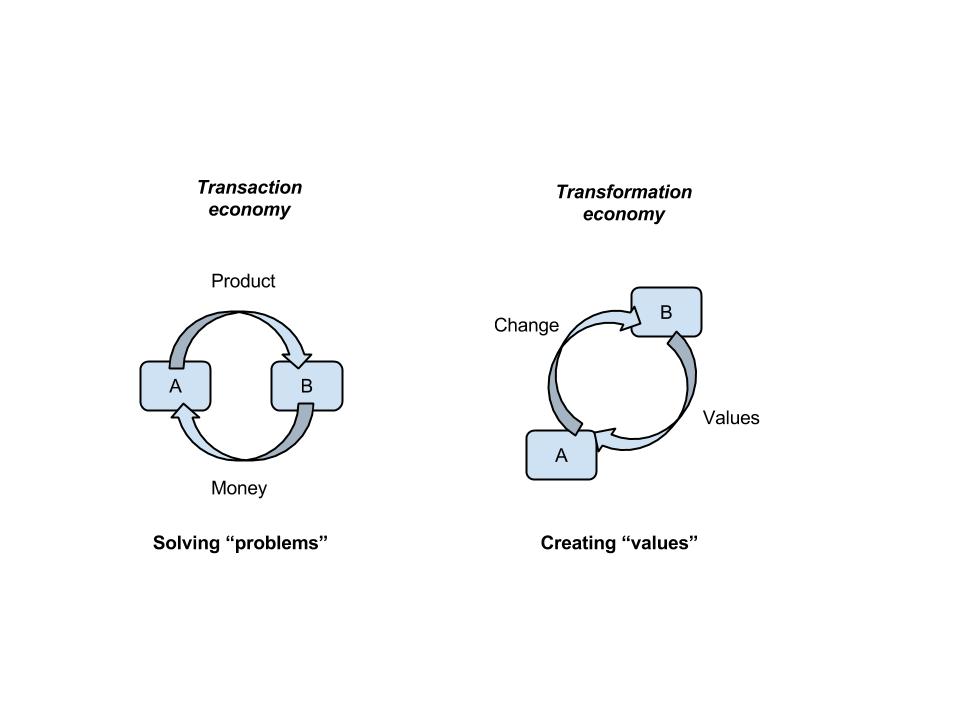
Two type of economy
Sustainocratic cooperative
This is a venture that takes responsibility for co-creation of something of true human value. One example is AiREAS that co-creates a “health city with healthy air”. AiREAS is entirely in the Transformation Economy but works with partners that excel in the Transaction Economy. Involved are all instruments that shape a human society: government, business, education, population.
We start with the higher purpose (healthy city) and work our way back to what we would like to modify today (priority). We start with an empty table and a powerful reason to be together. What the motivation us of the ones present is up to each of the partners. Their contradictions are usually their combined strengths. Together we define one or more projects and allocate resources. This is not just money. Also technology, manpower, knowledge, etc is allocated. Stip-step we call the process. It is focused on change.
Two economies, two different way to work
The transaction economy is focused on growth. Growth is a management issue and success is determined by rational wit, efficiency and control. Sales in a transaction environment is based on “solving problems”.
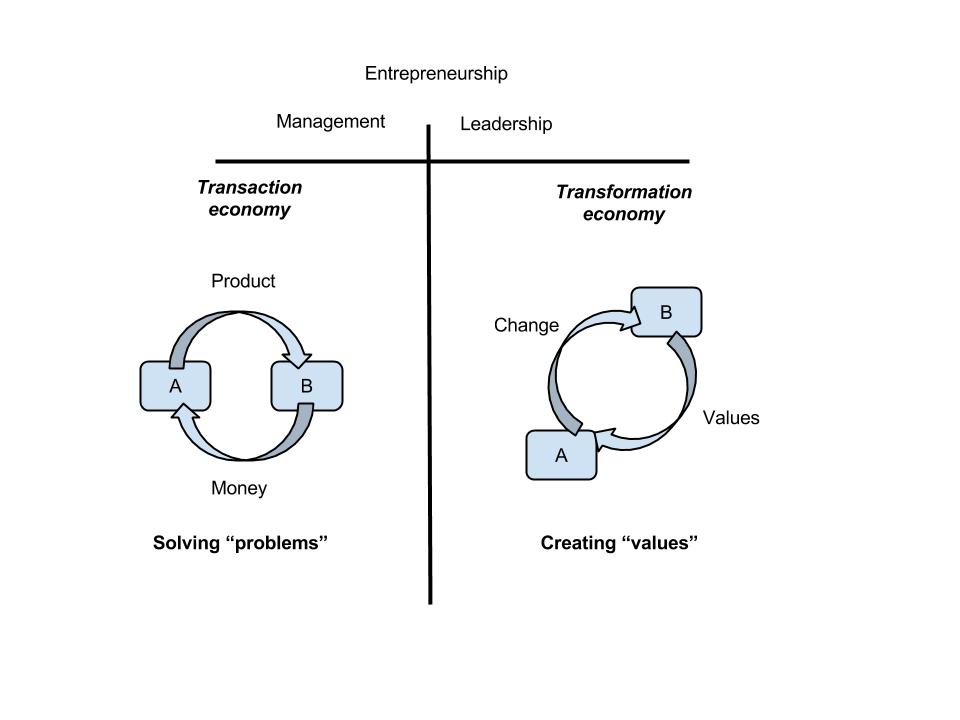
Management versus leadership
Change requires vision, guts and passion to go from one situation to a better one. Change is an investment around a responsibility of values that can be created. Transformation deals with an opportunity, not a problem.
Money needed, no money needed
In a transaction environment money is always needed to exchange for problem solving valuables. In a transformation environment no money is needed because there is no exchange of values, values are created. This requires talents and authority.
The two worlds need each other
Changes produces values that can be enlarged through sales within the growth environment of the world of transactions. The transactions world needs continuous renewal from the transformation world to avoid its saturation. We see in business (also in government) the tendency of unbalancing leadership and management. Management has the tendency of using a situation as unlimited cash cow. Leadership always wants the excitement of risk and change. Together they balance out very well but need totally different personalities to deal with the situation.
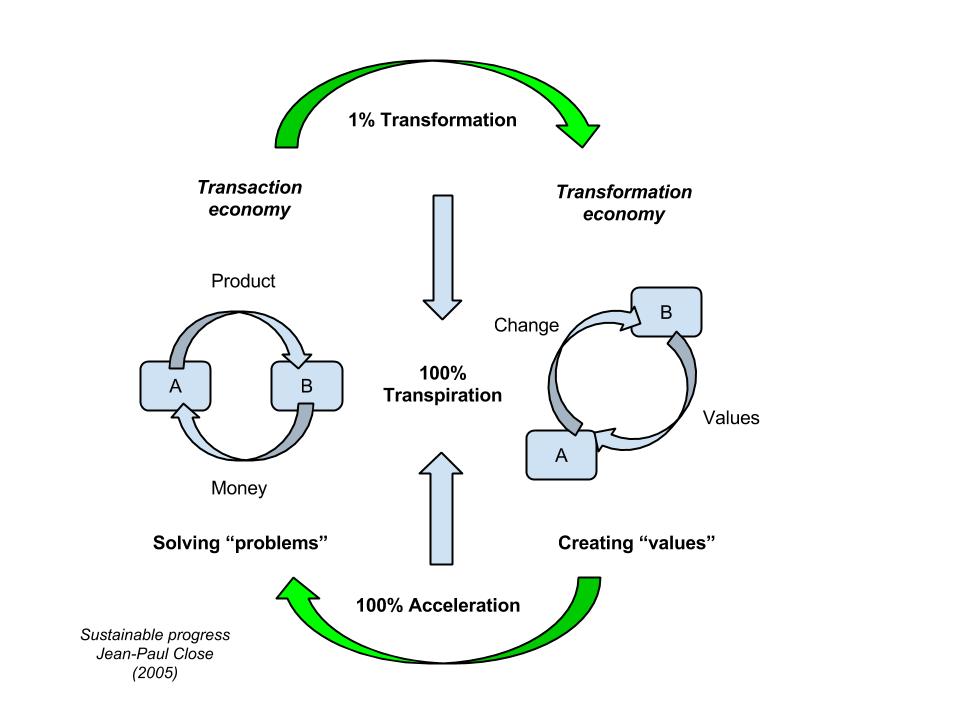
Two complementing worlds
When change is avoided
There are many situations when change is avoided. This is the case with national economies and their current tax infrastructures, or banks with their outstanding long term investments. Change will challenge their outstanding commitment and introduce risks. Many governments and banks cannot address change even if they wanted to. When hierarchies are built around growth, change is out of the question, even if it promises a new path for growth. Management people in power are more worried about what they can loose than what they can win.
Things change when a society is in long term crisis. When the old instruments do not work anymore new ones need to be tested and allowed. So when I introduced Sustainocracy as an engine of Transformative Change, it was dealt with as if it were Transactional. I invited people in business, government and science and they asked me how much they could grow in money making? Many even did not want to come aboard the venture if there was no money put upfront.
Transformation fund
AiREAS started with nothing more than a higher purpose and lots of passion and vision. Now we establish a transformation fund that is used for only one thing: to provide a sense of peace of mind to the transaction driven participants. They need to know that money is there for payment even through the fund is not touched. When values have been created in the AiREAS processes they are so unique and valuable to the rest of the world that each of the partners gets a fair share of wealth back. We even fill up the transformation fund with royalties before we need to pay out our participating partners. We show them that to create value we need no money, just confidence in our selves and a good reason to work together.
Money is a proof of valuable change used by those who follow leadership through effective problem solving management. In the STIR Foundation we opened now a transformation fund just to be able to increase our ambitions in the field of societal change for sustainable human progress. The higher the fund the more value we can create and the less funding we really need. Weird but just part of the time we live in.
Information? Just contact me: jp@stadvanmorgen.com
Happiness, what’s that?
The October open public evening lecture of the STIR Academy dealt with “happiness”. Why is happiness so important to us? What is it? How can we produce it?
Happiness
Happiness is key for progress. It represents an inner feeling that is hard to describe in words. The sensation can occur at any time and even under the strangest circumstances. It feels like a sort of joy yet it is more than that. In reality happiness is produced by endorphin’s, a set of hormones that are released by the brain under certain circumstances. It helps to develop our self esteem to address the challenges of life. In fact, happiness is an evolutionary development right from our single cell origins of life, and even further back: the very first harmonic connection between molecules to produce life.
One of the previous STIR lectures dealt with the “secretes of life” and the harmonic musical relationship between elements that are attracted to each other under extremely specific circumstances. They do not fuse or react but combine harmonically into something called “life”. This unique format of interconnection produces a standard frequency to which certain elements are attracted. In fact this molecular “musicality” of attraction is what triggers the endorphin in our body. It defines “purpose” on the unconscious levels, which we then try to figure out at the level of consciousness. Since we are blessed with self reflection we interpret the injection as pleasant which helps us learn and understand our progress in a pleasant way.
Happiness is hence produced by interaction of our senses with our molecular musical origins. That is why we can react with happiness when seeing certain colors, smelling certain smells or hear a certain sound. We can experience this happiness over and over again when we recall this trigger in our memory. There are various large fields of activity that make us happy and each field has to do with our living organic essentials:
- Food
Eating itself makes us feel happy. It is not just the mere consumption but also the activity of achieving food, preparing it and the satisfaction of eating and having eaten. Food is also a team exercise of the human being that makes us challenge each other in competition and join forces in productivity and consumption. In many cultures eating together is a daily ritual of happiness.
- Reproduction
The selection process of finding a mating partner, sexual activities, having children and raising them is a process of continuous joy and happiness. The inner excitement, the courtship, the surrendering, the development of a family and experiences of trust and togetherness, are key happiness values that push us towards reproduction in a positive way despite the worries, reduced levels of personal freedom and commitment to a single partner. We find harmony inside and outside through contrasts and excitement.

The voyage through life produces happiness
- Accomplishment
The voyage of life is full of obstacles. The experience of happiness is produced at the excitement of a prospect to do something, even if the adventure only takes place in our minds. The living fact of undertaking action through the expectation of certain results makes us feel happy throughout the entire process: the prospect, the trajectory, the achievement and the permanent memory.
Happiness is a true engine in life that makes us overcome fear, worries and insecurity. The positive tends to win from the negative, producing a forward sense of progression and even accept defeat through the happiness of having tried. Succeeding in complex challenges is taking the best out of people.
Music, accomplishment, teamwork
- Environment
Our natural environment is part of our physical and spiritual nature and origins. We are a living combination of everything that surrounds us. We are earth, wind, water and fire, combined through senses. We take a special joy in experiencing our roots through observation and interaction. We enjoy the colors, smells, feeling, tastes etc of nature. It provokes our instincts to express ourselves through art, movement, dance and music. Our happiness makes us create communities and cultures that are as diverse as nature itself.

Colors and natural harmony produces feelings of happiness
When we summarize happiness we come to a large set of key words that are all part of our continuous quest for harmony by addressing the challenges of life in a pleasant way. We enjoy every step forward, every achievement and cherish every positive memory. There is absolutely no reason why a normal healthy person should not be happy every moment of the day, learn to become aware of it and take joy in living life through managing it even in the most adverse conditions.
Happiness overcomes crises
Our economic world is in crisis. We see ourselves surrounded by the effects of a transaction based society focused on consumption and debt. Broken up families, individualism, loneliness, manipulation around debt, etc have become the unhappy rule of a lifestyle in which happiness was based on creating differences, the having and taking, selfishness. We see cities full of people who don’t know each other. The natural harmony has been severely broken up and people do not even know it anymore. Sense of happiness is sought in artificial tools for excitement such as over-consumption, alcohol, drugs and attractions parks. The more financial wealth the less happy people tend to get. The larger the debts the bigger the unhappiness. In our natural essence debt does not even exist. It is an unnatural inhibitor of happiness. Our societies are based now entirely on financial dependence eliminating natural inner happiness by placing fake happiness triggers around us as consumables. It makes people blunt, unaware and often even emotionally sick.
When however a financial crisis strikes the human being discovers again its natural origins and starts taking joy in the warmth of the community and the challenge of addressing life through creativity and purpose. It is happiness that solves the crises not capital injections, rules or debt systems. Despite all negative communication through the media about financial disasters we see large groups of people discover happiness and develop communities based on the values of joy and happiness rather than materialism. Happiness is produced by the voyage through life, the sharing and giving, the positive and our sense of progression. Indeed money does not make anyone happy. It may produce some sense of security in a money driven society but true happiness is found inside, right at the molecular basis of our being that arose billions of years ago when money, systems and societies had not yet even been invented. Happiness is the oldest feeling ever of the evolution of species and comes even well before fear.
STIR Academy
The academy invites people to a world of human health, safety and self sufficiency. The awareness of our feelings and the origins and purpose of our senses, including happiness, is key to produce sustainable human progress. Through emotional, spiritual, rational and physical interaction, research and awareness programs people

A sense of freedom is key to experience happiness to the full.
are invited to let go of their systems dependence and reconnect by taking responsibility of their own. People who break through in higher self awareness become active in sustainocratic ventures where sustainable human progress is the same as personal wealth.
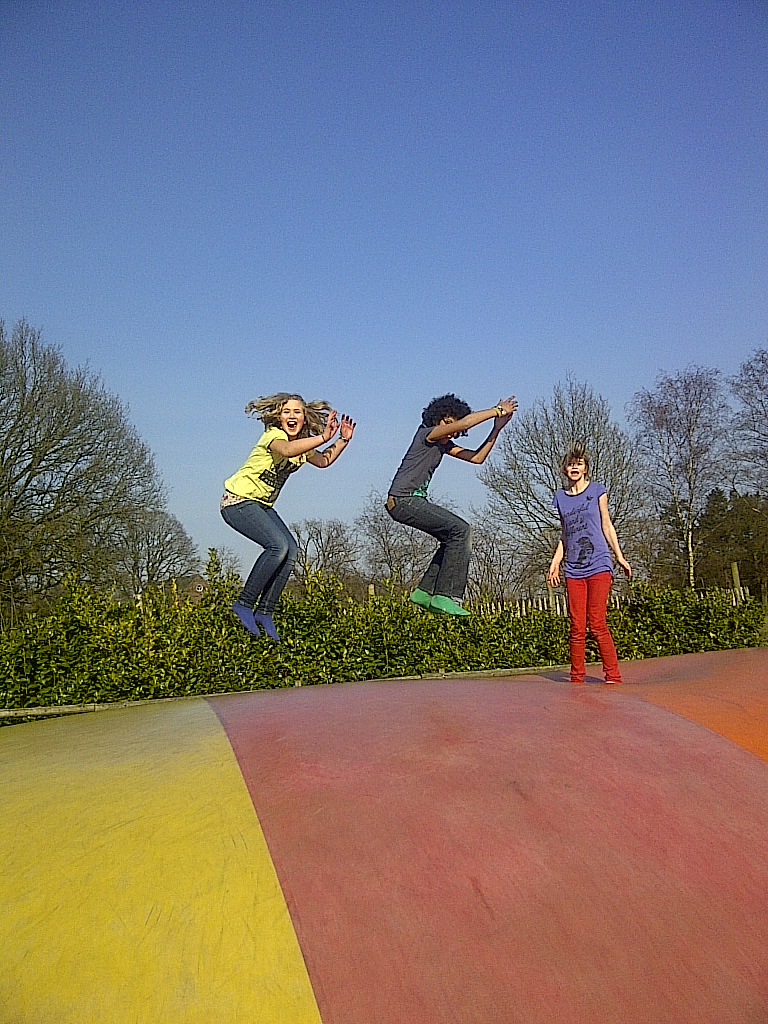
Happiness programs are key for children’s education

Happiness is easy, available everywhere, free of charge and always at hand when needed. Just open up to it by letting go of all inhibitors….
 Sustainocracy, the new democracy