What is a Sustainocrat?
A Sustainocrat is someone who simply accepts his/her biological nature in the diversity of living life with our key responsibility to keep it healthy, safe and progressive through proper interaction with our surroundings. This understanding gives a mindset that affects the way the Sustainocrat addresses every day’s realities and choices. It also determines the way we address a job, responsibility or authority within society. Everything is fine when society respects our highest ethical and environmental values but become an issue when not.
When needed the Sustainocrat inside us stands up and shows Sustainable Leadership, addressing the issues with authority and determination.
A few examples:

Hi, I am a bunch of molecules from nature that decided to come alive and become a human being: ME
A Sustainocrat realizes that if we pollute our environment we also pollute our biological selves. The consequences do not just affect our quality of life through undesired illnesses, it also makes economies collapse. So we need to take responsibility for what we eat, drink, breath and how we interact with our natural surroundings. The institutions that serve humankind need to do so with holistic ethics as a guidance, not just consumption.
A Sustainocrat makes purpose drive use of the instruments that humankind created over time (products, politics, economics, organizations, etc). The are the toolbox of a Sustainocrat, not the other way around like certain system dynamics want us to believe. The Sustainocrat uses these instruments for human benefit and symbiotic harmony with our environment.
We find Sustainocrats everywhere in society, at any level, age and authority, doing normal work as a citizen, even at the highest level of societal systems. We use our influence according our understanding and beliefs. A Sustainocrat from Belgium said: “Sustainocrats are not smarter or better than anyone else, they simply have the awareness that anyone can cross the door through the “system’s wall” where the old problems do not exist”.
Sustainocrats take self aware responsibility together through purpose driven, multidisciplinary alliances when our key responsibilities are in jeopardy anywhere in the world. We do not challenge the system, we just focus on 5 key issues, and invite influential leaders and Sustainocrats of the system to go along.
- Health
- Safety
- Applied knowledge
- Food
- Self sufficiency
Together the system is innovated using human natural and universal dynamics, well before it collapses into chaos and disaster. Sustainocrats are peaceful transformers when needed, using talents, conviction, perseverance, authority and teamwork when needed. The transformation process causes the renewal of the economy and a new boost.

Key responsibilities are taken together when needed
The awareness of a Sustainocrat is new. Until now the actions of humankind have never produced such massive destruction of our habitat. Global issues produced by our consumer economics and dependence demand responsibilities triggered from our living molecular reality, not the system’s reality. The network of Sustainocrats is growing as a human transformative movement in any business, government, educational, etc institution. As a grows and takes responsibility the balance is regained as well.
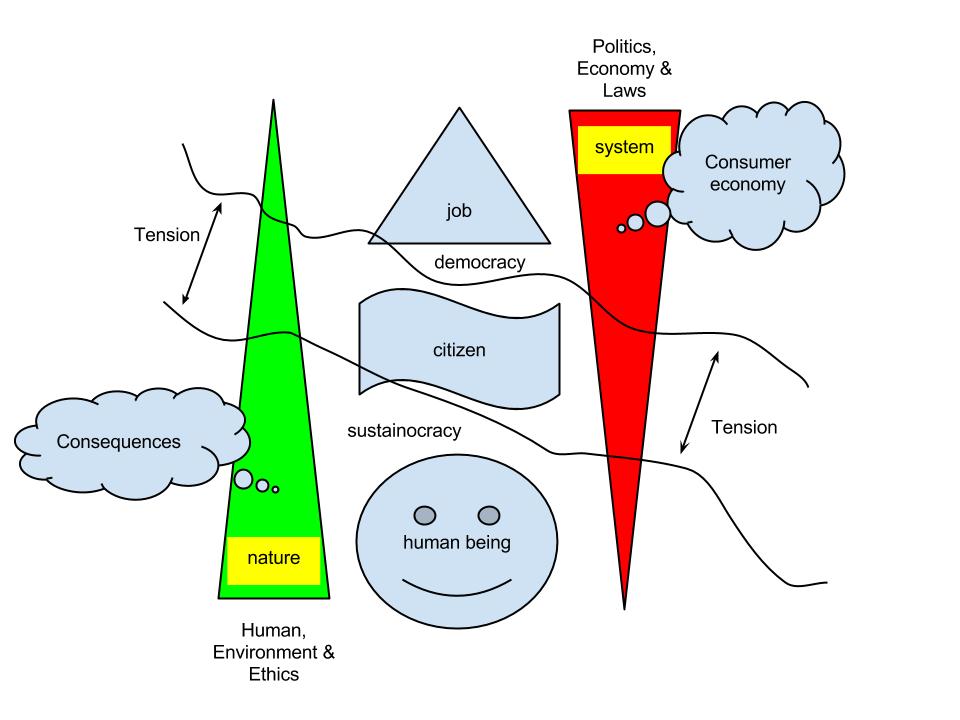
Before tension grows unsustainable the Sustainocrat already units to take measures.
People use their profession and citizenship to safeguard our biological well being by influencing the surroundings, creating co-operations like in the picture and taking responsibility at home and at work. After all, where ever we are we are a biological human being first. Neglecting this will only affect our own selves. Sustainocrats will draw the attention to it anywhere in the world allowing us to positively use our instruments (technology, organizations, knowledge, etc) for our sustainable progress instead of discomfort and disaster.
If you recognize yourself in the above you are a Sustainocrat too. Just say it so others connect when needed. When we address the Sustainocrat inside us we have nothing to sell, just to give: our talent and responsibility. We do that when things are important to us, like life itself.
Choosing your own blindfold
Today I received a short story of the Belgium system critic Werner van Ginneken (in Dutch). He defined the Sustainocrat as someone who is the same as everyone else but at the other side of “the wall”. This drawing summarizes his story.
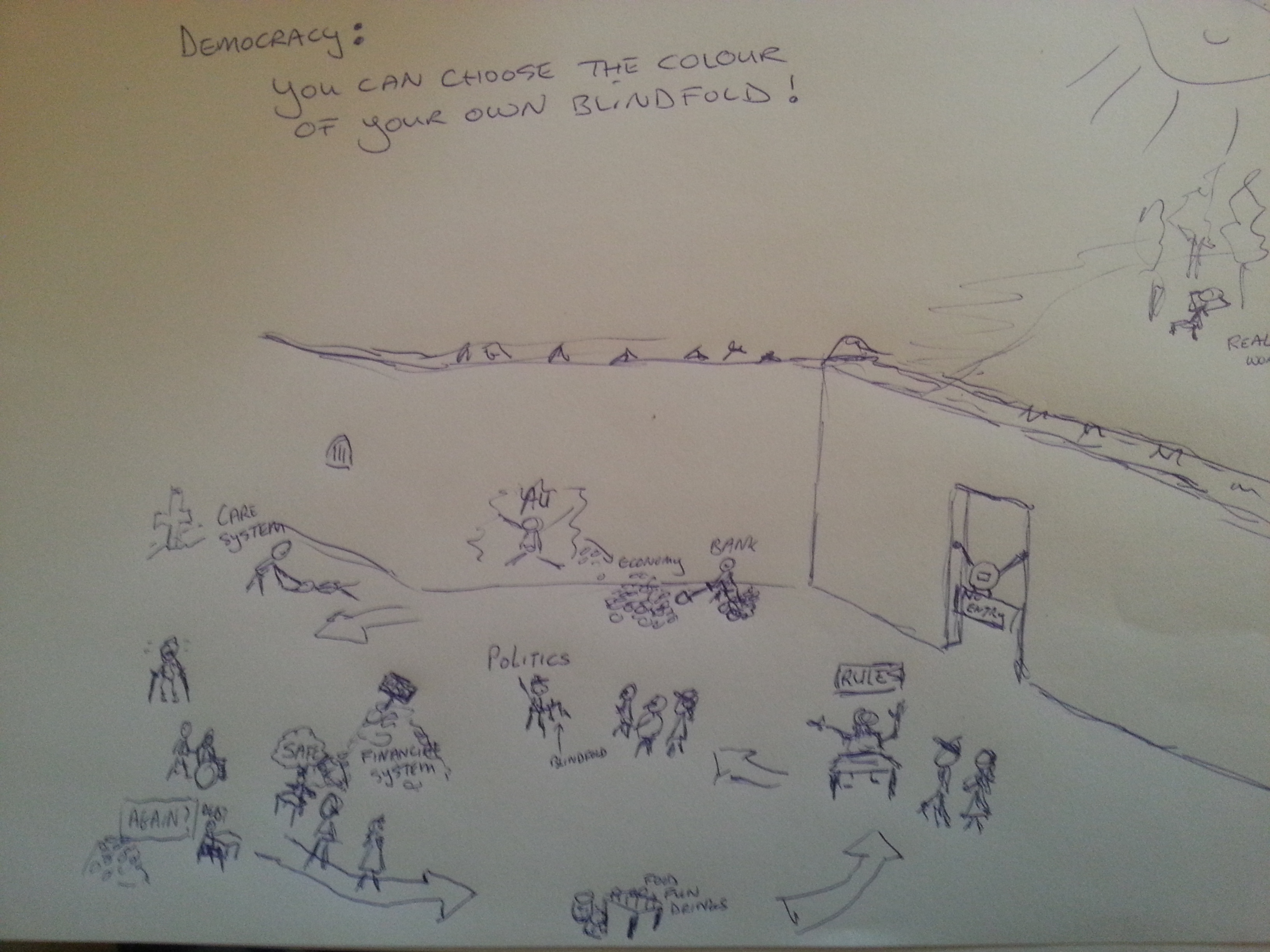
Which blindfold do you choose?
It is funny to see that it clarifies the current democratic structure of political parties that all defend the same financial system of consumer debt and dependencies by offering the population their own colored blindfold before letting them crash and try again after some care taking.
When I showed the picture to Werner he referred to another drawing that he had loved. I tried to find it but could not. It shows a river with someone walking at one side while seeing someone else at the other side in an apparent state of great happiness. “How do I get to the other side?” the person calls out to the happy one. “You are already there!” was the response.
Clue
We tend to create our own obstacles by accepting and supporting the irrational of systems or looking at the happiness of others rather than our own. Freedom from blindfolds is not yet a Sustainocrat but a good basis to become one.
Why we need money to show that we don’t need it
Sales tradition
We experience in our daily business life a money driven culture. We just tend to want to sell each other our products and services. So when I invite people to join a Sustainocratic cooperation they tend to ask two things to judge their opportunity: “Do you have a budget? What is your need?”. When I say that I have no budget nor direct need they often regard me as a waste of time.
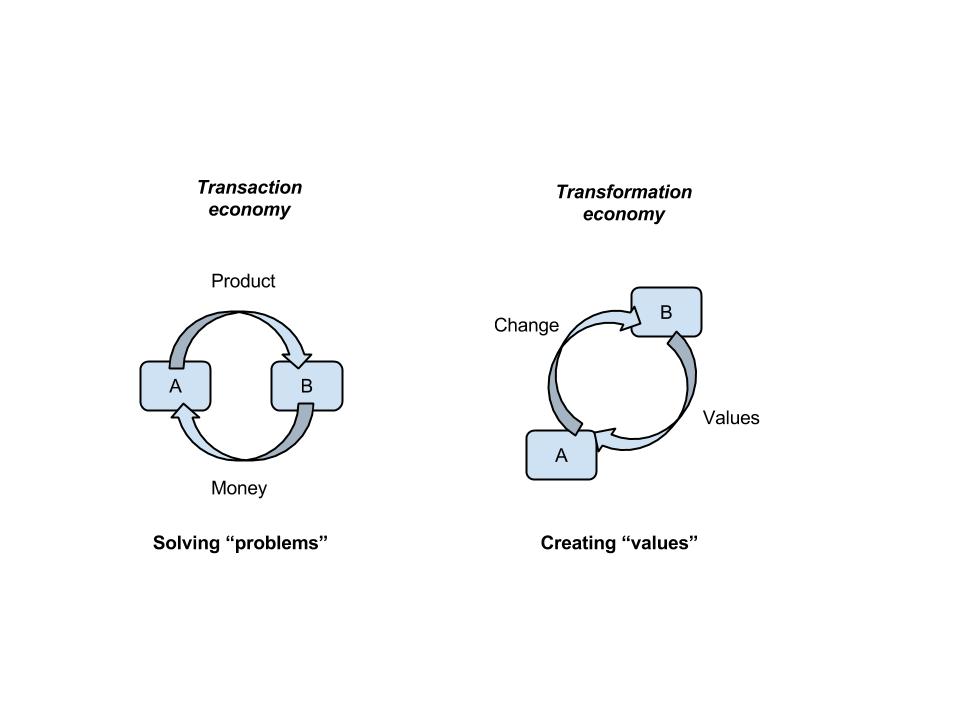
Two type of economy
Sustainocratic cooperative
This is a venture that takes responsibility for co-creation of something of true human value. One example is AiREAS that co-creates a “health city with healthy air”. AiREAS is entirely in the Transformation Economy but works with partners that excel in the Transaction Economy. Involved are all instruments that shape a human society: government, business, education, population.
We start with the higher purpose (healthy city) and work our way back to what we would like to modify today (priority). We start with an empty table and a powerful reason to be together. What the motivation us of the ones present is up to each of the partners. Their contradictions are usually their combined strengths. Together we define one or more projects and allocate resources. This is not just money. Also technology, manpower, knowledge, etc is allocated. Stip-step we call the process. It is focused on change.
Two economies, two different way to work
The transaction economy is focused on growth. Growth is a management issue and success is determined by rational wit, efficiency and control. Sales in a transaction environment is based on “solving problems”.
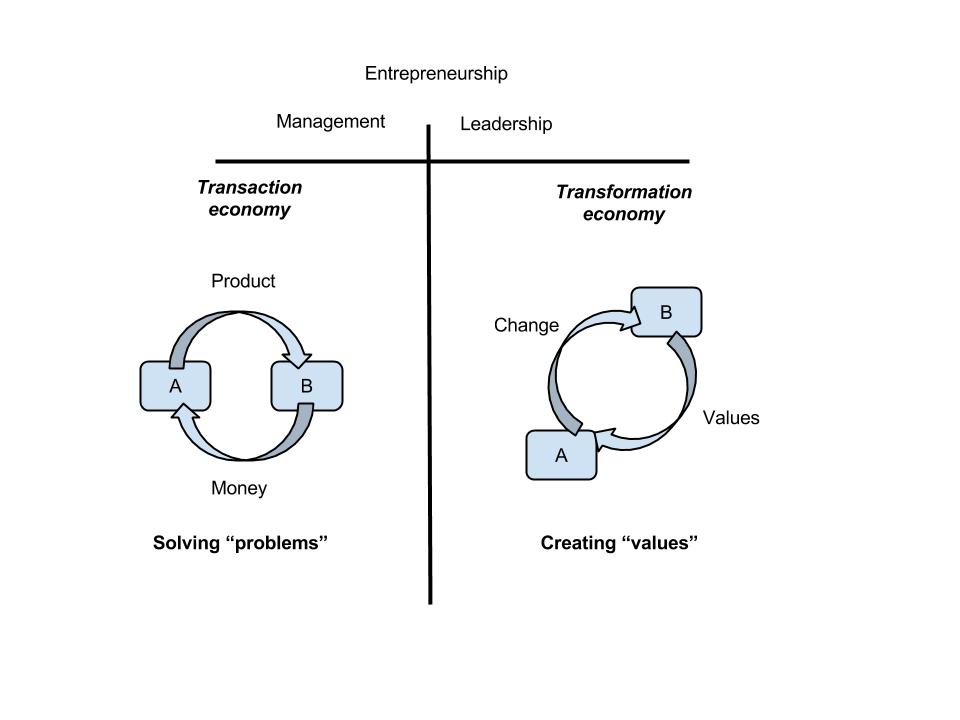
Management versus leadership
Change requires vision, guts and passion to go from one situation to a better one. Change is an investment around a responsibility of values that can be created. Transformation deals with an opportunity, not a problem.
Money needed, no money needed
In a transaction environment money is always needed to exchange for problem solving valuables. In a transformation environment no money is needed because there is no exchange of values, values are created. This requires talents and authority.
The two worlds need each other
Changes produces values that can be enlarged through sales within the growth environment of the world of transactions. The transactions world needs continuous renewal from the transformation world to avoid its saturation. We see in business (also in government) the tendency of unbalancing leadership and management. Management has the tendency of using a situation as unlimited cash cow. Leadership always wants the excitement of risk and change. Together they balance out very well but need totally different personalities to deal with the situation.
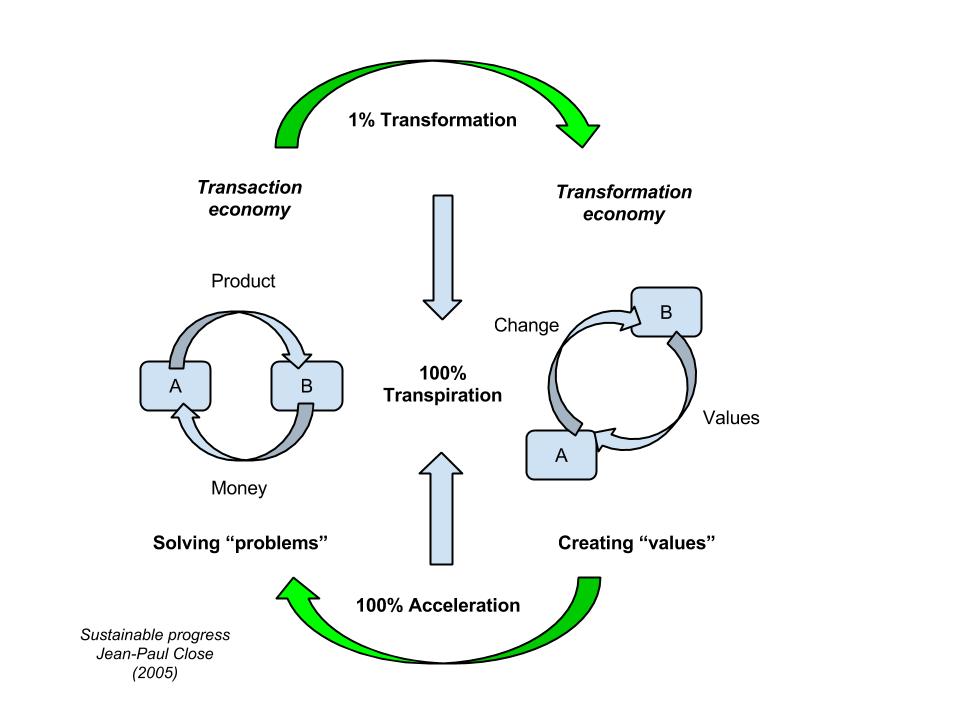
Two complementing worlds
When change is avoided
There are many situations when change is avoided. This is the case with national economies and their current tax infrastructures, or banks with their outstanding long term investments. Change will challenge their outstanding commitment and introduce risks. Many governments and banks cannot address change even if they wanted to. When hierarchies are built around growth, change is out of the question, even if it promises a new path for growth. Management people in power are more worried about what they can loose than what they can win.
Things change when a society is in long term crisis. When the old instruments do not work anymore new ones need to be tested and allowed. So when I introduced Sustainocracy as an engine of Transformative Change, it was dealt with as if it were Transactional. I invited people in business, government and science and they asked me how much they could grow in money making? Many even did not want to come aboard the venture if there was no money put upfront.
Transformation fund
AiREAS started with nothing more than a higher purpose and lots of passion and vision. Now we establish a transformation fund that is used for only one thing: to provide a sense of peace of mind to the transaction driven participants. They need to know that money is there for payment even through the fund is not touched. When values have been created in the AiREAS processes they are so unique and valuable to the rest of the world that each of the partners gets a fair share of wealth back. We even fill up the transformation fund with royalties before we need to pay out our participating partners. We show them that to create value we need no money, just confidence in our selves and a good reason to work together.
Money is a proof of valuable change used by those who follow leadership through effective problem solving management. In the STIR Foundation we opened now a transformation fund just to be able to increase our ambitions in the field of societal change for sustainable human progress. The higher the fund the more value we can create and the less funding we really need. Weird but just part of the time we live in.
Information? Just contact me: jp@stadvanmorgen.com
 Sustainocracy, the new democracy