Kondratieff versus Close
Nicolai Kondratieff (1892 – 1938) introduced a theory about cycles of 50 to 60 years in capitalist economics. The cycles show a sinusoidal shape that can be divided into four different “seasons”: prosperity, recession, depression and improvement.

Those of you who know my model of human complexities (see below) will also recognize the same four situations or states, named in a similar but different way and also following each other in a chronological way, despite human tendensy to counteract the flow in certain stages. Rather than showing a sinus timeline I show a cyclic movement that evolves into an evolutionary spiral (not drawn in this particular drawing that represents just a single cycle showing the phases we go through).
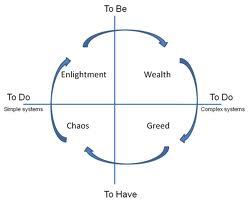
Human Complexities
Using my own model I relate a number of human variables to the cyclic experience, as individuals and as communities. Each phase and change among them has much to do with the human psyche which would explain the linear fluctuations in time in both the Kondratieff and my (Close) model. We can also map generations on both models to see where they stood in relation to economic development or recessions and what emotional or cultural environment supported each phase. In the Kondrakieff sinus this is easily done against very specific chronological data. It is easy to plot also very specific events as points of reference, s.a. World War II for instance.
The points of reference help to relate the different models by synchronization in time and region. World War II got us (large parts of Europe) into a state of chaos for instance. It would be a “starting” point in my model due to the time reference that can also be further extended to a specific regional location. This you can read for Holland, Spain and the USA in chapter 11 of my ebook on the Global Shift (2011)
Then we could observe how generations evolve, one after the other, with the effects of the cycles of human complexities and the Kondratieff sinus of economic seasoning on them. In my model I show that people who grow up in a situation of wealth are being educated accordingly. This means that we are being educated with wealth as a matter of fact. I remember my own growing up phase in the midst of the post war culture of prosperity of the late 60’s early 70’s in Holland. We all wanted to be a millionair by the age of 30. What we were really doing was to create our own crises by mere cultural mentality caused by the environment in which we lived. Generations follow each other up every 20 to 25 years which would show another sinusoidial wave based on culture and mentality following Kondratieff in a different phase. We could probably draw the technological peaks with the mentality ones on the models, just to see how they influence each other.
In my model I do not relate necessarily to periods of 50 or 60 years for one cycle to complete as this may have to do with administrative economics rather than human (generational and environmental) complexities. I have even suggested that in prehistorical times a complete human complexities cycle could take hundreds or even thousands of years, affected more by natural environmental periods of abundance, interaction with hostile encounters or the chaos produced by natural disasters. When we look at the Chinese dynasties a direct link can be made with such cycles. Economics did not exist nor did therefor the Kondratieff sinus. My model did apply though.
Only now, the recent few hundred years we have found the cycles shorten to such an extend that we live through one or two complete cycles in an entire lifetime. My model hence relates to environmental circumstances (culture, war, periods of peace, nature, catastophes, crises, etc) as key influencial factors on human behavior and a historical clear reference with which we can relate human reaction and evolution both technologically and socially.
My model also introduces the line of sustainable human progress along which the traumatic human events can be plotted. This is new in any documentation. I use my transition phases (greed and enlightenment) while economists would only refer to entering and leaving the chaos quadrant as two seperate phases (bull and bear markets respectivily). The line of sustainable human progress is an evolutionary straight line that moves from chaos to wealth and beyond. The transition phases (greed gets us back into chaos and enlightenment gets us back to organized wealth) can also be seen in the sinus of Kondratieff.

Transformation of greed to wealth
Kondratieff shows an organic human logic in time phases with a build up of technological highlights and the economic effects. The same complex origin for progress can be found in the human complexities (psychology, education, culture) within the phase of chaos (war, depression) and enlightenment (the left hand side of my model). Humankind apparently needs stress to be inventive while in times of wealth and greed little to nothing new is added. Instead we see then an increase in risk avoidance, bureaucracy and hierarchies, which translates into a measureable increase in costs of society. This is also the reason of sudden collapse into a recession in cycles of about 7 years (domino effect).
- Year 1: market crisis (consumer crisis for whatever reason)
- Year 2: business crisis (expected turnover not reached)
- Year 3: government crisis (expected tax income not reached)
- Year 4: government dependent instances crisis (education, police, etc)
- Year 5: business downsized, fused, innovated, went broke..builds up again
- Year 6: government gets more tax income
- Year 7: government dependencies get more air
During those seven years all economic institutions go through reorganizations, eliminating bureaucracy and trying to open themselves up for innovation. Costs are eliminated and they are downsized, renewed their structures to get a positive impulse. The impulse gets everything into a new investment round that results in 7 perceived good years and then it starts falling back again. This would suggest that the traditional 7 bad years, 7 good years, 7 bad years, 7 good years could be expalined in a sinusoidal wave of 49 years. With economics we created an artificial environment that shows a more organized sinuswave than when interacting with the multidimensional complexity of nature and the chaotic tribal confrontations of the past.
Sometimes the economic years are stretched a bit after a capital injection, an overenthusiastic increase of national debt, etc. The figure we see returning all the time (“about 50 years” – equivalent to an ancient average generational lifetime) is just a logical reflection of our administrative economic organization of one natural year and our human “perception” of what we believe is good or bad. This would also suggest that if we would half the administrative year or extend it to two years we would see the waves shorten and lengthen respectively. This may be something for further study by someone even though natural seasons may still have some significance in our, otherwise highly automated artificial productivity.
It also has to do with our fragmented structure of society along a chain of economic dependencies. If we set up society differently (eg a Sustainocracy) then the economic world would never collapse. Sinusoidal waves would not exist because we eliminated the duality in our progress by concentrating on a single higher common purpose (sustainable human progress) with highly flexible, dynamically adaptive non fixed, hierarchical organizations. We unite our knowledgeable awareness with our adaptive productivity towards a permanent never ending goal.
What the Kondratieff model does not foresee is the piling up of an exponential curve within the current artificial sinusoidal. This is effect is caused in the last 40 years after the liberation of money for speculation around shortages by the entire, global institutional world. It coincides with the “information technology” era of the 5th Kondratieff wave, which is why it confuses the analysts. Taking also the limited Earth resources into account, the dip of the 5th Kondrakieff wave coincides with my crossing over from greed to chaos and a point of singularity of overall financial collapse.
The creditcrisis of 2008 has been just a warning signal. Banks will never recover despite the huge capital injections and government finances collapse all together. The Kondratieff’s winter and my model’s point of chaos are this time expected to be more dramatic then ever, making the Russian natural winter feel warm, and the Arab spring feel peaceful, compared to previous events. Some think that the solution lies in a new technological phase s.a. nano-technology. I personally believe that the next phase has nothing to do with technology or capitalist economics but awareness and a totally new type of society.
And that is where I come in with Sustainocracy. I cannot create a Kondratieff sinusoidal counter wave now to avoid a mayor crash, nor prevent local poverty from rising, or avoid a potential new world war. I can however introduce a new paradigm that can instantly transform current society, situated structurally in greed (recession) on the way to chaos (depression), into one positioned permanently in wealth (prosperity) by taking institutional responsibility today. This would maybe break or interrupt the sinus or introduce a new aspect that actually supports the sinus but from a different point of view. My own shortcut, interrupting the traditional ups and downs of society, has to do with our current state of collective understanding (awareness, consiousness).
We now collectively understand the above and the consequences of continuing. By introducing sustainocracy we now have a choice. We could trust the sinusoidal wave as an external matter of fact and realize that a new generation of prosperity is hopefully being born today to grow up and make it happen during the Konfratieff dip. We can also take responsibility and use what we know now to create a society based on new facts, a higher awareness, before it’s too late. Like building a Sustainocracy right now in ever city or region in the world.
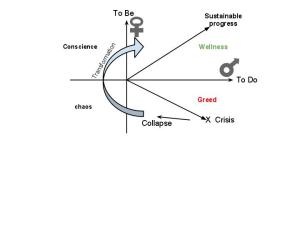
The revolution of the consciousness
How powerful will people remain when the collapse continues and the point of singularity makes the sinus wave the deepest ever? What interest can people have in total collapse? How powerful can these same people become when they assume sustainocratic responsibility and turn the ship with consiousness and planned wisdom before organic logic does it with brutal force? If you are in a position of power today just ask yourself that question.
It can be done through human ethical behavior, leadership and awareness. It is difficul but worth it. I am doing it with people around me who have fragmented authorities and power (government, business, science, civilians) and they use it with me in purpose driven social and technological innovation. We do not place money in the center of attention but sustainable human progress, a clear environmental and social balance in circular economics of value creation. By doing so we create a rapid change in mentality and see a period of many decades and even centuries in reformatting and organizing our civilization with a positive consequences for economies. That I call the second quantum leap of human kind. Not by chance but by willpower and awareness.

AiREAS is the first sustainocratic venture in the world
Sustainocratic transformation is a voluntary act of responsibility
It is not about what you have on offer….
It is about what you can create!
My mailbox is flooded all the time with offers from other people providing stuff that I do not need. Everyone wants my attention for their things. When I enter a discussion on LinkedIn or a blog I find people trying again to sell “their solutions” to “my problems”.
When I was offered space free of charge on the electronic billboard of my home town I actually noticed that we had billboards all together. Don’t ask me what was on it. When someone with over 50.000 twitter followers tweeted my YouTube link on sustainocracy I only got 7 views and I didnot even sell anything. That is in marketing terms a hitrate of 0.00014. Did that bother me? No not at all. The person who retweeted had been sufficiently impressed to share her feelings with the other and even 7 (!) people picked up the curiosity to have a look. In the process we together created something: curiousity, empathy, awareness, thinking, reflection, dialoge…..Every one single individual is important then, not the masses.
We are so used to consuming that we forget that we need to create too. Consuming extracts value from our surroundings. We consume it. If we do not return anything then the value disappears. Delivering money as a payment is not enough. What value does it have? Where does it come from?
Every day we set out to buy things from people who have things on offer. We buy petrol but what do we give back in terms of energy? We buy bread but do we compensate by planting grains? What is your balance today in creating and buying? How much time do you spend offering your services, products or wits? And how much time do you spend in thinking of creating something of value, something new?
How are we going to progress if no one creates? Just consumes?
In a sustainocracy we are not interested in your products, your services or what you have on offer. We are only interested in what you can create, co-create or help create. You may want to use your products in the process but maybe you find that you need to address your creativity and innovative spirit. We are interested in productive value driven talent, not a cost. Only when values are created they can be shared. Existing products can be valuable in such process of course but still need to placed in the context of the entire picture. We normally leave that responsibility to the buyer but in sustainocracy we take the responsibility together.
Solidarity taxes and ethics
In Holland we apply the “law of solidarity” for the national costs of healthcare. This means that everyone has to contribute by law. The exception that confirms the rule are religious people that place their faith in a higher power and do no want to insure themselves for medical care. To cover the solidarity principles and avoid misusages those people are exempted from contributing but agree to pay a higher tax.
Healthcare is one of the largest social costs in Dutch society and it grows tremendously. In 2013 we all have to contribute about 16.500€ per person (babies included) in taxes, of which 5000€ or more are related to healthcare. It takes a lot of solidarity to accept that.
The high costs may have to do with the graying population, the longer life expectancy and the many illnesses we encounter along the way. It also may have to do with the extremely high bureaucracy, inefficiency and hierarchical structure of the caring system. It may also have to do with the fact that the healthcare has been more or less liberated but with just one source of financial support: the seemingly unlimited tax and insurance payer’s money. Business people in health care are smart in tricking and cause over time an exponential curve of costs that have little to do with medical care and very much with a culture of greed over the back of the fearful, aging, lonely and worried and by law committed citizens.
The problem we face now is that we ethically question the type of society we have built. The costs of our healthcare are a direct consequence of our lifestyle. Many people introduce a new lifestyle and want to take a different approach to healthcare. They cannot because of the old lawful imposition of solidarity with the old system. They are not religous enough to turn their back to everything yet do reveal serious opposition against a system that destroys our habitat and with it ourselves. Paying an increased amount of money for an obsolete system gives the feeling of contributing to something that is wrong. When we also see that healthcare is being canabailzed by the system and only very little of the invested money actually gets used for health care the solidarity is rapidly ailing. Solidarity then means that you support a system that you want to disappear.
Alternatives health systems are being proposed and developped but find serious blockage along the way by the current system, supported by law. People who develop such progress do this for themselves and their fellow people. They show the same or more solidarity than those who just pay off their responsibilities through unquestioned taxes and insurances. Ethics should become a new parameter in society that allows changes to be happening with an important degree of progressive freedom. Solidarity should never be be expressed in money, it needs to expressed in terms of humanism, social meaningful interaction and value creation. If people pretend to be able to do better than government why should they not be allowed the chance?
Ethics is an inner commitent of people towards a universe and our human evolution. When this is questioned or blocked by a government or any other organization then people claim their universal rights. Solidarity should be with ethics, not money, hierarchies or politics. Time hence for change.
 Sustainocracy, the new democracy