Why does a self -proclaimed “smart” species like humankind seem to be uncapable of changing its own behavior from dangerous degenerative materialism into regenerative cooperation with nature? Can it be attributed to our collective stupidity? Political or financial interests? Certain manipulative unethical individuals? Our ego? Why don’t we simply get together and develop society in a regenerative way? Don’t we have the knowledge? The opportunity? The sense of urgency? Or is there something else? A missing link?
Is the STIR foundation the solution? With our approach to reality with Sustainocracy?
It may be clear that our current global approach to society is structurally and dangerously degenerative. Despite the obvious danger of societal and existential collaps it may be surprising and upsetting that the intelligent human species seems uncapable to turn the tide, despite its intellectual potential. Individually we may do our best but this only tends to delay disaster (flatten the degeneative curve) rather than divert it. What is missing for a real turnaround?
The first modern alarm bells were rung by the Club of Rome that a change in mentality (1965) is needed. Subsequently, powerful speeches of Severn Suzuki (1992) and Greta Thunberg (1996), represent of our upcomming generation, challenged world leaders to take responsibility. It all impressed the world but did not produce the desired transformation. Even an ancient dominant organization, such as the Catholic Church, did show a remarkable transformation in their approach to reality. Instead of the tradition of guilt and absolution the church started to advocate for shared responsibility and celebration (Laudata Si – 2015). Even the final message of the speaking gorilla Koko (2017) tells us what to do. .
With so many challenging warning messages, why doesn’t it happen? Our shared responsibility? It seems so simple.
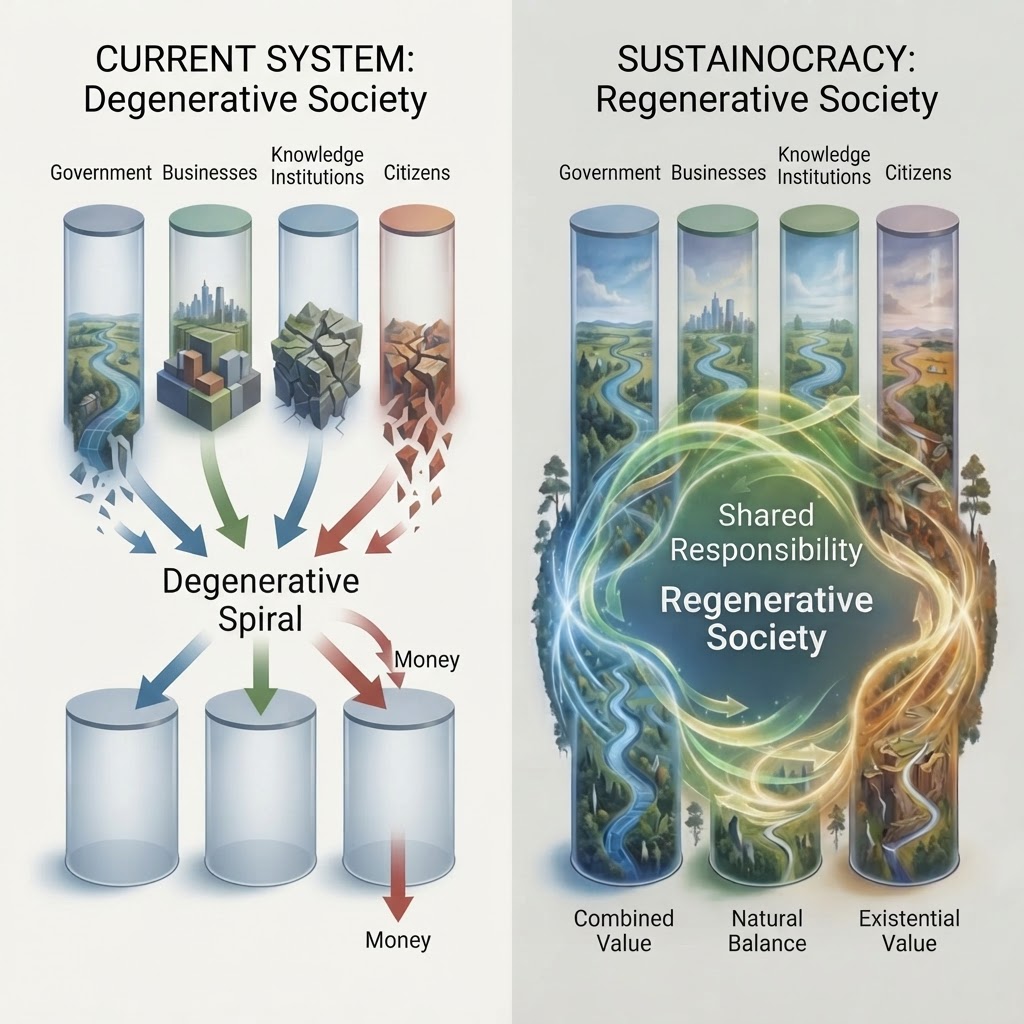
We know from experience that preaching may be inspiring but it does not automatically lead to voluntary change. Our current society is structured in a fragmented way, all around financial costs and interests, not shared existential responsibilities. We may be able to do our individual bit within our fragmented part, but what or who brings it all together into the shared part?
Government organizations are a cost and require the working of the financial economy for their functioning. Regulation is required to somehow structure society with some agreed behavioral instructions in order to avoid chaos. Think for instance how we behave in traffic. But when regulations become more than that, for instance blocking people to become more self-sufficient in the fullfilment of their needs, then they become instruments of surpressing and hierarichical control, blocking change rather than stimulating it. Business provides products and services, which can be very powerful for progress. But if, in the process, they destroy and massively pollute our environment out of ignorance or financial self- interests, then they become part of the problem. And we citizens, if we feel the right to keep consuming in an unlimited way and prefer to leave responsibility to others through democratic voting or the dependence on thr functioning of the economies, we also fail in the overall prospect of our sustainable development. If science is dependent on financial instruments and education geared to preparing our children for jobs rather than awareness and behavioral resposnibilities, the picture of our systematic incapicitation is complete.
It is easy, of course, to point at “the others” to justify our problems and lack of engagement into the shared responsibility issue, but where can we join? If each of the silos of society interrelate purely through financial objectives and instruments, dealing with consequences through expensive repair mechanisms and competition, we are missing the boat.
STIR: “Here are our existential basics. Let us get together and take that responsibility in a cooperative way.”
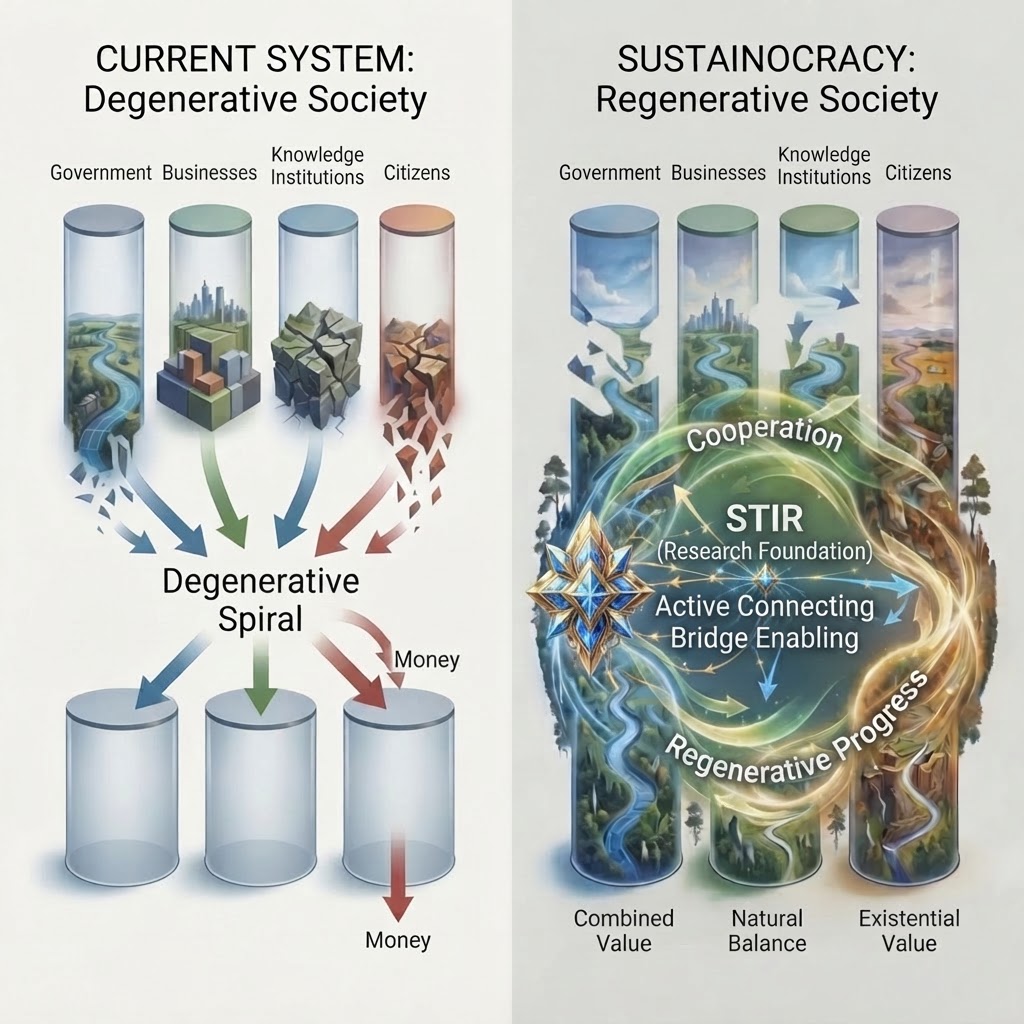
STIR defined five existential values for our sustainable existence. The first, our shared responsibility had been extensively menstioned. This is carried out at a regional leven. The other four are:
- our integral and positive health (physical, mental, emotional, spiritual).
- our safety, through respect for life in general, nature and each other.
- our awareness and learning process,
- and engagement with the fullfillment of our basic needs:
- Food
- Water
- Air
- Warmth
Each of the aforementioned silos has their unique contributive potential, not by taking over responsibilities out commercial of interests of dominance, but by enhacing them through knowledge and techniques. Key is the engagement of all individuals. Like this both the people and institutions develop their contributive autheticity and respected reason to be.
Three important aspects appear:
- Willingness to join the shared responsiblity table for our sustainable human development as initiated by STIR. If not, one risks having to explain why not.
- Learn and develop the individual contributive attitude in a measurable and leadership way, including the possibility of enhancement of contributions of others..
- Accept the shared need to let go of obsolete and damaging habits and elements in society, making way for new behavioral and innovative formats.

