Purpose driven economy
With the kickoff of the first sustainocratic initiative in the city of Eindhoven (the Netherlands) the first step is made to create a “purpose driven economy”. What is the difference with what we have today? And why is it important for the rest of the world to follow the experiment in Eindhoven and, better still, start one of their own?
Current economies
Our current economies are not purpose but consequence driven. The human being is positioned as compulsory consumer. The entire institutionalized society is focused on creating a mountain of wealth around this consumer that gives a sense of abundance at all times. The only way to access this abundance is through financial means. Some of these means are individually obtained through the production, logistics and sales infrastructure necessary to maintain this mountain of abundance. Other get paid out of the hierarchies funded through taxation on this consumer organization. Or through speculation on material resources contained in this “having” type of culture. And finally also debt.
The consequences of such consumer economy show a growing tendency of (negative) influences that need attention through investments. Think of infrastructures, healthcare organizations, police, etc attending the attitude of greed and its effects on the human being, physically and mentally. This also shows an exponential growth which is equally reflected in the world economy through the costs of societies. At the same time we see our environment and human behavior deteriorate fast.
The model of economies of growth purely based on unlimited consumption and the consequences thereof, is obsolete because we use our natural resources wrongly, destroy our environment, sicken ourselves and eventually eliminate our evolutionary chances.
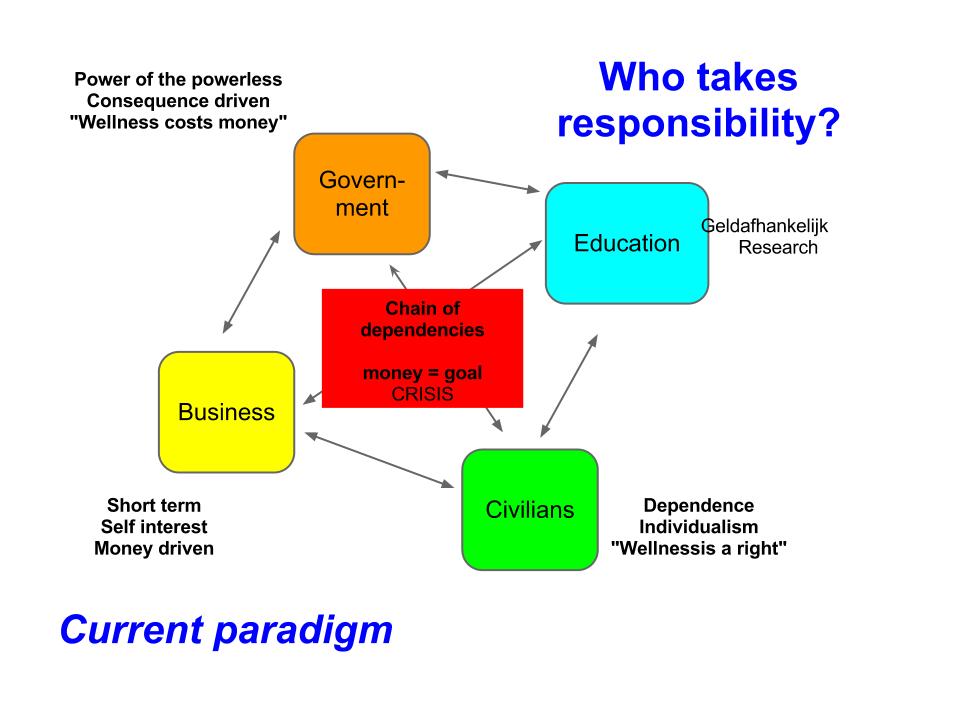
The consumer economy grows while destroying our selves and our habitat
Fragmented complex society
We know this now, including scientific proof, but have difficulties in changing the course of society. We created a very complex mesh of fragmented financial entities with dependencies and interests among each other on which powers and influences are being based. Each institutions has a perceived right to exist and defend its own interests. There is not one single institution that takes full responsibility for sustainable human progress. The institutional mesh is based on fragmented self interest and competition.
Key is the understanding that no institutional specialization can take holistic responsibility for human safety, health or sustainable progress. It is the human being itself that needs to take this responsibility. What went wrong in the consequence driven consumer economy was that the human being delegated its wellness through fragmented institutionalized structures that grew into tremendously inflated organs like an abscess or cancer would do on a sick body. Instead of serving humankind they try to serve themselves. This fragmented type of human organization is institutionally sick with the risk of the cancers to develop themselves further and destroy our evoutionary chances.
Purpose driven economies
The big difference with the old consumer economy is that it is not based on consumption and growth but on true value creation (purpose). It is not based on massive productivity and distribution but on local content. It is a circular type of economy where “purpose” is defined according local human needs, obtained through local effort and using local resources in a circular way.
To achieve a purpose driven economy an intense transformation is needed. But it can be done using the same institutional instruments of the old society. Each participant needs to cure its cancer like development and abuse and become functional again within the scope of local for local requirements. It requires a different mentality and true transformative leadership in each institution involved.
Abundance is not presented through logistic channels from around the world, it is created by local cooperative efforts. In such local cooperation we see the four traditional human values come together: attitude, creativity, environment and wisdom. Those values in the old economy were split into separate institutions that do not act locally but globally, not in an integrated way but based on self interest, greed and fragmented excellence. Now we bring this global expertise back to the local context.
Using what we have learned
The great advantage of today is that the old consequence driven consumer economy has left us with a huge amount of accumulated experience and material knowledge thanks to the concentrated specialized, fragmented functions of expertise that developed over time. This would never have occurred if this phase of humankind had not taken place. For a long time it was very constructive. Now it has become destructive.
We hence do not criticize our past but use the best of its elements in our new progress. We can of course be critical to those old time forces that try to prevent us from creating purpose driven progress. It is just a matter of time for that opposition to disappear. Eventually the purpose driven economies will develop there where the old one has become obsolete, entered into a crisis, providing room for renewal, not just in a physical, organizational sense but especially emotionally, spiritual and rationally when people become aware.
Complex transformative process
It is a complex process that is typically developed locally and bottom up with executive support to make it happen. The reason that it happened in Eindhoven first and not yet in another region is simply because this small Dutch town unites the essential ingredients to make it happen. What are these ingredients:
- Awareness at executive level
- Open democracy of true equality
- Level of education and experience
- The right people at the right time
These qualities produce the necessary flexibility that can address the future with adaptive determination in a complex modern world. People take responsibility individually, convince their surroundings to support change and find ways to make it happen. The purpose is found in the essentials of human existence: food, health, security, wellness (housing, energy, etc) and knowledge. When it becomes clear that the global consequence driven consumer economy is obsolete speed is required to create a new sense of reality and responsibility, including a change in behavior. When the time of old abundance is over, new abundance needs to be created, preferably on time.
Wellness is not a cost or right but the result of a responsibility and hard work (purpose) together. When circumstances change stability is found in change too. In a sustainocracy the purpose driven economy is initiated together. We do this by making human wellness a purpose driven issue of the local population with the support of the accumulated institutional excellence and enhancing potential.
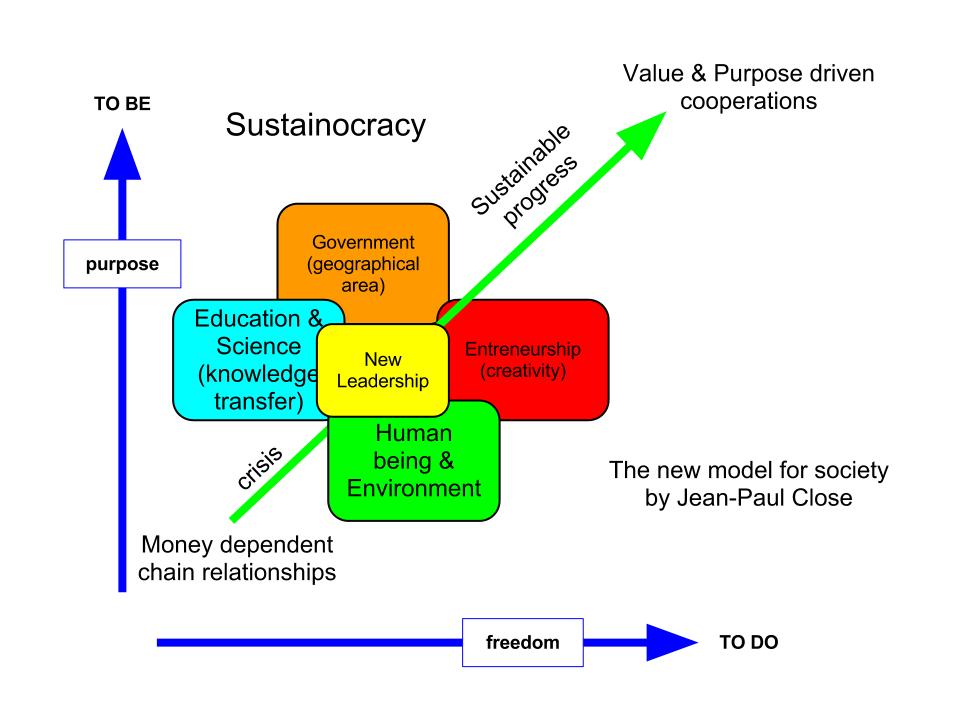
The purpose driven society develops local for local using the institutional excellence of the old paradigm
Conclusion:
Purpose driven economic development based on sustainocratic complexities is needed to save humankind from the present day destructive expectations caused by the consequence driven consumer economy. If not we will face disaster. Yet if we assume responsibility individually and institutionally we also face a huge transformative challenge that will upset everything that we have known so far. The choice between destruction or working together on a healthier perspective is easy for me. I have become self aware and dedicated more than a decade to come to these views and initiatives. It is a start, giving comfort that humankind has a choice indeed. A choice that simply depends on one own and not someone else. But I realize that it is a difficult one, not only when one has to make it, but also for me to reach out to the world and make the choice known to all. If one does not know than no choice will be made. My personal challenge is hence multiple. Make it happen for myself, provide proof to my surroundings and reach out to all of you with sufficient clarity that you take sufficient confidence in the course that I have taken in order to let go of old securities and create new ones for yourselves and your direct surroundings.
Ethics is human, not institutional
Much is being discussed about “ethics” in business, finance, government, education, etc. The biggest misconception of all is to attribute ethics to institutions. Ethics is human, not institutional. An institution cannot be blamed for unethical behavior, their leaders and employees can.
Definition of Ethics:
Many people confuse ethics with social morality, as in religion, belief or cultural behavior. One of the more useful definitions of ethics is provided by wikipedia in the names of members of the foundation of critical thinking: “a set of concepts and principles that guide us in determining what behavior helps or harms sentient creatures”.
If fact ethics refers to “the conscious way we interact with our environment, human and living nature, in a constructive or destructive way”. Ethics is complex as it demand from us the conscious reflection about our progressive behavior and its consequences. Progress has always a destructive and constructive element, when initiated by human beings as well as evolutionary progress within nature. It opens up a large array of philosophical thinking on the extend of responsibility of the human impact on its environment. How ethic is it to destroy a certain natural landscape for our infrastructures, housing, industrial processes or even agriculture? Where does human progressive dominance end to allow room for other species to evolve or is human dominance and its effects on other species part of their own evolutionary challenge? Hasn’t the competitive crises in the human species stimulated our self-awareness in such a way that we became more creative and competitive? Hasn’t the anthropocene affected life of other species in such a way that new genetic variations have appeared that adopted perfectly well to the human dominance and even to human pollution? Isn’t humankind on its own a challenge for nature to react with destructive force to create balance again in living progress? How ethical must the human species be with its environment and what ethics can we expect from our environment?
When we look at the effects of humankind on its environment then this can be considered very high, especially now, in the era that we live in today. On the other hand we see that these effects are lethal for the long term human sustainability. It is expected that climate changes and pollution will eventually reduce humankind to a much smaller population then we count today. Within 40 years humankind may well implode to a size of little more than 1 billion people (as opposed to more than 7 billion today).
Ethics has hence nothing to do with the way we influence nature itself. This will bounce back to us with equal force as what we did to nature. Nature has this unique ability to find balance in all kinds of extremes, even against humanity. So when we refer to ethics we need to reflect on the way we affect nature in the short and long term to produce effects on us. With this type of ethical consideration we place human evolution within the meaning of sustainable human progress. In this sense we do not dominate nature as we affect our surroundings but assume an adaptive attitude around the effects of nature on us. Nature seeks natural balance no matter what effects this has on humankind. We however seek balance with our consciousness (learning process) about our surroundings to provide us infinite evolutionary chances using the environment properly. We become adaptive partners with our environment for our own benefit. Ethics then refers to the level of reciprocal balance we create with our universe in which we assure our health and security at all times by respecting nature for what it is.
So when people debate on institutional ethics we need to get to terms what an institution really is? From an operational point of view an institution is a specialized group of people performing to reach some predetermined team objective. There are many types of institutions that all perform different types of tasks in a human community. From an ethical point of view we can now look at the institution and determine what impact it has on our sustainable human progress from an environmental point of view? The problem we face is the paradigm in which such evaluation takes place.
Institutions have been traditionally registered and founded to become a legal entity that behaves according human, not natural laws. An institution is a legal instrument that allows the grouping of people around certain objectives protecting the integrity of the people against failure of the institution, while allowing the people involved to share the benefits of it. The institution can hence do things that people would maybe not do themselves from a moral point of view. What motives would an institution have to do what it does and can ethical values be attributed, and by who? Yes, we can, but not to the institution, to the people giving direction to the institution. Why?
The institution is a piece of paper. When no-one does anything with that piece of paper it will not do any harm or good. It is just a number. An institution becomes instrumental in the hands of the human being. It is the human being that deals with the institution that needs to be confronted with the ethics of this usage. The fact that an institution is constituted according to certain human laws does not liberate the user of the instrument from applying moral awareness and consider the ethics of its positioning or functioning. In our current society based on capitalist economics the morality of human progress is expressed in financial means. Within this paradigm ecology and human progress are considered a cost. Ethics are valued against the price one needs to pay and the material benefit one gets in return. The overall holistic picture of a universe reacting back to us is not considered tangible enough to be attributed to the ethics of a single institution nor of its leadership. It is the human system that is unethical because it shows a scientifically proven damaging track record against nature itself and especially our own expectations for a healthy future. What is then unethical? The financial system? Money? Capitalist economics? Consumption? Industrialization? Manufacturing?
None of this is unethical because for every system an alternative system can be chosen. The fact that humankind has self-aware choices makes the usage of instruments that have an unethical impact on our environment unethical. It can be compared with a word. The word itself can never be attributed an emotion or value. It is the context in which the word is being used. The same goes with money. Money has no value, it is the value we attribute to it in a certain context. We can compare it with a hammer. The hammer is a tool that can be used in a constructive way to create a chair. It can also be used to kill. In both cases ethics can be applied, not to the hammer but to the hand that uses it and the purpose it is used for.
So instruments like words, coins, hammers or registered pieces of paper have absolutely no ethical meaning until they are used by human beings for one or another purpose. Right now the ethics of humankind is extremely off course. We are all to blame but those who claim leadership and intentionally keep up the system that is so destructive, should be brought to justice. The problem we have is that ethics has not found its way yet sufficiently in our systems of human laws and that is what is urgently needed. Sustainocracy can be help because it provides the tooling necessary to make a natural selection. It also helps institutions to transform while they still can. The excuse is still that they did not know better, had no choice and were not aware of a new paradigm. Soon no-one will be able to hold with such excuse because new standards are being set. These standards are based on true ethics. When people have a choice they immediately are at fault when their choice is contrary to a true ethical paradigm such sustainocracy. At this stage humankind can not afford to accept unethical leadership or behavior anymore whether we like it or not.
Poverty of old rich changes the world, not money
Geographical poverty
In the world there are roughly three economic “worlds”, the old rich, the new rich and the poor. These can be seen horizontally per region in the world. The old rich regions speculate with value, the new rich countries create some of the value still through industrial process with cheap labor, and then there are the poor that have nothing but themselves. Meanwhile climate changes and pollution of the rich make the globe more inhabitable affecting the rich in their quest for resources using greed, and the poor who are being robbed of their chances for survival. Some try to get to the rich parts of the world by hazardous migration, others just perish, accepting their destiny in some way as inevitable.
This has always been the case ever since industrialization began and even before. Nowadays the old rich suffer crises because they cannibalize on their own wealth, the new rich do not learn the lessons of the old rich and go into the same direction while the poor remain poor, exploited by the rich, die and don’t know much better by lack of reference. What is “rich” anyway? That your children survive beyond age 2 or 5? That you have a car, a house to live in, two TV sets, a mobile phone and access to the supermarket every day? Peace at home or in the street?
Poverty among the rich
Then there is this other way of looking at the same three worlds but vertically, within the confinement of the rich countries. We find the same mix of poverty, wealthy and rich but within the same region. The difference with the general poverty around the world is that this type of poverty has known what it is like to be rich in material sense and sees it around them all the time. In the area of poverty within rich regions we see three ways that people deal with it:
- Solidarity, meaning that fellow people, families, friends and surroundings help the people out voluntarily for their primary needs. Often people who are being helped just need some support because they thrive to be self supported and need no official help. They are the entrepreneurial types of society that do their best. They normally see their situation as temporary and part of life, trusting to be able to deal with it.
- Social welfare, a government caring system to assist people who have entered in some kind of misery until they can find their way back into the system by themselves or through pressure of the government. Often these are people who have suffered a loss, a divorce or whatever mishap. It can also represent a cultural problem of employment diversity. Social welfare is the social cushion that provides them with rest and material peace of mind for a while.
- Criminality and chaos, is when people do not trust the system or themselves anymore and abuse the system through rebellion acts, criminality and chaos, out of mentality or need.
In new rich countries we see governments trying to deal with the newly growing rich, taxation, equality and old poverty through education programs and welfare creation. In the current old rich societies however we see a general raise of poverty that covers all three situations. Yet the mix tends to alter due to the development of the collapsing richness. The crises that the culture and paradigm suffers develops an explosive situation that eventually will provoke a paradigm shift. It is these poor that upset the old system and introduce new conditions for stable progress, but not before some chaos and collapse is created in the community. It is not the money that will change the world, it is the poverty among the old rich.
The traditional solidarity of local people goes to their own relatives or close ones. Many rich countries have opened up their borders so much for the entry of cheap labor that foreign poverty mixes with local poverty, both with a different mentality around scarcity. The local poor start to believe that the chances are being taken away from them by the foreigners. The newcomers come for work and see the rich society as something to take their chances no matter what. Some come with a genuine interest to take benefit, others with a hit and run opportunistic attitude towards the abundance in the materially rich environment.
Crime rises among all populations groups simply because of the masses in jeopardy, the distrust between locals and foreign groups and the declining “can do” culture in the region. When social security funds dry up as the old rich country cannot keep up the old standards the welfare support is taken away gradually and causes more poverty. The solidarity in the community slows down and finally stops because people lose faith and ask their people to take responsibility. They do that by finding ways to rise against the inequality through marches, protest or attacks, yet they also develop new pre-paradigms and paradigms. The significance of have lived through different worldviews as an individual is key for progress. Poverty then is a way to let go of the old securities that the remaining rich try to defend. But this defense, even with the powerful support of the law, is not enough to withhold the demanding forces of the people who want to introduce change. We have seen this happen in Northern Africa and the Middle East. We will see it happening across the globe.
The following questions arises:
- When, with what proportion of poverty in the mix, does a stable economy of old rich collapse into chaos prior to renewal
- Can a country take precaution before? Eg by allowing social innovation by the poor instead of defending the situation of the rich
- Is social welfare always an adequate cushion? Or should it be limited only to the new rich while the old rich should focus on paradigm shift through social investment rather than protection?
As poverty in the rich countries grows we general see the difference between rich and poor grow too. The speculation at the top end of the social pyramid is showing economic growth while the bottom is reaching a point of starvation. The differences grow and so does the social stress. Yet the new poverty has the insight, knowledge and education to produce change that can move the old rich into a new phase of development through fundamental changes. The growing rich out of the old paradigm will try to influence change negatively. I also referred to this in the blog entry of the route of least resistance. The only problem any country deals with in this situation is its governance. What side does government chose? The conservative rich out of tax interests and their influential lobby? Or the innovative poor understanding the need for social innovation? Can a middle way exist?
Looking forward to your reactions……
 Sustainocracy, the new democracy