Why people avoid Spirituality
From Sept 21 -23 a group of academic and entrepreneurial visionary intellectuals from 14 countries met for the annual conference of EURO-SPES. The topic was “Spirituality & Sustainability” and the gathering took place in Visegrad (Hungary), 40 km north of Budapest. Our organizing host was Prof. Laszlo Zsolnai.
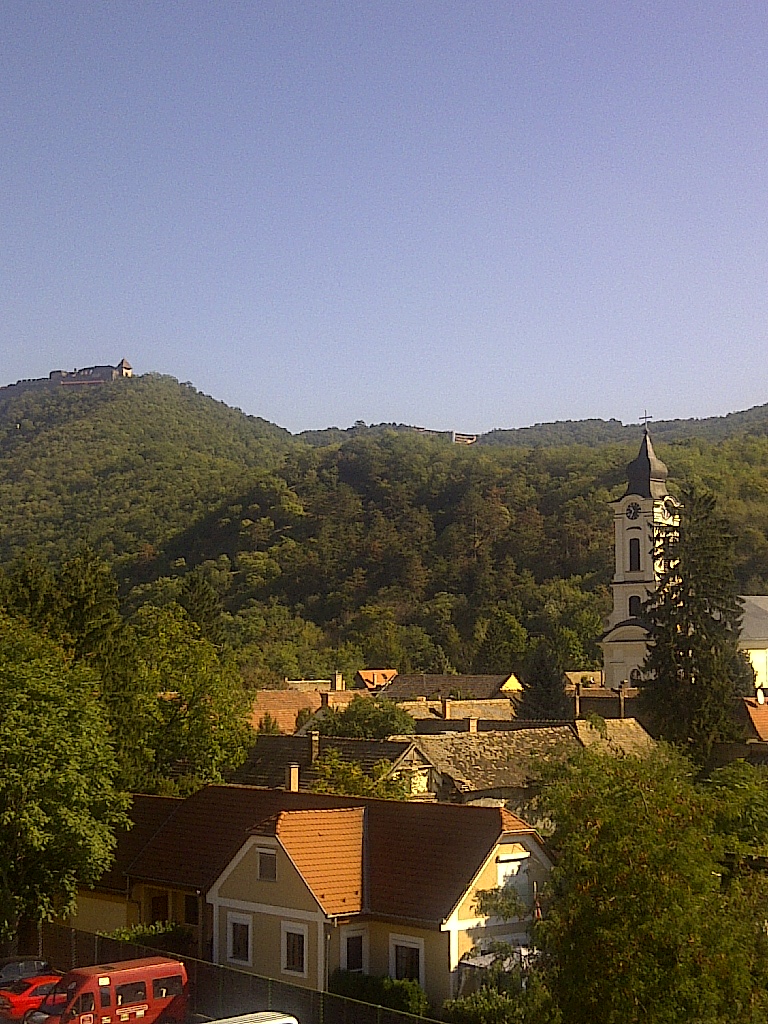
A beautiful weekend in a beautiful place full of history
Spirituality is a word that in the world of hard materialism is being neglected or despised as being soft or religious. This is a huge misconception and a true mental and practical blockage for development of true sustainable progress. Spirituality has various definitions as participating scientists correctly pointed out but the general description of the word is “the inner quest for the true meaning of our existence”. For people who live the simplified life of materialism such quest is of course a scary confrontation with their own consciousness and certainly something to be avoided. The world of the “having” is exactly opposite of the world of the “being”. Both reject each other like poles of a magnet. The transit from a “having” kind of mentality to one in search for identity (being) is usually referred to as a “crisis”. The process is one of letting go (voluntarily or involuntarily) of material securities and trying to find comfort in the new world of inner feelings and meaning.
In such open field of emotions people start reacting in many ways, some aggressive or depressed, others become artists or find unprecedented hidden forces of leadership. During the conference we were enlightened with views in each of these fields of expertise. Academic research is showing the importance of spirituality for humankind to recover from crises and develop sustainable evolutionary progress through the renewal of true meaning. It represents a combination of rationalization of inner search for meaning and putting the growing awareness into practice in experiments around new ways of organizing ourselves, individually and as a community. This is called the pre-paradigm, a phase before, after or within crises, in which alternatives develop to a reigning paradigm that is falling apart. Such pre-paradigms are always confrontational to the one that is being disputed. A pre-paradigm uses the logic of spiritual consciousness and is usually neglected and even denied by those who are unaware, or intentional to uphold the existing paradigm out of personal or institutional interests. The old paradigm has lawful support while the new paradigm has the power of timeless meaningfulness.
It was shown that such human evolutionary patterns of obsolete but reigning paradigm, crisis, pre-paradigm development through spirituality, and the opposition between old and new paradigm, are a natural evolutionary phenomena of a self-aware species. Even the dramatic consequences of a powerful yet obsolete paradigm, that could cause death and destruction, can be seen as a universal natural disaster hitting humankind, forcing ourselves to renew our spiritual awareness and develop a new evolutionary cycle. But this natural phenomena is of course not an excuse for those who are aware of it to let it happen just like that. The force of reasoning and new paradigm development is nowadays, thanks to many modern elements of peaceful reflection, education and opposition, capable of overcoming a forthcoming crisis without the natural need for or potential threat of a mass destruction.

Academic intellectuals, artists and entrepreneurs from 14 countries meet for the paradigm shift
Sustainability was explained from an existential and practical point of view, using also nature as a point of inspirational reference. Various presentations coincided about the forthcoming mayor crash, a melt down of the world order of economics after decades of exponential growth and speculation. For the first time academic financial specialists looked at the broader picture and showed the unsustainable truth of current economic materialism. Not many presentations could pinpoint yet a solution. Some were still tempted to use economic instruments that were contrasted by others, including me, as “decades too late” and at this stage unrealistic and equally obsolete.
Solutions needed to be found in the inner world of reflection, awareness and consciousness, not the external worlds of old material securities. My own practical presentation of sustainocracy was well received. As I was one of the very first to present my case I had three more days left to get some deepening reflection about it with those who connected with the complexity of my line of thinking and my practical proof of concept that already went beyond the phase of pre-paradigm. During the questioning rounds after each presentation the power of my own model of human complexities proved its worth for my own inner guidance for reflection and interaction with the others.

The psychology of change in a paradigm shift is the true transformative challenge of humankind
The complexity of the current global situation was also beautifully shown through expressions of art around the world, presented by academic scientists, and available to create awareness in a difficult world of opposition, apathy, ignorance, commercial over-communication, fear and manipulation. The surprising beauty or challenging intellectual creativity brought forward in all kinds of artistic disciplines was mind blowing. Speakers could pinpoint where the problems were in the unbelievable massiveness of humankind in the world today, but also that solutions were not easily at hand. Humankind was expecting solutions from the external material world while all agreed that the real solutions needed to be found in the inner world of meaning through spirituality and structural renewal of our civilization’s organization around life and evolutionary essentials.
Many presentations therefor referred to the necessary inner quest for reason and meaning, not just as an individual but also as an organization and entire civilization. Many also referred to the powerful explosive potential that spirituality has when it hits the individual and the masses. “Water must flow freely” (biologist and journalist) Janos Vargha stated when he explained his decades of battle against the system of political and economic madness when the Danube was nearly doomed for exploitation with damaging effects beyond repair. He won!

In the red circle the “monster of the Danube”, artificial remains of human institutionalized madness
And so will spirituality as this too must flow freely. The dam that was going to affect natural life, including human’s, in and around the Danube, is now a metaphor for the blocking forces of artificial institutionalized economic and political interests that stand free flow of awareness and reason in the way. Public opposition builds up powerfully and eventually breaks through the dam with force. Right now we are all like Janos in the 80’s, claiming the free flow of meaningful reason and renewal in a peaceful but demanding way, before damage is irreparable. We have time at our side, those who try to uphold their unsustainable power position do not. This personal reflection should give us trust, no matter what happens:
“Spiritual meaning will eventually win as it always has, simply because it has eternity on its side while the temporary power of the self proclaimed mighty dies with those mortals that try to uphold it in their lifetime”.
The encounter was very powerful indeed and finalized with people who found each other in meaning, reasoning and purpose. Friendships were born, alliances too, and solutions were shared that went beyond the stage of experimental pre-paradigm. During that weekend in Visegrad along the Danube bend of Hungary the cultivators of a new human future shared seeds to sow across the world. The new paradigm of sustainable human progress exists and will grow there where true spirituality meets with purpose driven leadership and entrepreneurship.
Good & Bad economies
When we refer to an economy we tend to think only of the amount of money we have to spend for our daily needs and extras. From a larger perspective we can see that economies represent a particular complexity that goes beyond the simple availability of individual cash. It has everything to do with the way we deal with money as a culture. There are even various types of economy, some are all right while others are devastatingly bad. And still, in each of the versions we have cash in our pockets to spend on our daily concerns. Money doesn’t care, do we?
Good economies
A good economy is one based on value creation. It is focused on structural innovation of all elements of society. People contribute to the innovation through creativity, entrepreneurship and labor contribution. Money is an exchangeable value without interest since the true value creation is something else, based on human wellness and social cohesion. Money is just a means, a catalyst to enable value creation and then comes free for another go. Money is also a symbol that represents a value that is saved for a while because it created another value before. For instance in farming people work together on the land and receive money as a token for their labor. This can be exchanged again for primary life support when this is created or harvested. Money circulates and does not grow. What grows is the added value and wellness of the community. Taxation is limited due to the value driven output of the community that requires little bureaucracy and public funding because people address progress themselves and together. These economies don’t grow, their wellness does by investing labor in renewal and modernization. Ownership has no other purpose than usage of property against a negative interest due to deterioration of goods. People are likely to invest in their surrounding to keep it valuable through innovated wellness. Labor is seen valued as social contribution and wellness is the payback.
Bad economy
Such economy is based on consumption of material goods. The distribution and consumption is being taxed to finance the consequences of consumer growth. The investment in distribution, infrastructure, health care and other consequences of such type of organization is huge. The economy tends to grow and endebt itself enormously, making money into a valuable with interest as it does not circulate but flows from debt to institution, relying on more consumption and inflation. Such economy is highly volatile due to its dependence on consumer patterns and speculation with the available resources. Having property is lucrative do to its automatic growth in value on which new debt can be based. Investment is based on structuring the environment for more consumption and affective distribution. Mentality becomes greedy, the having is never enough and landscapes change due to te growing consumer concentration points (cities) and infrastructures to supply them. Inflation is huge due to the continuous needs for more and more while money is the only means to access what people consider valuable when the do not have it and unvaluable when they have it. Such economy is sick. Yet it uses exactly the same money.
Good economies are sustainable and bad ones not. Good economies are not rich in material sense but are trustworthy, bad ones are rich but their currencies have been inflated artificially. Good economies have no real debt as the money that circulates is based on real colatoral. Bad economies have huge debts to account for and pay large amounts of interest over the back of the future inflation on shortages.
Most economies in the world have transformed over the years from good to bad economies. It is not the money that is good or bad but the way we deal with it. Transforming from a good to a bad economy is easy. It is based on human greed. Suddenly the amount of cash in circulation is expanding without any real reason, just due to the perceived value of commodities that are kept in shortage. Populations gradually become lazy and enjoy consumption without having to do very much for it. Investments go towards more and more infrastructure and hardware. People get focused on “having” through materialism and so do institutions. Money and touchable values become the core interest of the consumer and consequence driven culture. Money is a goal for both the consumer world and the world of consequences and both never seem to have enough.
Moving from a bad to a good economy is extremely complex. The greed and perceived abundance of goods is a human quality that does not erradicate that easily. A bad economy deals with massive amounts of money that seems valuable to the general community. Money is money, exactly the same from bad and good economies. The money itself is not the problem, it is the culture around it. The fact that it is based on mainly hot air or a huge debt is not of interest, as long as people have their daily cash. The culture is speculative, not wanting to do real labor for reciprocity, just wanting to deal with financial growth in any way. Money does not circulate but flows just one way, from an overvalued item or debt against overvalued items, to the bank. There is no value creation anymore other than making this hot air ballon grow through more of the same. As the consequences grow so do the needs of a government through tax and pressure on the population.
To break through that culture a severe crisis is needed, often war, depriving people from everything and making them aware again of true values. People do not degrade their perceived financial wealth just by themselves, not even with the best arguments. Hard work for sustainable progress is a dirty word when the alternative is to sit back and watch your properties grow sky high. Criminality, poverty, debt, psychological disorders, health problems, pollution, apathy, etc It all rises, just like the economy of unsustainable growth and mentality. Can it be changed? No, not through intrinsic motivation. Elements can be addressed as long as abundance remains but mentality of greed is persistant especially as institutions also are dominantely based on it.
Is it then possible to create the abundance of a good economy within a bad economy? Undoubtedly to a large extend but then one needs to speculate with talent and innovation instead of materialism and lack of investment. The true good of people is creativity and when we value that in a result driven way we can create abundance through open cooperations. Certain rules should be introduced against interest rates, fractal banking, apathy, etc favoring a proactive code of conduct based on human progress rather then self enrichment.
In a good economy democracy works because people choose for progress and personal involvement, creating their own wealth directly and not depending on others through money systems. In a bad economy democracy does not work because one choses for greed no matter what. Today the world faces a huge transformational need from a bad to a good economy everwhere. It is probably the greatest challenge ever of humankind. Not a challenge against the odds of nature or the quest of knowledge. The challenge is with ourselves and the greed that obsesses us when we get a chance and will not let go until it is forcefully taken from us by disaster. Even wisdom does not help, only maybe the exchange of bad for good value against the awareness of some, especially ourselves.
We face a challenging and confrontational time ahead.
Paradigm shift pioneering difficulty
Awareness of the need of a paradigm shift is the beginning of a complex personal process. The problem resides in the fact that the rest of the world is still wound up in the old pattern that one wants to take a distance of. The next step is to take responsibility. Instead of trying to convince other people of the need of the paradigm shift one gets to a point of taking personal responsibility. It is impossible to tell others what to do so one ends up doing it oneself. But starting the pre-phase of a new paradigm is a huge responsibility that is not yet backed by your own surrounding. In a practical sense: if you take a distance from a money driven paradigm to start one based on human wellness or human sustainable progress you find yourself totally disconnected from the ruling (human) life supporting system that surrounds you, without an alternative yet to support the pioneer. That is one of the reasons why one finds hardly any support for a paradigm shift. One stands alone. Letting go of old securities before new ones are installed is work of “fools”. One can easily crash in the attempt or be crushed by the old system that does not want paria like you disputing the system. You become an outcast, an outlaw, a paria, a loner, an idealist, at the worst “a weirdo” or at the best “an adventurer” ……
When you anyhow decide to take the responsibility of a paradigm shift you enter an empty world. This world needs everything to be created still. The paradigm you envisage is in your head but does not yet materialize in true reality. You have become a sort of Amundsen, Scott, Stanley or Livingstone, a Niel Armstrong, a person who set out to discover and create a new world out of nothing, just a dream….. You are an unsupported conquerer, a single handed constructor of a new world, a first seed of a new civilization landing to find fertile grounds. It may sound dramatic, romantic even but the emptiness, loneliness and hugeness of the environment and challenge is both scary and exciting. The drama of being such pioneer is in the paradox of where one comes from and decided to leave, and the idealism that made one start the venture. The old world that one leaves behind is totally opposite, a miror image, another dimension. Having the possibility to compare one finds the enormous contradictions that also reside within the pioneer himself and made him finally choose. Living and taking responsibility in the transformation is hence a magnificent adventure of tremendous inner and outer contrasts. It becomes a spiritual and realistic voyage of wisdom and idealism, a “can do” experience based on fundaments of inner trust in abilities, purpose and motivation. The driving force is so strong that fear becomes the first challenge that is overcome.
When I defined sustainocracy and started implementing it I realize that I am taking people and institutions on a round and maybe even one-way trip to an empty new world. This world is empty for their awareness as well as their practical reality. I ask them to help construct a new reality as if we had landed on a new planet, not copying our old rules from home but taking the opportunity to start a new civilization based on ideals, views and lessons learned. As these people work with me on this new planet they know that they can fly back continuously to the old world to go get materials and support, or to stay again after the work is done. This simple security gives them comfort to be with me for a while. The first loads of people and institutions come with disbelieve and discomfort, arriving at an empty space but with the inner reassurance that it is only temporary. For me however it is different. I am there to stay. Why they travelled with me has to do with their own choice or some imposition by the old hierarchy of the old world that seeks some old speculative values in the venture. They often carry their old habbits and manners, finding it difficult to let go and learn to behave in a different setting.
Conducting such new human world in its state of birth feels impressive. I become the creator in a way myself. A creator who is deprived of everything yet has everything. A paradox of the Wholiness where duality comes together in the All. It sounds romantic again but it is not. Spiritually it feels very rich but in practical sense it is bloody hard work with very little aparent reward or recognition. Who cares? I do, and that is enough.
While we work like aliens in the new paradigm people get acquainted with the new settings and the warmth of constructing something together. Some decide to stay permanently and slowly the community grows. Institutions that participate start new initiatives based on the new rules and situation, or decide to transform entirely into the new world. When that happens the creations becomes of everyone and not just of the creator. The pioneer can step back and enjoy the development of the new paradigm, concentrating just on the format and letting content flow freely and creatively. A new world is born and ships full of newcomers arrive to offer their help and their own pioneership to further enhance and grow out the new world within the paradigm.
AiREAS
On October 11th 2012 the very first small colony of the complex sustainocratic paradigm makes itself known to the old world. AiREAS is the first ever sustainocratic venture of the world and initiates its activities in Eindhoven, the Netherlands. Its purpose is to create new human dynamics in the city that makes itself healthy and vital instead of heaving to depend on the consequence driven regulatory activities of governance when unhealthy dynamics cause discomfort and economic problems. The initiative is like building a community on Mars. It is a colony that is still fragile, consisting mostly of people that have a return ticket home and enjoy the adventure of the novelty of the challenge. Some believe that old Earth rules still apply and others are not even aware that they are in a new world. Yet it is a start. The next step is to develop the fragile situation into a more solid and permanent setting, a true precedence for the rest of the old world to relate to. The new paradigm has to prove itself by providing sufficient comfort and security to the early participants for them to wish to stay and not go back. AiREAS relates just to the environmental issue of a sustainable human society as defined by me. When it proves its worth to the participants it is only a small step to expand its mission to the other human values. Then we will see that the paradigm expands rapidly, attracting massive amounts of new people that overcome their personal fears of letting go of the old world to enter the opportunities of the new one with trust, ideals and ideas. They have all become creators and the new paradigm becomes a common good.
 Sustainocracy, the new democracy