Home » Posts tagged 'evolution' (Page 6)
Tag Archives: evolution

Key ingredients for Peace and Progress provided by Sustainocracy
Our current mainstream (we call it “the old society”) structure of society has historically developed around inequality, hierarchies, power positions, competition, institutional self interests, silos etc. This has never been a productive ground for lasting Peace. The word “progress” got many meanings but never related to the sustainable perspectives of humankind. The issue of “growth” has been applied on every aspect of our lives but never the issue of “balance” or “symbiose” as a shared responsibility.
In Sustainocracy we do this as a new mindset with great importance for sustainable human resilience. Sustainocracy is based on our core natural human values for sustainable human progress and resilience (balanced wellness) as a living biological species, and our shared responsibility to develop and share those values in co-creation. Here are a few illustrations out of our line of thinking and acting of Sustainocracy that serve as ingredients for lasting Peace and Progress.
Most importantly, it is relatively easy to achieve because the ingredients involve all of the traditional players in society, including you and me, only in a new , no conflictive mindset (Sage).
1. Leadership transformation
In Sustainocracy we recognize at least five leadership styles (thankyou Sujith Ravindran for the clarification). These are the Sage or Story teller, the King, the Expert, the Magician and the Commander. In our current society they have structured themselves in a hierarchy under the storytelling of a money driven and dependent reality. In our new reality we integrate the leadership styles around the storytelling of core natural human values (see below). Each leadership area is equal to the others and together form a solid foundation for regional inner peace development through lasting and shared wellness.
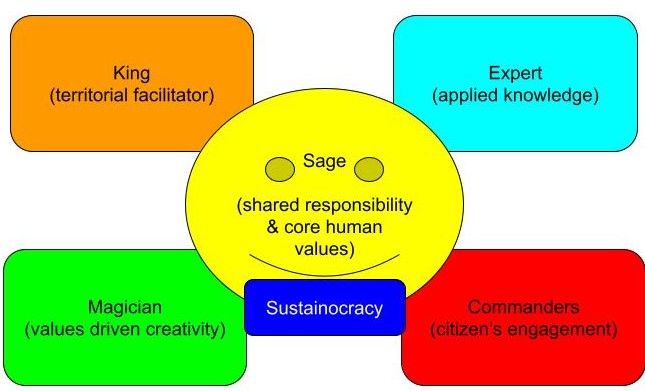
The shared responsibility around a common purpose is key for Peace and also Progress. Every archetype of leadership is valued in its own right. Not because it exerts power over the others out of self interest, because it uses its authority to contribute and connect with the others and to achieve the deeper purpose of the core values in a significant way.
This implies the awareness of one´s own contributive authenticity and the self trust of each of the pillars of the cooperation. Once authenticity is sensed then self belief and awareness rules and needs no competition or self protection through controls, regulation or fragmentation. The following column of values is key for each of the participants in this ecosystem.
2. The column of inner and outer values starts with self trust
In this image we see this column. The column represents a self sellecting mechanism among those people and institutions that have outgrown their competitive phase and show their authenticity and worth at the evolutionary multidisciplinary leadership table. Leadership here has nothing to do with the desire to control or manage. It has to do with the desire to serve, contribute, develop and if necessary apply changes in one’s own approach to the challenge and group.
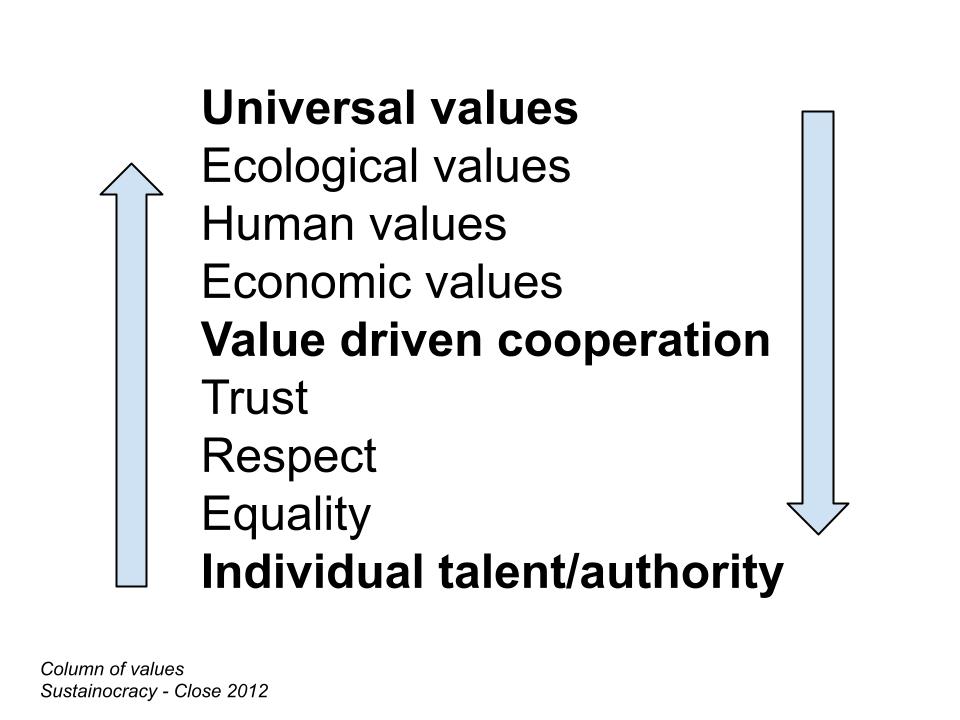
Once the layer of trust is reached in a community of respected equals then Peace is a fact and so is the co-creative shared responsibility for sustainable Progress.
3. The five core conditions for sustainable human exsistance
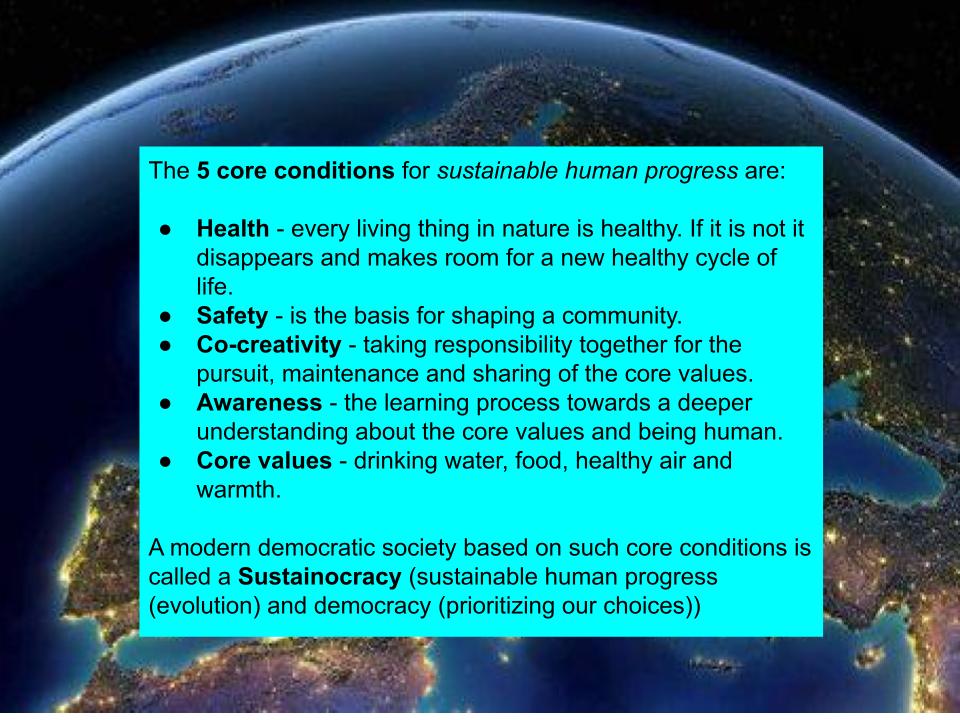
It is not difficult to understand that if these core values are met and shared among the population then there is no need for competition. People can be challenged to spend more time together socially, through recreation or sport, or care for and with each other. Only a fraction of time is needed to participate in the shared productivity for progress. Even the leasure time is part of this productivity.
4. Understanding level 4 regional development
This is one of the reasons why we may have needed important parts of our historical processes. After all the three underlying levels are important for large societies and especially cities to function. Having those infrastructures in place, even with the possible need to modify them entirely within the new mindset, is an asset. In smaller communities the absence of such complex infrastructures can be absorbed by the interaction of the people themselves.

5. Understanding the Economy of Change (Transformation Economy)
Key in the Sustainocratic processes is the constant reflection about the core natural values and the willingness to make adjustments in behavior, projects, the infrastructures and even old legislation, by applying the leadership archetype skills to the max. It is always difficult to introduce change, yet if it is well motivated it serves as an example for others to follow. Whatever is created together in this phase of purpose driven change can feed new impulses of the economy of growth, not just in its absolute sense, also in the sense of balanced profitability or investments by optimizing costs reductions too.
The differences with the previous economy of growth are that costs or money are just means, not a result of the problems or opportunities of growth. Growth is never the norm, sustainable human wellness and progress is. Growth is constantly monitored for change if needed.
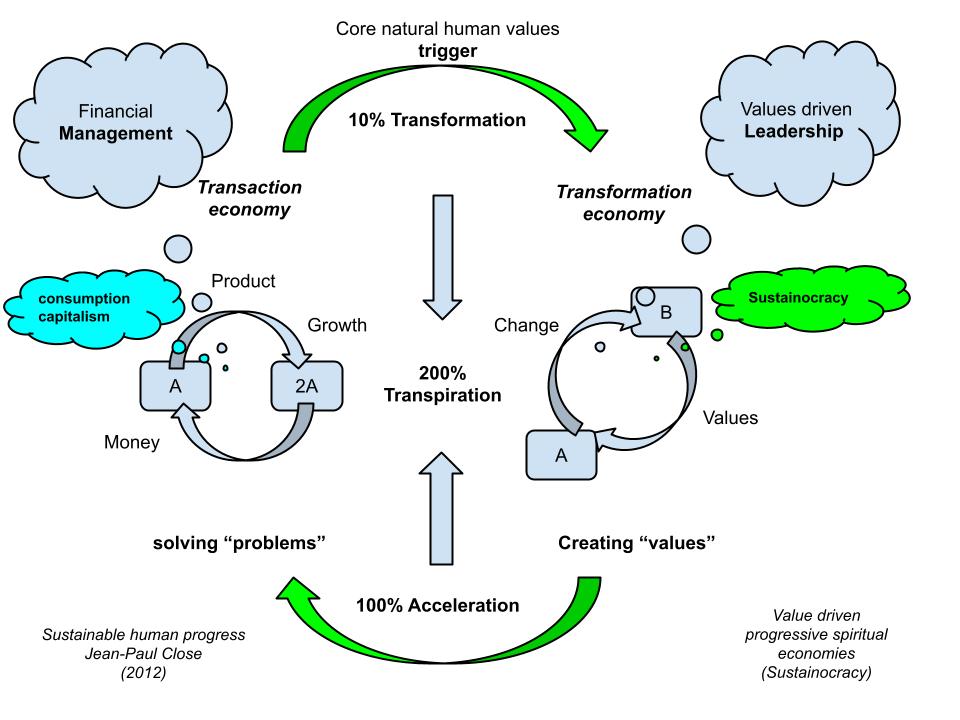
The willingness to let go of a status quo (10% of Transformation = 100% acceleration) provides space for renewal (200% transpiration) and a new cycle of health development, including maybe growth of certain fragmented contributions. It is a law of nature. Holding on to what is proven to be bad for our health or safety, no matter what the motives, is eventually destructive for the entire ecosystem. It should therefore be avoided at all times, even if we have to rewrite our constitutions to protect us against mal practice, abuse and speculation by any of our archetypes or elements within (including governments) the societal ecosystem. Here we can also introduce the 4 x WIN index and values and project driven mentality for all involved.
6. The sustainocrat
In the “old society” particular dominance could vary between archetype, often motivated by the lack of a common ethical operational ground. The relationships are based on protecting self interests which always ended up in a duality of negotiable options, blocked or served. That made the relationships unreliable, opportunistic and transactional. The invisible old “Sage” was the underlying dependence on “money” that somehow conditioned the interaction between them/us all.
If we bring these same players together in a new mindset we need a unifyer, a positive invitation and representative of the new sage (visible this time). This unifyer breaks the old relationship’s energy by introducing a new one (based on point 2, the talented authenticity and ethical positioning of each participant). He or she also makes sure that each of the engaged participants is recognized, respected and valued for their authentic presence at the table. And each in here is absolute and indisputably equal to any other. This independent unifyer is called the “Sustainocrat”. This is usually not one, but two individuals. One to act as unifyer, the other as the one that does the administrative processes of managing transparently the contributions in the project driven processes.
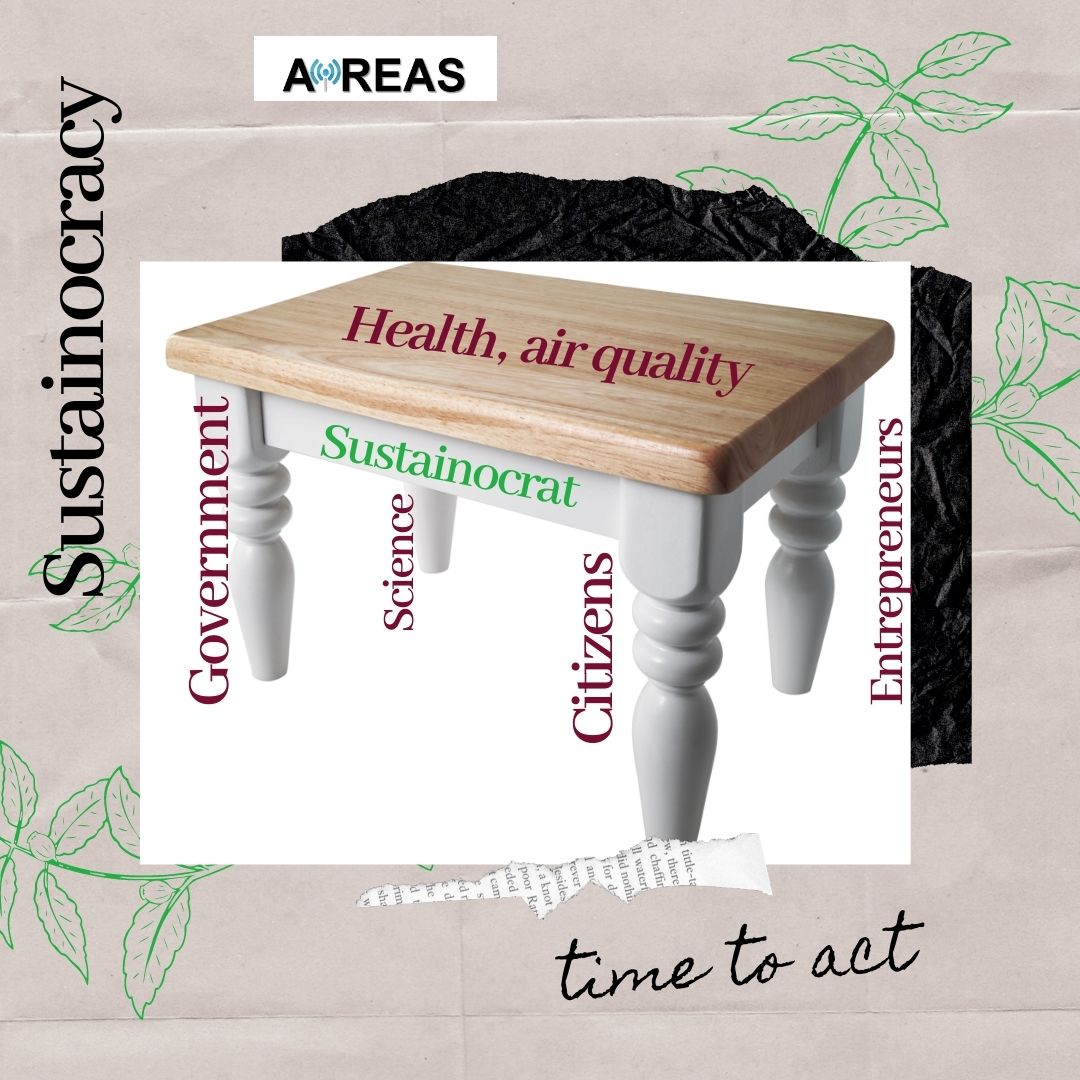
Concluding
Key in this recipe for sustainable Peace and Progress is the willingness to share responsibilities for sustainable human progress and wellness together while respecting each other’s authority and position in the sustainocratic ecosystem. It is entirely derived from nature itself, a natural evolutionary wisdom of many billions of years, that is embedded in our DNA even if we have taken a distance from it during a long period of confusion. The rediscovery of what we are, what our purpose is towards ourselves as a living species, together with the science, technology and ethical understanding built up over many hundreds of years, brings us together in this mindset for the benefit of entire humankind, our planet and our fellow species.

4 x Win Index
MDE Index or the Multidimensional Entrepreneurship Index
Modern enterprises, or institutions, no matter what their identity is (government, business or science), are becoming increasingly values driven. This means that they justify their existance by the contributions they represent in the societal ecosystem of sustainable human wellness.
This is a very different world than the one we leave behind. This was measured entirely by financial dependence and goals, referred to as 1 x Profit (1 x WIN) or the single bottom line profitability. This world would pass any human, social and ecological consequences of its functioning to society while focussing entirely on its own selfish financial excellence. This old way of working would differentiate business (1 x WIN) from governance (3 x COST) where governance would try to sustain itself through financial debts, taxes and regulations. 4 x WIN (the Pyramid Paradigm) brings the institutions together within the common purpose of values driven societal and ecological wellness for sustainable human progress.
The MDE 4 x WIN Index highlights those who produce genuine value
In the image below we see why we have such huge problems in the world and how we can solve them through the transition towards 4 x WIN (Sustainocracy).
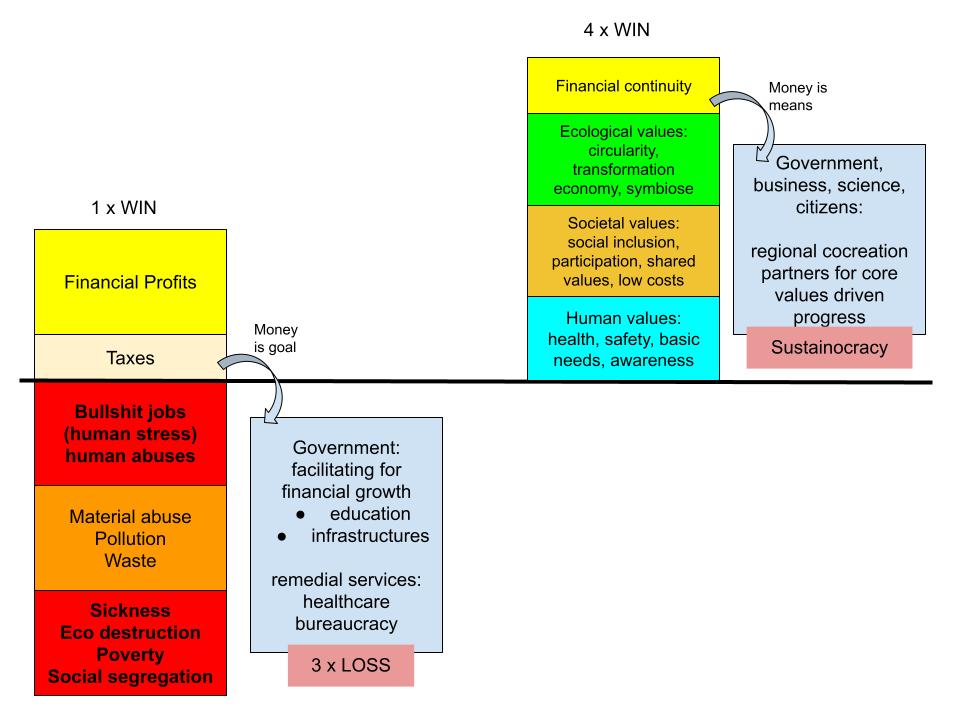
The image also shows the mayor transition required for all involved to move from 1 x WIN/3 x LOSS to 4 x WIN. Those who do will take the benefits as the old 1 x WIN environment will gradually disappear. The transition to 4 x WIN by citizens and institutions is an awareness driven ecolution even though it is often sensed by those in the process as a revolution for themselves. They feel however reassured in the process when sensing the appreciation and engagement of the surroundings that undergoes the same evolutionary challenges.
The 4 x WIN Index is yet another stimulous to develop this environment and make it grow with more and more institutions making the move from 1 x WIN to 4 x WIN. Sustainocracy creates environments where institutions can develop themselves in this servant environment and enter a positive learning curve with many gratifying impulses. Examples of such 4 x WIN environments are:
- AiREAS – health and environmental quality
- FRE2SH – city farming and rural food resilience development
- COS3i – social citizen’s inclusion in core human values driven processes
- School of Talents & Wellness – participatory learning in 4 x WIN
- Earthbeat – engagement of world wide youth through video sharing of 4 x WIN initiatives
- your initiative?
From reacting to symptoms to applying awareness for mechanisms of integral change
One of the main challenges we face as society is to break with the treatment continuum within a structurally unhealthy and destructive financially steared and dependent paradigm. What does this mean?
Our human community presence and participation is guided by a jobs related productivity in a political and financial ecosystem created by humankind. We get rewarded through those financial means. This gives us access to the perceived abundance provided by this system in order to fullfil our daily needs. When signs or symptoms arise of system flaws, in terms of human illnesses, pollution, poverty, inequality, etc, we try to resolve them through treatments. These are focused on getting back to the optimal status quo (the neutral point) for system’s productivity.
A political financial system, such as capitalism, reacts to signs and symptoms that potentially destabelize the functioning of the system. It does not react to the disfunctional relationship it has with other overarching systems such as nature in general or the complexity of biological or spiritual human health. The Sustainable Development Goals (SDGs) are a clear example of such a treatment paradigm that tries to fight premature (system) death by addressing issues that are caused by the system itself. It does not dispute the system itself.

We see this in the example of covid-19. The system already reacted to exponential rise of health care needs due to unemployment, poverty and an aging population. It did that through a general cost reduction program of the health care systems. They also raised health care prices, insurrances and personal financial contributions to the services. It also reacts on the impact on the IC capacity by both reducing the IC capacity and attempting to reduce the affluence of very sick people through lock down mechanisms and vaccination campaigns. It react to Covid19 as if it were the only problem at hand. Suddenly all other diseases seemed to have disappeared, just like system related health issues like diabetes, overweight, alcohol and drug abuse, negative stress, behavior disorders, etc. They don’t receive equivalent attention at all.
It does this purely from a system’s dynamics (premature system death as seen in financial crises, system collapses, etc). The measures have nothing to do with human health, a healthy society or a healthy economy. On the contrary! We even see that those reactive measures create an overload of new signs and symptoms (stress, burn outs, delayed treatments of other diseases, people aggression, suicides, increased mental problems, climate problems, etc). The treatment paradigm again reacts with more measures, more police, more vaccines, more bureaucracy, more controls of everything, more demand for power and money. Yet it does not look at itself as the prime cause of all problems. The neutral point is never reached anymore and a point of general collaps is coming closer and closer.
Awareness and learning
Awareness is a condition of our human reality. We can place ourselves above our systems and see ourselves and all issues in multidimensional contex. This brings us into a learning curve as a species. Our systems only have this learning curve when we apply ours to them. For instance we can determine that a petrol based car produces pollution. The car itself does not. We can change the technology of the car, put on a filter or eliminate its use. The car itself will not, it will always be a car. In the case of a system such as capitalism we can see its system flaws, but it remains capitalism. So people working within capitalism act the capitalistic way, just like the petrol engine does in the car. It is the context that defines the functioning.
We cannot change capitalism, we can change the context, environment and mindset in which people (including politicans, businesses, etc) excersize their functions and responsibilities. We then learn to abandon capitalism and adopt something else, such as the core natural human values and shared responsibilities defined in Sustainocracy. The little blue square in the drawing above.
We don’t look at the premature death avoidance of capitalism, we look at the premature dealth avoidance of humankind in general and our relationship with nature (instead of money). A new awareness and learning curve appears that grows and places capitalism and everything else into context. One of the symptoms then to eliminate is the capitalist working, not by sustaining it but by replacing it. By adopting the laws of nature and our core values as our points of reference we develop our long lasting wellness as a species. We apply proactive learning and constant adaptation of the human made systems we use instead of adapting people to the systems.
This represents a mayor turnaround in governance and mindset of the entire population. If we don’t do it we will face the general collapse produced by an obsolulete system’s dynamics that is forcefully being held up by those that excersize blind power through it. If we do we need to reorganize ourselves and disconnect from the old hegemony, also in our own behavior and addressing reality.


 Sustainocracy, the new democracy