Paradigma shift
The world has entered a social, economic and ecological paradigma (=complex set of beliefs) shift within society and business leadership too. Such shift does not go without pain since entire nations, political structures, cultures, etc need to be abolished, redefining the way society, welfare and wellness is being achieved and sustained. Each of the countries in the world has entered the world crisis from a different angle and with a different local history, but goes through the same paradigma transformation. We have all seen it coming already for a long time but now it is actually happening.
The USA has long been a reference point for innovation and the local change of leadership, President Barack Obama, has the task to redefine the national paradigma. All eyes are on him now but the economic injection he announced last week is not transformative and has been drafted from the old paradigma. This indicates that the paradigma shift is not alive yet in the councilors of Obama and they try to solve the local problems “the old way”. We cannot wait for America to understand what is really happening.
So it is time for leadership in Europe to stand up and show that it can lead the way into a new paradigma taking the pressure off the US on critical issues. My vote goes for one of the smaller countries, s.a. Holland, with a highly educated population and a conglomerate of large multinationals to join forces for transformational innovations. I believe that the new paradigma, s.a. the multidimensional model that I presented as new paradigma in summer 2008, can best be tested out in such geographical confinement and to be deployed in other countries step by step subsequently. Alternatively we could define a series of key areas around the world, including maybe one or more in the USA where we initiate the paradigma shift with an overall transformational nature and observe the different outcomes due to cultural and innovative valuables. To do that the entire world first would need to be convinced of the steps to undertake. This is unforunately not yet the case which means that the crisis will only deepen and the suffering too.
What ever we do we need to do is, structurally:
- reduce our dependence on critical resources back to below the critical level, through innovative remodelling of society,
- vitalize the world population, through poverty, health and incentive programs to concentrate on total re-make of society as we know it,
- concentrate our business strategies on a sustainability role of added values in local or global society.
We are now 3 billion people running the global capitalist show and we may as well start behaving as such. We feel responsible for the warming up of our climat, the melting of the poles and changing weather. We cannot influence nature other than damaging our own habitat. We have destroyed our economies by holding on too long on an old obsolete paradigma. If we want to learn how to behave we need to shift paradigma fast or else we end up distroying our chances all together with much more dramatic consequences for all.
Business executives can become forrunners of the new paradigma by adopting it at an early stage and creating a multidimensional power well before anyone else.
Welfare destruction
(Peter Drucker reference sourcing: Mr. Adriaan Meij, www.ame.nl )
In 1995 Peter Drucker stated that “companies that make less profit than their costs of capital actually make no profit at all, they in fact destruct welfare”. Using this economic reason we go a little further and state that “companies that have no sustainable ideological basis for the material successes actually parasite on themselves and the environment”. Combining both criteria we get our multidimensional model and we use that to index companies along the multidimensional axes representing a forward equilibrium between the moral policy development and capital development. Money is a means not a goal.
We index groups of companies of a same sector and came to the conclusion overall 99% are destructive for welfare due to an excessive material focus. In Holland a colleague company (www.ame.nl) publishes the index of the top 120 ICT enterprises concluding that they all together invoiced over 631 billion euros world wide, employing nearly 2 million people full time and destructing all together 14 billion euros of our wealth. This loss was the total balans. The companies representing 78% of the total turnover and over 54% of the amont of companies where the worst performers. The balans was lifted to the current level over a deficite of 14 billion by the 22% of great performers.
Interestingly we did a similar research but without the statistics, since we are more interested in the policies in the boardroom connected to the identity of the company, on supermarketschains, banks and wasterecovery companies. The result was equally staggering as the ICT branch. Over 75% was not even bothered about their moral responsiibilities distroying happily our habbitat in order to make a profit. Oly a few actually bothered and were even the ones tha presented better overall financial results. All this indexing only shows that large organisations are not at all used anymore to create added value and compete by subtracting values (cheaper labor, cheaper materials, cheaper housing, etc.). When you sum all that up you come to the conclusion that business is destroying everthing we care just by trying to be successful. We did not need a credit crisis to get into trouble, in the end it would have been something else that would have done the same trick.
It appears to be difficult to get back to a situation of competing on added values because of the material mindset of business nowadays. But it is imperitive to do so if we want to get back, in years, to a stable economy again. The world has avoided to change according the laws of sustainability for over 20 years follow the all destructive path that we can visualize now with numbers. We are now confronted with billion of people wanting to live life with welfare instead of a few hundred million. This means that things need to be transformed rapidly, we have no time. So we might as well get started.
If interested download f.o.c. the document “the convenient solution to the inconvenient truth”.
Where do you stand morally?
If we consider that 99% of western businesses are managed purely on material basis (KPI’s, product/price, cost reduction programs, etc.) you are not really to blame when you find out that you do the same. But the credit crisis has shown us that this way of thinking causes us to behave far to insensitively to moral values which causes the general and gradual decline of our overall wellbeing. In the end we do not distinguish ourselves anymore from competition and all players together become responsible for a moral crisis of which the credit crisis is just an example. More are to come.
When we draw a point of balance between moral and rational material decision making than we can visualise this point on the following drawing:
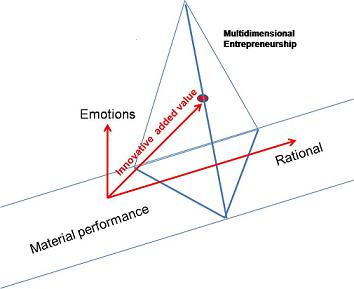
Find the point of balance
The rational path is our traditional way of entrepreneurial thinking: Product/Client/Cost optimalization with pure material goals. Money is the target and we would be willing to take immoral decisions just to make the triangle work. For who? For our pockets.
But in a global era we are too many doing just the same, covered by government who push for growth. What identity do we develop among so many others? How long a technical lifetime does our product innovation have nowadays? How loyal are our clients to us if the receive temptations all the time? How good can our cost optimization be if we run out of low wage countries? How high will inflation be if we have to compete to purchase our natural resources?
Doesn’t this mean that we are forgetting something? While we are at it making money we are destroying our own market potential by increasing the costs of resources, making low wage countries rich and competing our products so cheap we can hardly make them anymore. How TVs can a household have? Or anything else by that matter? Shouldn’t we remind ourselves continously that there are three basic moral rules to make sure we can run a business still at all in the future? Why should we want other to take the responsibility to comply with those rules and not us? Why are the companies that do comply more successful in general than those that don’t?
How moral are you when you run your business? What do you want to achieve? Money? Or recognition for a good job? Just think about it.

